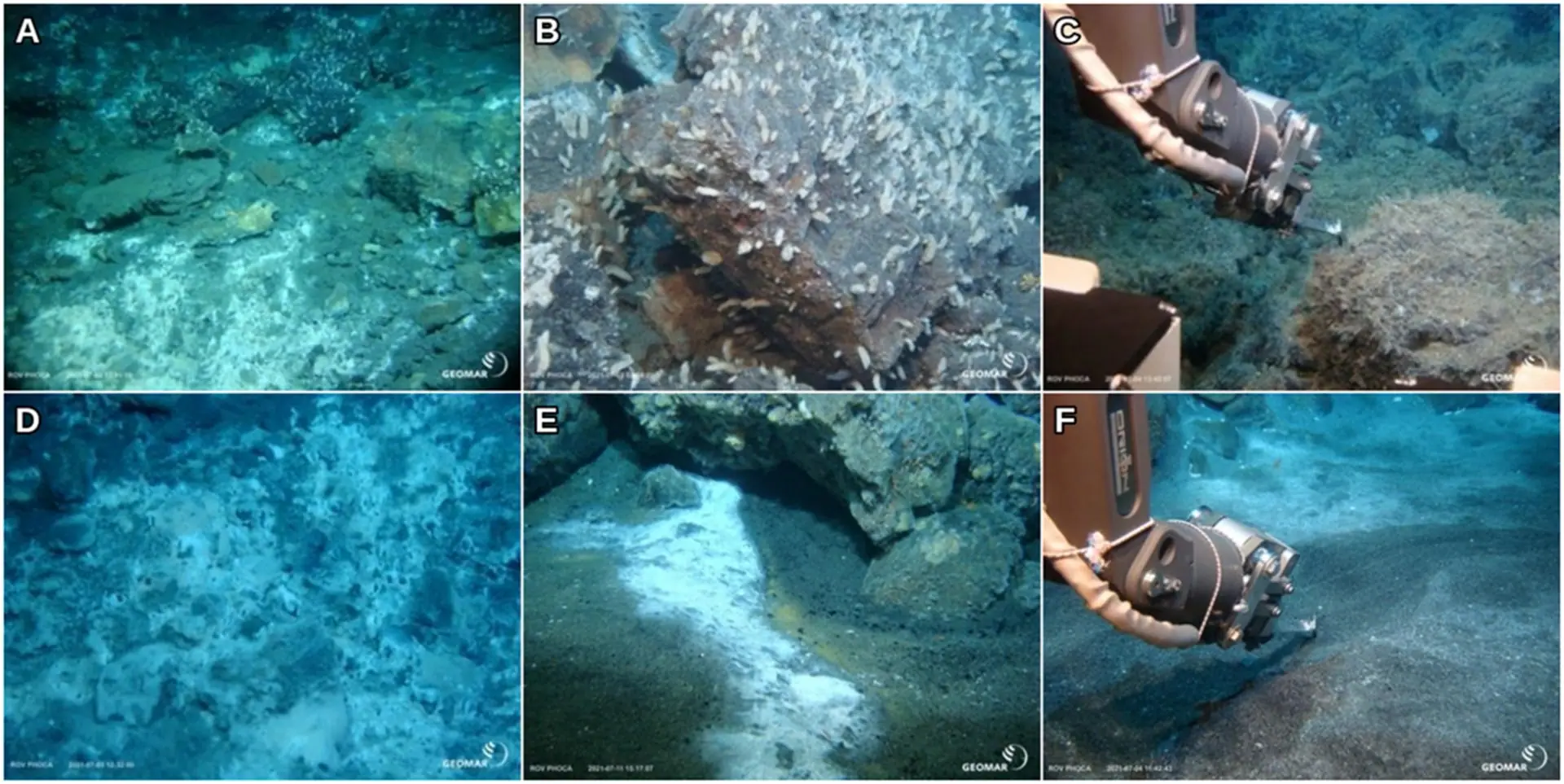
At the Grimsey vent field on the seafloor off northern Iceland, anhydrite chimneys about 400 m down discharge hydrothermal fluid at up to 251 °C. The images around them, however, showed anemones, sponges, shrimp and other animals, and those identified to species were widespread species of the nearby shelf. A team from Germany's Senckenberg institute, the NIOZ Royal Netherlands Institute for Sea Research and partner institutes studied the site together with the shallower Kolbeinsey vent field, about 100 m deep, and reported the results in Frontiers in Marine Science on 10 November 2026.
How do the Grimsey and Kolbeinsey vent fields differ?
The main differences are depth and seafloor geology: the shallow Kolbeinsey vent field sits on basalt lava, whereas the deeper Grimsey vent field is hosted in sediment.
Iceland lies on the Mid-Atlantic Ridge, where the spreading of the plates and hotspot activity keep magmatic activity frequent. The Kolbeinsey vent field lies near the crest of the Kolbeinsey Ridge, which runs off the island's north coast, at about 100 m. The Grimsey vent field lies deeper, at about 400 m, within the Tjörnes Fracture Zone, a transform fault zone.
| Kolbeinsey vent field | Grimsey vent field | |
|---|---|---|
| Water depth | about 100 m | about 400 m |
| Seafloor | pillow lava and cobble, no chimneys | anhydrite chimneys and hot sediment at their bases |
| Highest temperature measured | about 162 °C inside rock fissures | 169 to 251 °C depending on the chimney (inside the orifices) |
| Surrounding seawater | 5 to 6 °C | 2 °C |
| Animals in the images | 65 taxa, 7,362 individuals in 719 images | 35 taxa, 542 individuals in 265 images |
At Grimsey, nine chimneys were seen during the 2021 dives and the 2023 autonomous underwater vehicle (AUV) survey. They ranged from rather soft structures about 20 to 100 cm in size to a chimney about 6 m high standing on a deposit some 15 m wide. Earlier studies reported that the fluid here can boil as it is discharged, producing plumes of bubbles. The sediment between the chimneys was pocked with holes that were possibly caused by escaping gas. Sediment cores brought on board kept releasing gas bubbles for about 3.5 hours.
The paper notes that sediment-hosted systems with massive anhydrite chimney deposits are rare worldwide, and calls the Grimsey vent field a valuable reference site for future research.
How were the two vent fields studied?
The core of the work was the IceAGE_KR cruise on the research vessel RV Pelagia from 1 to 15 July 2021. During the cruise the remotely operated vehicle (ROV) PHOCA from the GEOMAR Helmholtz Centre for Ocean Research Kiel made 12 dives across the two vent fields, each lasting 4 hours 23 minutes on average.
The team extracted 19,000 images from the dive videos at ten-second intervals. In 984 selected images they counted the larger animals (megafauna) and classified the seafloor in each frame as lava, microbial mat or sediment. To capture the smaller animals that images miss (macrofauna larger than 1 mm), the ROV collected 38 samples of rock, chimney fragments, sediment and more, and a multicorer took four sediment cores. Temperature was measured with the ROV's probe at 30 of the 38 sampling sites, and places warmer than the surrounding seawater were classed as vent-influenced. At the other sites, shimmering water or mats seen on video were used instead.
At Grimsey, GEOMAR's AUV Anton flew less than 25 m above the seafloor in 2023 and mapped about 1.4 km² at a resolution of about 40 cm. The map shows many straight grooves, and the paper says their size and shape are consistent with relict iceberg plough marks rather than marks left by fishing gear.
Were there animals right next to the vents?
Hardly any large animals appeared in the images where the vent influence was strongest, but the samples showed that small animals do live close to the vents.
At the centre of the Kolbeinsey vent field, rock fissures reached about 162 °C, but the water cooled to about 10 °C within a short distance as it mixed with seawater. White microbial mats covered the surroundings and appeared in 25% of the images. On the mats, the team counted at most 1.8 animals per image, less than a sixth of the 11.4 to 21.5 found on pillow lava, cobble and boulders. Bryozoans and soft corals stood out on the pillow lava. Rockfish of the genus Sebastes appeared in more than half of the pillow lava images.
Of the 2,000 small animals collected at Kolbeinsey, 1,845 came from vent-influenced pillow lava at about 10 °C. By contrast, mats on sediment that reached 40 to 90 °C at 10 to 15 cm depth yielded just five animals from five samples.
At Grimsey, microbial mats appeared in 60% of the images, mostly on chimney surfaces. Only 0.4 animals per image were counted on the chimneys, yet 17 taxa were recorded there, including Hormathia anemones and whelks of the family Buccinidae. Of the 542 animals, 416 were counted on the fine sediment between the chimneys, and the sponge Craniella made up nearly 90% of them, with 361 individuals. Near the chimneys the team also saw the northern shrimp Pandalus borealis, a commercially fished species.
The paper stresses that the low number of animals visible on the mats should not be read as low faunal abundance. The 24 samples from Grimsey contained 274 small animals, the largest number, 108, from mats on chimneys (5 to 18 °C). The sediment sample with the highest recorded temperature, 155 °C, contained none.
Some anemones around the vents were covered with white filamentous material of putatively microbial origin. The paper stresses that this alone is not evidence of a symbiosis with microbes. Given the site's intermediate depth, it suggests that the Grimsey vent field may be a useful place to test for chemosynthetic associations.
Why were no vent-only animals seen?
The paper says its results broadly fit what is known from shallow vents and from shelf vents at similar depths. Shallow vents, those in the upper 200 m, lie where organic matter produced by photosynthesis is abundant, so their communities have been thought to consist mainly of the same animals as the surrounding shelf. Only a few species are known to live exclusively at such vents.
Deep-sea vents, by contrast, are known for dense populations of endemic animals that rely on chemosynthesis. At Kolbeinsey and Grimsey, none of the taxa reported as obligate inhabitants of shallow vents appeared in the images, and the species identified were widespread boreal and Arctic shelf species. The small animals (macrofauna) were identified only to broad groups, so the absence of vent-only species cannot be ruled out. The paper also compares other North Atlantic vent fields and notes that the deeper Loki's Castle vent field (about 2,300 m) hosts specialised vent fauna.
| Vent field | Location | Depth | Fauna (as described in the paper) |
|---|---|---|---|
| Kolbeinsey | Kolbeinsey Ridge | about 100 m | regional shelf species; no vent-obligate species seen |
| Grimsey | Tjörnes Fracture Zone | about 400 m | as above; small animals also in hot sediment and on chimneys |
| Jan Mayen vent fields | southern Mohn Ridge | 500 to 750 m | almost entirely regional bathyal species; most consumers rely on photosynthetic organic matter |
| IceAGE vent field | Reykjanes Ridge | 650 m | widespread taxa such as the northeast Atlantic barnacle Bathylasma hirsutum |
| Loki's Castle | same ridge system as the Mohn Ridge | about 2,300 m | specialised vent fauna |
The paper suggests that depth-related differences in productivity, ridge topography and connectivity between populations may affect the evolution of vent-endemic fauna. Of the 721 vent fields in the InterRidge database, 666 are confirmed or inferred to be active. Only a few dozen shallow vents are known worldwide, and in the paper's words, high-latitude shallow vents remain among the least studied vent systems.
The fishing closure at Grimsey and the paper's recommendations
From 1 August 2026 to 30 September 2028, all fishing gear is banned in an area of about 3.4 km² that includes the Grimsey vent field, under a regulation of Iceland's Ministry of Industries. The paper describes the closure as a first step towards protection that has already been taken.
Neither the ROV footage nor the AUV map showed any seafloor damage from bottom-contact fishing. Because the survey covered only a small part of each field and older marks may not persist, however, the paper stresses that this is not an assessment of fishing pressure in the wider area. Lost fishing gear has already been documented at Icelandic vent sites on the Reykjanes Ridge. Northern shrimp grounds also occur in the broader region north of Iceland. The researchers recommend actively protecting both fields from bottom-contact fishing and other disturbance, and suggest that a measure like the Grimsey closure could also be applied at Kolbeinsey.
For another high-latitude example of seafloor communities closely linked to their surroundings, see the study that linked Alaska's deep-sea sponge and coral communities to currents and water masses.
What to keep in mind when reading the numbers
The "65 taxa" and "35 taxa" in the table are not necessarily species. Of the 85 units counted in the images, 29 were resolved to species or genus, and 22 are informal morphotypes. Kolbeinsey looks richer partly because about 14 times as many individuals were counted there. When the comparison is standardised to 542 individuals, Kolbeinsey yields 36.5 taxa, close to Grimsey's 35.
The image shares (55% pillow lava at Kolbeinsey, 60% microbial mats at Grimsey and so on) also describe the surveyed area, not the area of each vent field as a whole. The researchers themselves say that separating the effect of vent fluids from that of substrate will require sampling comparable seafloor outside the vent fields as controls. Whether the rockfish and shrimp use the vent fields as refuges or feeding grounds has not yet been tested. Nor is it known how far the vent influence reaches, which means the true size of each vent field is still unknown. The paper presents the new data as a baseline for tracking future change and regards both vent fields as candidates for future protection. The Kolbeinsey fauna had been described before, in work going back to 1989, but according to the paper the Grimsey fauna had not been described before.