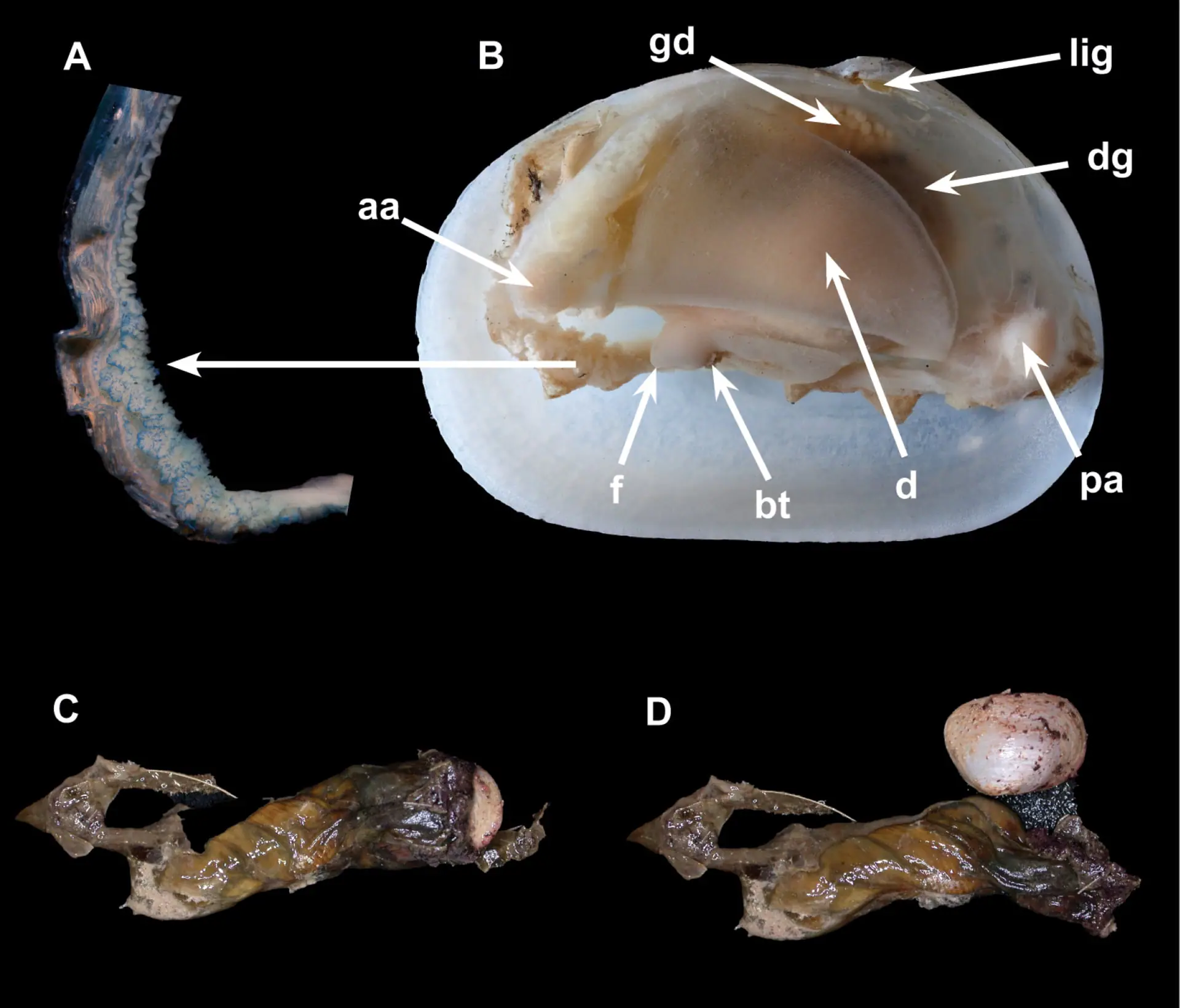
Peanut worms collected around hydrothermal vents off the Izu-Ogasawara Islands, a cold seep off the Nansei Islands and a whale carcass off Cape Noma in Kagoshima Prefecture include two species new to science, each with tiny hooks at the front of the body shaped like the teeth of a saw. A research group including Takeshi Kon, a research associate at the University of the Ryukyus Museum (Fujukan), and Yoshihiro Fujiwara, a senior researcher at the Japan Agency for Marine-Earth Science and Technology (JAMSTEC), examined specimens that JAMSTEC submersibles and remotely operated vehicles collected from the seafloor at depths of 225 to 1,224 m between 1999 and 2011. The two species, Phascolosoma serratum and Phascolosoma inoculatum, were described in the journal Zoological Science on 7 November 2026.
What is new about Phascolosoma serratum
What is new is that the microscopic hooks at the front of the body carry many projections that give them the shape of saw teeth, a feature the University of the Ryukyus says has never been reported in peanut worms. The paper's abstract likewise describes the hooks as serrated along the posterior margin.
Peanut worms (Sipuncula) are a group within the annelids. The two new species belong to the genus Phascolosoma, and the shape of the hooks is an important clue for telling peanut worm species apart.
Besides comparing shapes, the group read the sequences of six genes, including COI and ribosomal RNA genes. The specimens fell into three groups that are clearly distinct both in shape and in DNA, and the two new species also differed in their DNA from previously known peanut worms.
Where were the new species and the third group found
Phascolosoma serratum was found at a hydrothermal vent field on Kaikata Seamount off the Ogasawara Islands and at the whale fall off Cape Noma. Phascolosoma inoculatum was collected at vent fields at Myojin-sho and Myojin Knoll off the Izu Islands and at the cold seep on Kuroshima Knoll off the Nansei Islands.
Kaikata Seamount, a submarine volcano about 980 km south of Tokyo, is listed as an active volcano in the Japan Meteorological Agency's volcano database, which also records white discoloured water caused by hydrothermal activity at the top of the central cone of its eastern peak, at a depth of 448 m. Kuroshima Knoll, by contrast, is a rise about 26 km south of Ishigaki Island. Studies presented at scientific meetings report that the gas seeping there appears to be mainly methane.
- Kaikata Seamount (hydrothermal vents): Phascolosoma serratum
- Myojin-sho (hydrothermal vents): Phascolosoma inoculatum
- Myojin Knoll (hydrothermal vents): Phascolosoma inoculatum
- Kuroshima Knoll (cold seep): Phascolosoma inoculatum
- Off Cape Noma (whale fall): Phascolosoma serratum
| Phascolosoma serratum | Phascolosoma inoculatum | P. turnerae complex | |
|---|---|---|---|
| Status | New species | New species | Unresolved group closely resembling a known species |
| Habitats | Vents and whale fall | Vents and cold seep | All three: vents, cold seep and whale fall |
| Hooks | Saw-toothed | Saw-toothed | Not described in the releases or abstract |
| Eyespot pigment | Present | Absent | Present |
The editors compiled this table by comparing the University of the Ryukyus release with the paper's abstract. The two new species have similar hooks but can be told apart by whether their eyespots carry pigment. The third group looks almost identical to Phascolosoma turnerae Rice, 1985, from the western Atlantic and the Mediterranean, but its DNA differs from populations in the Bahamas and the Mediterranean, so the paper treats it only provisionally as the "P. turnerae complex". The University of the Ryukyus thinks an undiscovered species may be hiding within it as well.
Why do vents and whale bones belong to the same story
The paper's abstract groups the vents, seeps and whale falls where the three groups were found together as deep-sea chemosynthesis-based ecosystems. The JAMSTEC release compares them to deep-sea "oases".
The key was the shape of the phylogenetic tree. Phascolosoma split into two lineages, deep-sea members living in chemosynthetic ecosystems and members living in shallow water. The deep-sea members form a single cluster. Had the genus colonised chemosynthetic habitats several times independently, the deep-sea species would be scattered across the tree, so this shape suggests the colonisation happened only once. Some deep-sea species have not yet been sequenced, however, and the University of the Ryukyus says this still needs to be tested.
Were the stepping stones sunken wood and marine reptiles from before the whales
The reconstruction of ancestral habitats supports a scenario in which the ancestors of the deep-sea lineage first moved into environments around sunken wood and animal remains, and from there spread to vents and seeps. The paper's abstract says that organic-fall ecosystems such as wood falls served as evolutionary "stepping stones" for colonising chemosynthesis-based habitats.
The timing is what stands out. The move was dated to about 109 million years ago, and even the full range falls between roughly 62 and 162 million years ago. According to the University of the Ryukyus, there were no whales in the sea at that time, so the ancestors are thought to have used sunken wood and the remains of marine reptiles such as plesiosaurs and sea turtles. The lineage of Phascolosoma serratum, which today lives on whale bones off Cape Noma, may thus have spread by way of other animals' remains before whales existed.
Kon, a member of the research group, commented that deep-sea peanut worms are small and inconspicuous, but that tracing their DNA revealed a history of habitat colonisation going back about 100 million years. He also says that the northwestern Pacific, including the waters near Okinawa, still holds many deep-sea animals that are not well known.
New species found among specimens stored for 15 years or more
The study did not rely on fresh samples. It used specimens collected between 1999 and 2011 by the crewed submersible Shinkai 2000 and the remotely operated vehicles Dolphin-3K and Hyper-Dolphin, and preserved for many years. Even the newest specimens, from 2011, waited about 15 years to be described, and the oldest, from 1999, about 27 years.
Keeping old specimens made analysis with newer methods possible, a point JAMSTEC also highlights. The deepest sampling site lay at 1,224 m, about 1.9 times the height of the Tokyo Skytree. Even at depths that crewed submersibles can visit, new species of poorly studied peanut worms were still waiting to be found.
From the editors: what remains unknown
What the saw-toothed hooks do is still unknown. The University of the Ryukyus lists the link between their shape and the worms' diet and habitat as a question for future work. The structure of the unpigmented eyespots of Phascolosoma inoculatum also remains to be examined.
The estimate of about 109 million years ago comes with a range of roughly 62 to 162 million years ago, a spread of about 100 million years. The release acknowledges that the exact timing could not be pinned down. The editors were able to read the two press releases and the paper's abstract, but not the full paper, which presumably contains detailed descriptions such as the number and size of the specimens.
For another study of the seafloor off Japan, see hidden earthquake layers in mud from the Kumano Trough.