In the Great Australian Bight off southern Australia, at depths of 3,992 to 5,081 m, a bivalve that lives inside the esophagus of a deep-sea sea urchin has been described as a new species, Vaticinaria gulicola. The paper presents it as only the second genus of galeommatoid bivalves that truly (not accidentally) lives inside another animal, and the first found inside urchins.
What kind of clam is Vaticinaria gulicola?
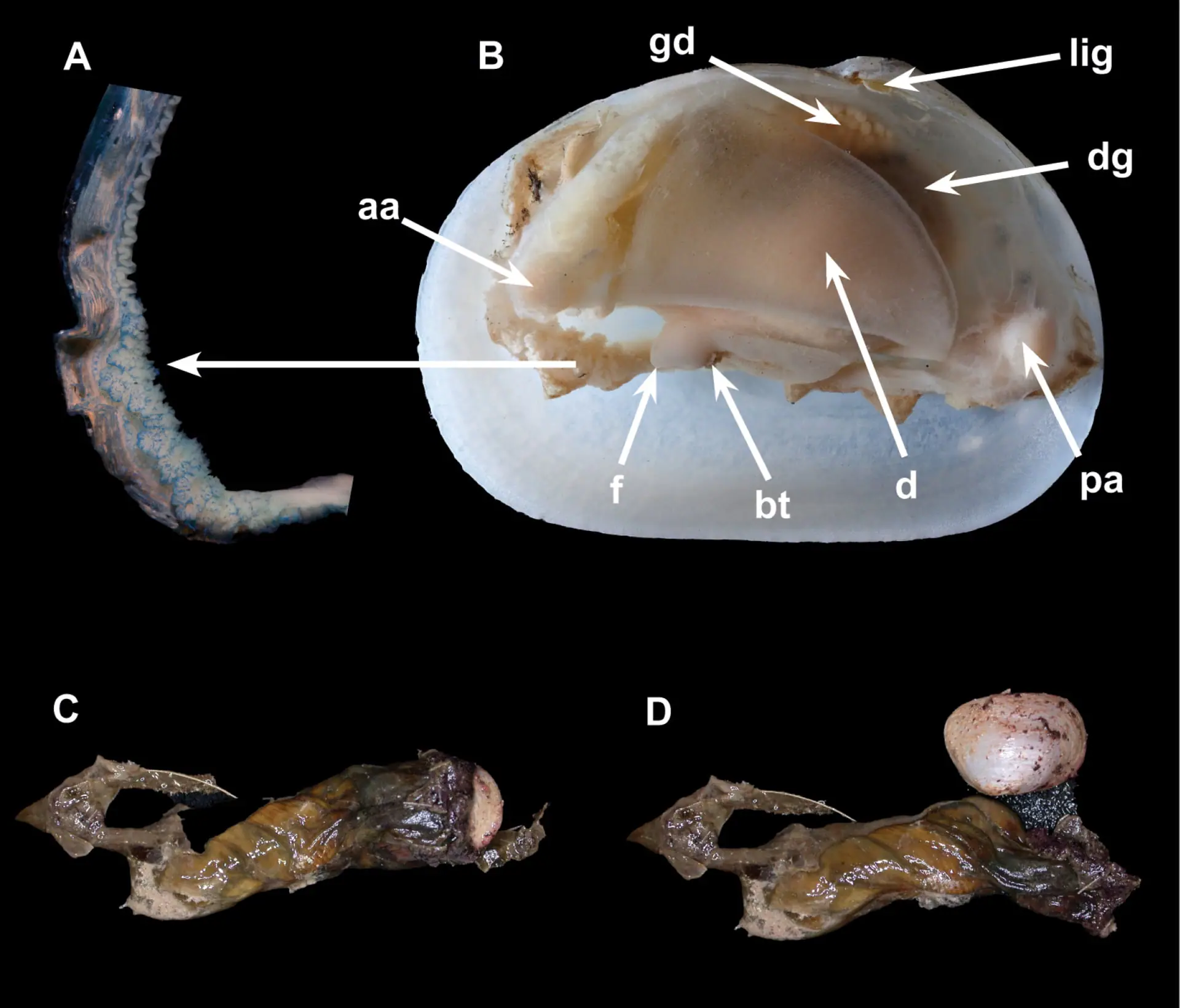
Vaticinaria gulicola is a bivalve with a thin, porcelain-like, slightly translucent shell and a translucent to pale yellowish-brown outer layer; the largest specimens reach 19.1 mm, almost 2 cm, which the paper describes as very large for a galeommatoid. The species name gulicola combines the Latin gula (throat) and -cola (inhabitant of), naming the animal for where it lives: the urchin's esophagus.
| Item | Vaticinaria gulicola |
|---|---|
| Where found | Great Australian Bight, 3,992–5,081 m |
| Type locality | 36°4.4'S, 131°43.34'E, 4,608 m |
| Size | Shell length up to 19.1 mm (holotype 17.8 mm) |
| Shell | Thin, slightly translucent, strongly inflated; no hinge teeth |
| Habitat | Inside the esophagus of the deep-sea irregular urchin Carnarechinus clypeatus |
| Where specimens are kept | Museums Victoria, South Australian Museum, Santa Barbara Museum of Natural History |
The paper appeared in ZooKeys on 9 November 2026, and its three authors are:
- Paul Valentich-Scott (Santa Barbara Museum of Natural History, USA)
- Hugh MacIntosh (Royal British Columbia Museum, Canada)
- Ryutaro Goto (Seto Marine Biological Laboratory, Kyoto University, Japan)
Galeommatoidea is a group of bivalves rich in species that live alongside other animals; a 2015 estimate cited in the paper puts it at 153 genera and more than 620 species, yet only a handful live deeper than 500 m, and most of those are commensal with urchins.
How did researchers learn it lives in an urchin's esophagus?
The clue was a "thin, slippery tube" that held the clams. Closer examination showed the tube was an urchin's esophagus, and DNA then identified the host species.
The clams came from a large deep-sea survey led by CSIRO, Australia's national science agency. Set up to record the deep-sea fauna of the Great Australian Bight ahead of potential oil and gas exploration, the survey programme sampled depths of 200 to 5,000 m and yielded 66,721 invertebrate specimens of 1,267 species, of which 401 (32%) were thought to be new to science. These clams were collected with a 4-metre beam trawl on two voyages of the research vessel RV Investigator, in October–November 2015 and April 2017.
The deepest trawls, at 4,000 to 5,000 m, brought up numerous fairly large bivalves. Byssal threads (threads used to attach to things) were visible on their feet. They suggested a commensal lifestyle, but the clams had become separated from their inferred hosts. Searching the trawl material further, the team found clams lodged inside thin, slippery tubes.
A COI gene sequence from part of a tube matched the irregular urchin Carnarechinus clypeatus at 98.9%. This urchin is extremely fragile, and the trawls recovered it only in fragments; as a species, too, it is known only from very fragmentary remains. Six clams were found inside the esophagus. Pieces of the urchin's skeleton (test) were still attached to one end of the tube, which helped identify the host as an urchin.
Why did no one notice them in a 150-year-old specimen?
A clam inside an urchin's esophagus cannot be seen from outside. The host urchin also comes up only in fragments, which, in our view, probably made the clams easy to miss. Clams inside urchins had been reported before, but this paper is the first to link them to the genus Vaticinaria.
| Year | Event |
|---|---|
| 1872–1876 | The Challenger Expedition collects Carnarechinus clypeatus in the South Atlantic; this specimen became part of the type material of the species |
| 1976 | Alexander Mironov reports in 1978 on urchins from a cruise of the research vessel Dmitriy Mendeleev: up to nine clams, 1.3 to 15 mm long, sat in a folded expansion of the gut near the mouth |
| 1985–1986 | Urchins from a South Atlantic survey also hold eight clams, 2.5 to 15 mm long (assigned to the family Montacutidae), in the gut. In 1993 Mironov writes that he had once thought the clams were the urchin's prey but now saw them living safely inside it |
| 2026 | The new paper: re-examining the Challenger urchin specimen reveals several Vaticinaria moseleyi, a species of the same genus, in its esophagus |
The last row is the most striking: the Challenger urchin specimen at the Natural History Museum in London still had clams of the genus Vaticinaria in its esophagus. The paper says that their remaining hidden for 150 years shows just how cryptic this way of life is.
The paper also assigns the clams Mironov reported in 1978 to the new species from the Great Australian Bight, and those he reported in 1993 to V. moseleyi from the South Atlantic. Both are the paper's inferences: the first rests on sketches by Elena Krylova and on where the specimens were collected, the second on collection location alone.
What does the clam eat inside the esophagus?
This has not been confirmed. Citing a 1982 study that deep-sea urchins in general feed selectively on organic-rich sediment, the paper suggests this may give the clams in the esophagus a steady supply of organic particles.
The front edge of the clam's mantle (the tissue that wraps the body inside the shell) is thick, tough and covered in small papillae. The paper suggests that this part works as an inhalant opening, and that the papillae may keep out the sediment that fills the urchin's gut. In 1993, Mironov had also written that the clams probably trap food particles from the water current created by the urchin.
On the other hand, the gills are large but the labial palps, which sort particles near the mouth, are small, suggesting the clam does little particle sorting. How the species reproduces and how its larvae reach the inside of an urchin remain unknown.
How does it differ from the clams that live in sea cucumbers?
The only other galeommatoid genus known to truly (not accidentally) live inside another animal is Entovalva, which lives in the esophagi of sea cucumbers, yet Vaticinaria shows none of the body changes for life inside a host seen in Entovalva.
| Item | Entovalva (sea cucumber esophagus) | Vaticinaria (urchin esophagus) |
|---|---|---|
| Species | 4 | The paper lists V. gulicola, V. moseleyi and V. borniana; only the first two have been found inside urchins, and no habitat is given for V. borniana |
| Size | Reduced | Shell up to 19.1 mm, very large for a galeommatoid |
| Shell | Greatly reduced | Valves can close completely |
| Foot | Expanded | Not expanded |
The paper notes that the maximum depth of Vaticinaria, 5,081 m, is the second-deepest galeommatoid record, after Ptilomyax hadalis, which lives on the outside of an urchin at 7,335 m. A phylogenetic analysis of the 28S rRNA gene placed it as sister to Brachiomya stigmatica, a shallow-water species that lives on the outside of urchins. From this the paper suggests the two genera's association with urchins may share a common origin, while noting that only one gene was compared and that more urchin-associated genera are needed to pin down its position.
From the editors
A Japanese researcher took part in this study: Ryutaro Goto of Kyoto University's Seto Marine Biological Laboratory is one of the co-authors. According to the paper, a company in Tokyo read the sequences of part of the clams' 28S gene. Part of the work was funded by a programme of Japan's Ministry of Education (L-INSIGHT) and a Kyoto University programme (MUSUBIME).
Only the specimens from off Australia had material suitable for DNA analysis; the host urchin is known only from fragments, and the course of its gut remains a guess. The authors write that they hope fresh samples for DNA work will confirm whether the Vaticinaria of the South Atlantic and South Pacific really are separate species. The role of the mantle papillae, too, will stay a hypothesis until someone observes a living clam. In its focus on a tiny home on the muddy deep-sea floor, this study echoes the research that found 4,139 small animals in the crevices of polymetallic nodules: deep-sea life also occupies places like an urchin's esophagus or a crack in a stone, which nets and cameras hardly capture.