In the Clarion-Clipperton Zone (CCZ) of the central Pacific, researchers dissected 244 polymetallic nodules (manganese nodules) in the laboratory and found a total of 4,139 small animals, such as nematodes and copepods, living in their internal cracks and cavities. The study, by an international team led by researchers from MARUM – Center for Marine Environmental Sciences at the University of Bremen and NIOZ – Royal Netherlands Institute for Sea Research, with partners in Belgium and France, was published in Scientific Reports on 11 November 2026. The crevice dwellers differed from the animals in the surrounding mud, and the team warns that mining the nodules would remove this habitat together with its residents.
What exactly is a polymetallic nodule?
Polymetallic nodules are dark, fist-sized lumps of iron and manganese oxides that grow over millions of years, often by just a few millimetres in 1 million years. Because the abyssal plains at 4,000 to 6,000 metres are covered almost entirely in soft mud, the scattered nodules are among the few hard surfaces on that muddy seafloor.
Nodules are rich in nickel, cobalt and copper, which makes them one of the main targets for deep-sea mineral extraction.
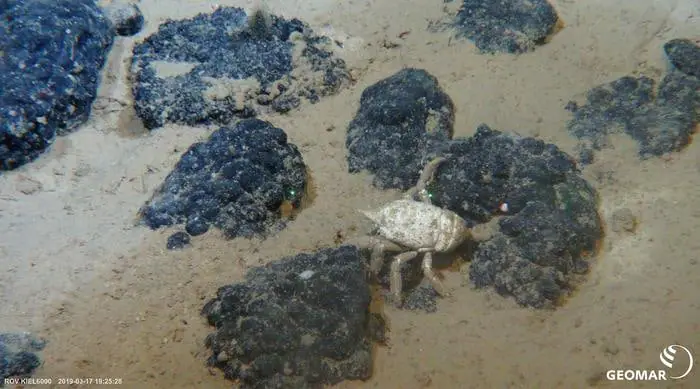
In seafloor photos of nodule fields, the eye goes first to larger animals such as crustaceans on or between the nodules. This study looked at what such photos cannot show: the inside of the nodules.
What was living in the crevices?
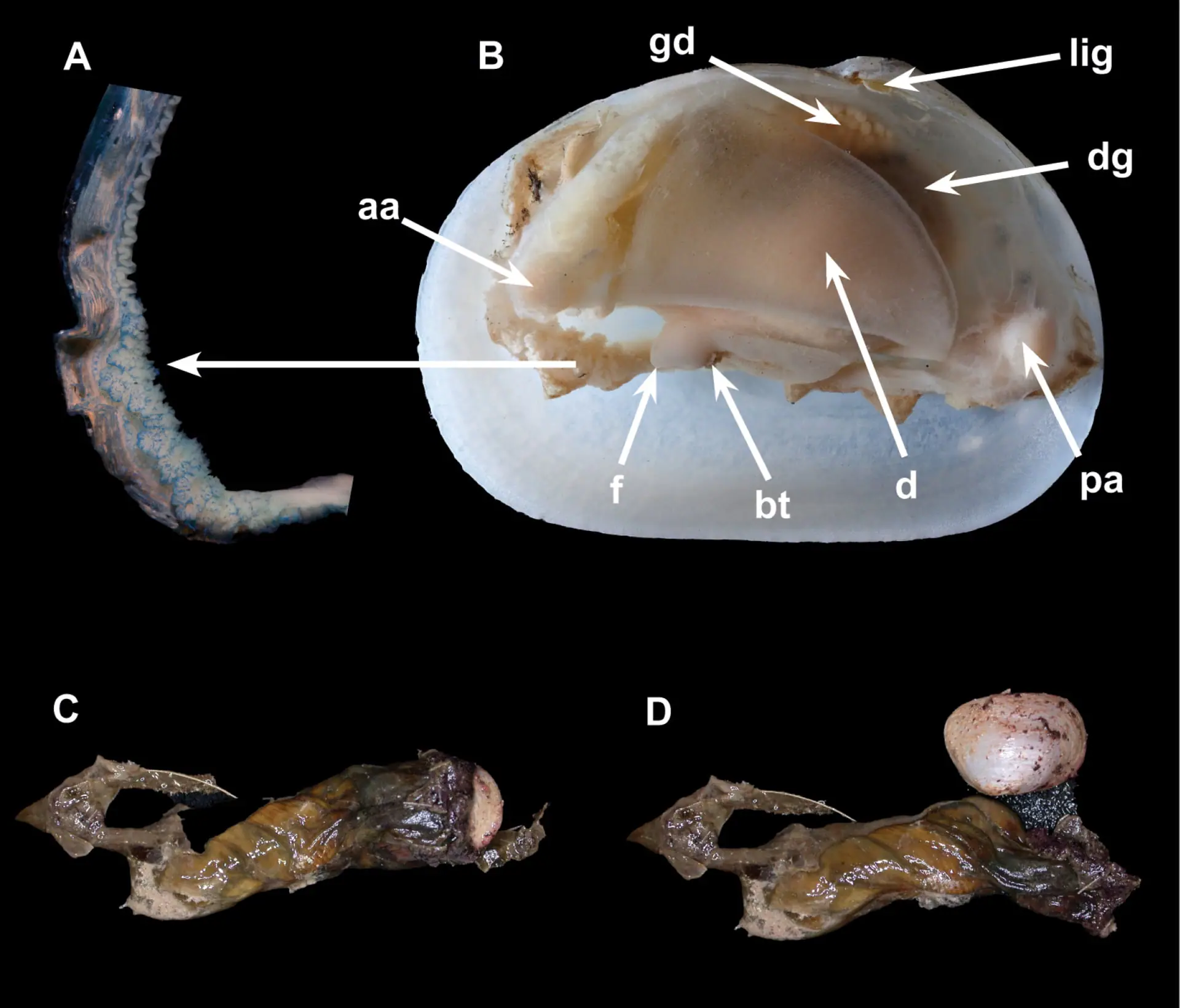
The crevices were home to small animals dominated by nematodes and copepods (tiny crustaceans); small seafloor animals of this kind are called meiofauna, a term used in the title of the paper. Besides the animals, single-celled foraminifera turned up again and again.
The team also studied the physical properties of the nodules and confirmed that they contain internal cracks and microfossils. Dr Tanja Stratmann, a deep-sea ecologist and one of the three researchers who led the study, put it this way:
In our study we show that the sizes of cracks inside the nodules are large enough to provide home to animals that are smaller than a millimeter in size.
— Tanja Stratmann (MARUM – Center for Marine Environmental Sciences, University of Bremen)
One single-celled species, Thurammina sp. 1, was particularly common inside the nodules. According to the news release, it appears to be perfectly adapted to the sheltered spaces within them.
What did 244 nodules reveal?
The team collected nodules and sediment with box corers, diving robots and other tools, then carefully dissected the nodules in the laboratory to extract the organisms from the crevices. Set side by side, the figures in the news release and the paper's abstract look like this.
| Item | Result |
|---|---|
| Nodules examined | 244 |
| Animals found | 4,139 in total |
| Per nodule | 17 on average |
| Most crowded nodule | 245 animals |
| Link with nodule size | Significantly more animals in larger nodules |
| Nematodes | About 10% of the number in nearby sediment |
| Copepods | About 25% of the number in nearby sediment |
| Community make-up (18S rRNA) | Different from the sediment; similar between nodules at sites up to 1,000 km apart |
Dividing 4,139 animals by 244 nodules does give an average of 17. The nodule with 245 residents held more than 14 times that average, so the numbers varied widely from one nodule to the next.
Does "10% of the sediment" mean the nodule habitat is minor?
In raw numbers, the crevices held fewer animals than the surrounding sediment: about 10% for nematodes and about 25% for copepods. The news release still calls this significant for the whole ecosystem. The point it stresses in particular is that the species composition of the animals living there is different.
The paper's abstract specifies that these 10% and 25% figures compare crevice abundances with those recorded in nearby sediments across two exploration contract areas in the eastern CCZ. They do not mean that one tenth of all deep-sea nematodes live in nodules. The abstract does not say on what basis the comparison was made, for example density per area or total counts in the samples.
Genetic analysis (18S rRNA) showed that the nematode and copepod assemblages in the nodule crevices differed from those in sediment collected on the same expedition and in the same contract areas. At the same time, crevice communities were very similar between nodules at sites up to 1,000 km apart. Dr Coral Diaz-Recio Lorenzo, who is listed first among the paper's authors and moved from NIOZ to the Roscoff Biological Station (Sorbonne University) in France, is one of the researchers who led the study. She describes the crevices as small shelters that house animals the team does not encounter in the soft sediment of the seafloor.
Why would mining cause irreversible loss?
Because nodules take millions of years to form, removing them would take away the crevice habitat and its inhabitants together. No nodule would regrow within a human lifetime, and the news release calls such a loss permanent on geological time scales. Professor Sabine Gollner of NIOZ, another of the researchers who led the study, says this needs to be considered in the environmental management of deep-sea mining:
Our findings point out that commercial mining may result in an irreversible loss of undescribed and unique biodiversity associated to nodules.
— Sabine Gollner (NIOZ – Royal Netherlands Institute for Sea Research)
It is not yet known, however, whether the species in a lost community would disappear from the planet or could survive in other areas. The news release also names this as a question for future research.
What can this study not tell us yet?
We were able to read the news release and the paper's abstract, but not the full paper, so we could not check the exact sampling depths or the measured sizes of the crevices. That is why this article gives depth only as the 4,000 to 6,000 metre range that the release gives for where nodules occur. Nor can we tell from the release or the abstract how far the similarity between nodules at sites up to 1,000 km apart holds at the species level.
That point matters for judging the impact of mining. If the same species live in nodules across a wide area, they might survive even if part of it were mined. If species differ from area to area, the loss would be greater. Follow-up studies are independently funded under MiningImpact 2 and 3, projects of the European JPI Oceans initiative, and at the time of the release Dr Stratmann was taking part in an international research expedition to the CCZ.
From the editors
In seafloor photos, a nodule is just a dark lump. By examining 244 nodules, this study shows that the inside of that lump is a separate world with an average of 17 small residents. In the study of deep-sea sponges and corals off Alaska, communities were more closely linked to currents and water masses than to depth; here, the small habitat of a nodule's crevices held a community distinct from the mud right next to it. The possibility that hard stones scattered across a muddy seafloor are irreplaceable even for animals smaller than a millimetre gives a concrete point to weigh in the debate over mining.