What comes to mind when you hear "the largest animal migration on Earth"? Perhaps migrating birds or herds of wildebeest. Yet an explainer on the website of NOAA Ocean Exploration, part of the U.S. National Oceanic and Atmospheric Administration (NOAA), says the answer is an up-and-down journey that happens in the ocean every single day: diel vertical migration.
What kind of migration is diel vertical migration
Every day, billions of animals rise and sink in oceans all over the world. Most of them are zooplankton, a loose term here for smallish animals including fish, various shrimp and jellies. This movement is called diel vertical migration, and the explainer describes it as the largest migration on Earth.
The first person to note these daily movements of aquatic animals was the French naturalist Georges Cuvier in the early 1800s. Like human sleep, the migration follows a daily rhythm that has been linked to genes. How far the animals move, however, also depends on outside cues, mainly light, along with water temperature, the amount of food and the risk of being eaten.
Why do they go up and down every day
Moving up and down every day takes a lot of energy. For many animals, the leading explanation for why it is worth it is that they get both food and safety. By rising to the food-rich surface waters in the dark of night, they can feed while staying hidden from predators that rely on light to find their prey. Then, before the sun comes up, they head back down into the depths.
Other ideas are that the trip helps reduce ultraviolet damage to their DNA or lets them ride currents to places with more food. Another idea is that they move to take advantage of colder, deeper water to grow larger or produce more eggs.
What was the "false seafloor" on sonar
This migration once revealed itself in an unexpected way. It happened during World War II. According to another NOAA Ocean Exploration explainer (2022), technicians using sonar, then a new technology, noticed that the seafloor appeared much shallower than expected, and that its depth changed at night. It looked as if a second seafloor were floating a few hundred metres below the surface.
Sonar measures depth from how long it takes a sound pulse to bounce back, but what it was picking up was not the seafloor at all: it was a thick layer of fish, squid, jellyfish and other animals. Fish swim bladders reflect sound so strongly that the layer looked like a real bottom. This layer is called the deep scattering layer, and it usually lies around 300 to 500 m deep. It can be deeper during the day, parts of it can become shallower at night, and it is found in oceans around the world. The "seafloor" seemed to change depth because many of the animals that make up the layer were carrying out diel vertical migration.
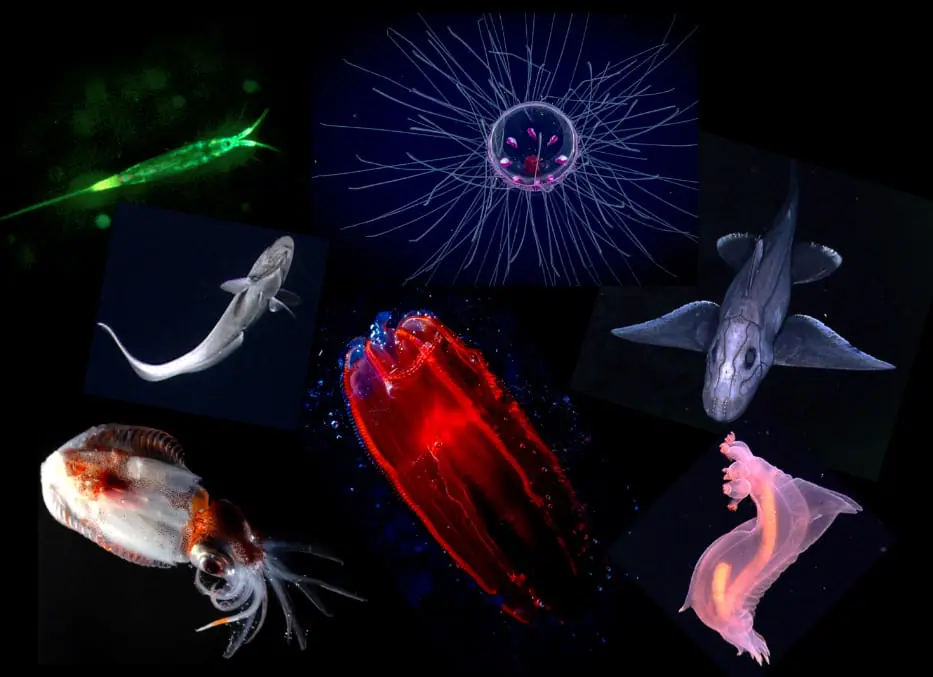
The image above was recorded during a 2019 expedition. Within the blue and green layer, warmer colours mean a stronger echo, which in some cases indicates more animals. The main image shows midwater animals that may be found in this layer.
How does this migration matter for the ocean and the planet
According to the 2022 explainer, most of the animals living in the open ocean are concentrated in this layer. Whales, dolphins and sharks also dive down to feed there, and many of the fish that people eat can get their food in this layer. The 2021 explainer adds that when algae-eating animals leave shallow waters during the day, the organisms that make food from sunlight face less grazing and can multiply.
The migration is so large that it can stir the water itself. One study showed that vertically migrating jellyfish can move water. This water movement likely carries nutrients and particles to places they would not otherwise reach.
This migration also helps carry carbon taken in at the surface down into the depths. The 2021 explainer says that the droppings of animals that feed at the surface and return to the depths speed up the transport of carbon to the ocean floor. If climate change alters the strength of this migration, the carbon cycle could be affected. How the migration in different parts of the world is responding to climate change is still poorly understood.
The nightly journeys of tiny animals play a major role in ocean life and in the movement of carbon on our planet. Deep Sea Log has also covered the bits of life that sink into the deep sea in an article on marine snow. For more on midwater fish, see our article on the genetics of deep-sea fish and shrimp in the Gulf of Mexico.