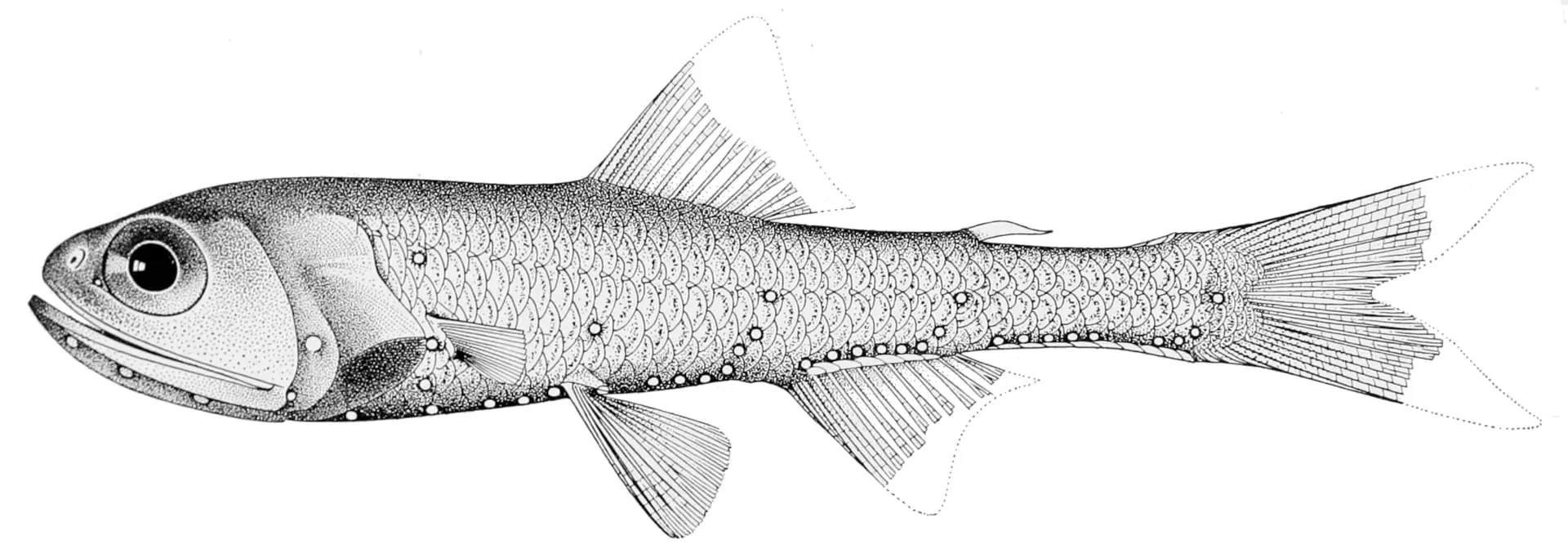
All five species examined, three lanternfish and two shrimp living in the mesopelagic zone of the Gulf of Mexico (200–1,000 m deep), show genetic warning signs associated with an elevated risk of extinction. A team led by Florida International University (FIU) analyzed DNA from 486 individuals collected between 2011 and 2023 and published the results in Nature Communications in November 2026. One lanternfish, Diaphus dumerilii, lost 7–8% of its genetic diversity over those 12 years.
What did the team study, and how much?
The team picked five species that are abundant in the Gulf's mesopelagic zone, differ in their traits and play important roles in its food web: three fish and two shrimp. The specimens come from sampling by the DEEPEND consortium, which has towed nets from the research vessel R/V Point Sur in the northern and eastern Gulf, collecting separately at different depths between 0 and 1,500 m. The paper describes the DEEPEND samples as one of the longest time series of mesopelagic and deeper-living swimming animals in the history of oceanography.
| Group | Species | Years sampled |
|---|---|---|
| Lanternfishes (Myctophidae) | Diaphus dumerilii, Ceratoscopelus warmingii, Lepidophanes guentheri | 2011, 2015, 2016, 2018, 2021, 2023 (12 years) |
| Sergestid shrimps (Sergestidae) | Phorcosergia grandis, Robustosergia robusta | 2015, 2016, 2018, 2021, 2023 (8 years) |
The team analyzed 590 individuals of the five species, and 486 that passed quality filters made it into the final dataset. For the three fish, data from 2011 to 2016 came from sequences produced in an earlier study.
How much lanternfish genetic diversity was lost?
The largest loss was in Diaphus dumerilii, which dropped by 10.9–13.1% between 2011 and 2016, partly recovered afterwards, and by 2023 showed a net loss of about 8% of its genetic diversity. The changes in the other four species were not uniform. The fish Ceratoscopelus warmingii declined by 3–5% up to 2018 and then returned to 2011 levels, while the shrimp Phorcosergia grandis declined, recovered and declined again after 2021, ending 2023 1.6–3% below its 2015 values. In the remaining two species the changes were small, and the team does not consider them biologically meaningful.
| Species | Change in genetic diversity (paper) |
|---|---|
| Diaphus dumerilii (fish) | 10.9–13.1% loss in 2011–2016, partial recovery, net loss of about 8% by 2023 |
| Ceratoscopelus warmingii (fish) | 3–5% loss up to 2018, then back to 2011 levels |
| Phorcosergia grandis (shrimp) | Decline in 2015–2016, recovery, second decline after 2021; 2023 values 1.6–3% below 2015 |
| Lepidophanes guentheri (fish) | Little change |
| Robustosergia robusta (shrimp) | Little change |
The paper compares these numbers with other animals. Atlantic bluefin tuna lost 1.5% when samples from before 1941 were compared with those from 2013 and 2018, mountain gorillas lost 3% over a century, and northern and southern white rhinoceros lost 10% and 34% when samples from 1845 and 2010 were compared. The paper concludes that what Diaphus dumerilii lost in just over a decade is comparable to what well-known threatened species lost over much longer periods.
Heather Bracken-Grissom of FIU, a co-author, explained why genetic diversity matters:
Genetic diversity provides the variation populations need to adapt to changing conditions, resist disease and recover from environmental disturbances. When that diversity disappears, a species can also lose the ability to withstand future threats.
— Heather Bracken-Grissom (Institute of Environment, Florida International University)
What does a small effective population size mean?
Effective population size is an estimate, derived from genetic data, of how many individuals are effectively passing their genes to the next generation; it is not the same as the number of fish or shrimp in the sea. The press release also stresses that it does not necessarily mean there are few animals, only that relatively few individuals are contributing genetically to future generations.
The Global Biodiversity Framework (GBF) adopted in 2022 recommends using this value to gauge extinction risk. The benchmarks cited in the paper are above 50 for short-term viability and above 500 for long-term viability. For every one of the five species, most estimates from three different calculation methods fell below 500, and each species also had estimates near or below 50 in some time intervals.
This runs against the long-held view that animals of the deep midwater, with their vast habitats and large numbers, form large and stable populations. Pedro A. Peres, who led the study, put it this way:
This challenges the idea that deep-sea species are naturally more resilient because they occupy such vast environments.
— Pedro A. Peres (Florida International University)
Will the Gulf of Mexico still suit them in 2100?
Climate projections indicate that the Gulf could become less suitable for four of the five species. The team trained models on where the species occur in the Atlantic, from the equator to sub-polar waters, and projected conditions in the Gulf for 2050 and 2100 under four emission scenarios.
The decline in the habitat suitability measure ranged from 5.2% to 70% depending on the species and scenario. The largest losses came in 2100 under high-emission scenarios. The shrimp Phorcosergia grandis was the one exception, with the Gulf projected to become more suitable. Its models performed the worst, however, and some of them predicted a decrease. The paper also acknowledges that deep-sea species have few occurrence records and that such projections should be read with caution.
Is there a link to the oil spill?
The study did not test a link to the 2010 disaster at the Deepwater Horizon drilling rig. In that accident, 4 to 4.9 million barrels of oil were released at about 1,500 m depth. DEEPEND began in order to study its consequences. Earlier studies reported that many deep midwater species of fishes, crustaceans and other animals saw their abundance fall by 62–80% over the following 15 years.
The researchers do not directly attribute the genetic changes to the spill. Together with abundance data from other surveys, the paper points to possible population crashes during 2011–2015. Peres believes some deep-sea populations may already have been genetically vulnerable before the spill. In his view, events such as oil spills may affect populations that already have limited genetic resilience.
How does this connect to Japan's seas?
The two shrimp species studied belong to the same family, Sergestidae, as the sakura shrimp (Lucensosergia lucens) fished in Suruga Bay. A group including the University of Tokyo's Atmosphere and Ocean Research Institute and Tokai University, working with a Taiwanese fisheries research institute, studied the genes of sakura shrimp from Suruga Bay and Taiwan and reported in March 2025 that there is genetic exchange between the two. That study looked at connections between populations, not at gains or losses of genetic diversity. Suruga Bay has seen record-low sakura shrimp catches since the late 2010s, and the group says cooperation between Japan and Taiwan is essential for sound management of the resource.
While this study projects future changes in habitat, a study that surveyed Japan's coasts with environmental DNA has already reported fish found farther north than their recorded ranges. For the design of areas that protect deep-sea life, see also our article on protected areas in a deep-sea mining region.
Editor's note: being numerous is no guarantee of safety
The five species were chosen partly because they are abundant in the Gulf's mesopelagic zone, where more than 1,000 species have been recorded. Peres says that looking only at abundance, without considering genetic diversity and long-term viability, can miss a great deal, and this study tried to close that gap by analyzing 12 years of fish specimens and 8 years of shrimp specimens within a consistent analytical framework.
At the same time, the study covers five species and infers whole populations from 5 to 25 specimens per year. The 50/500 benchmarks for effective population size are widely used in conservation, but the paper itself notes that whether they apply to all organisms is still debated. Whether the Gulf results hold for the midwaters of other seas remains unknown, because comparable long-term collections barely exist.