The deepest-living fish confirmed so far is a snailfish filmed at a depth of 8,336 m in the Izu-Ogasawara Trench, which runs south of Japan. NOAA Ocean Exploration (part of the U.S. National Oceanic and Atmospheric Administration) explains that no fish is likely to live deeper than about 8,400 m because of the pressure.
What kind of fish is the deepest-living fish
In NOAA's description, snailfishes are shaped a bit like tadpoles: big heads, little eyes and skin without scales. They live all around the world, from shallow coastal seas to ocean trenches, and some species are especially well adapted to deep water.
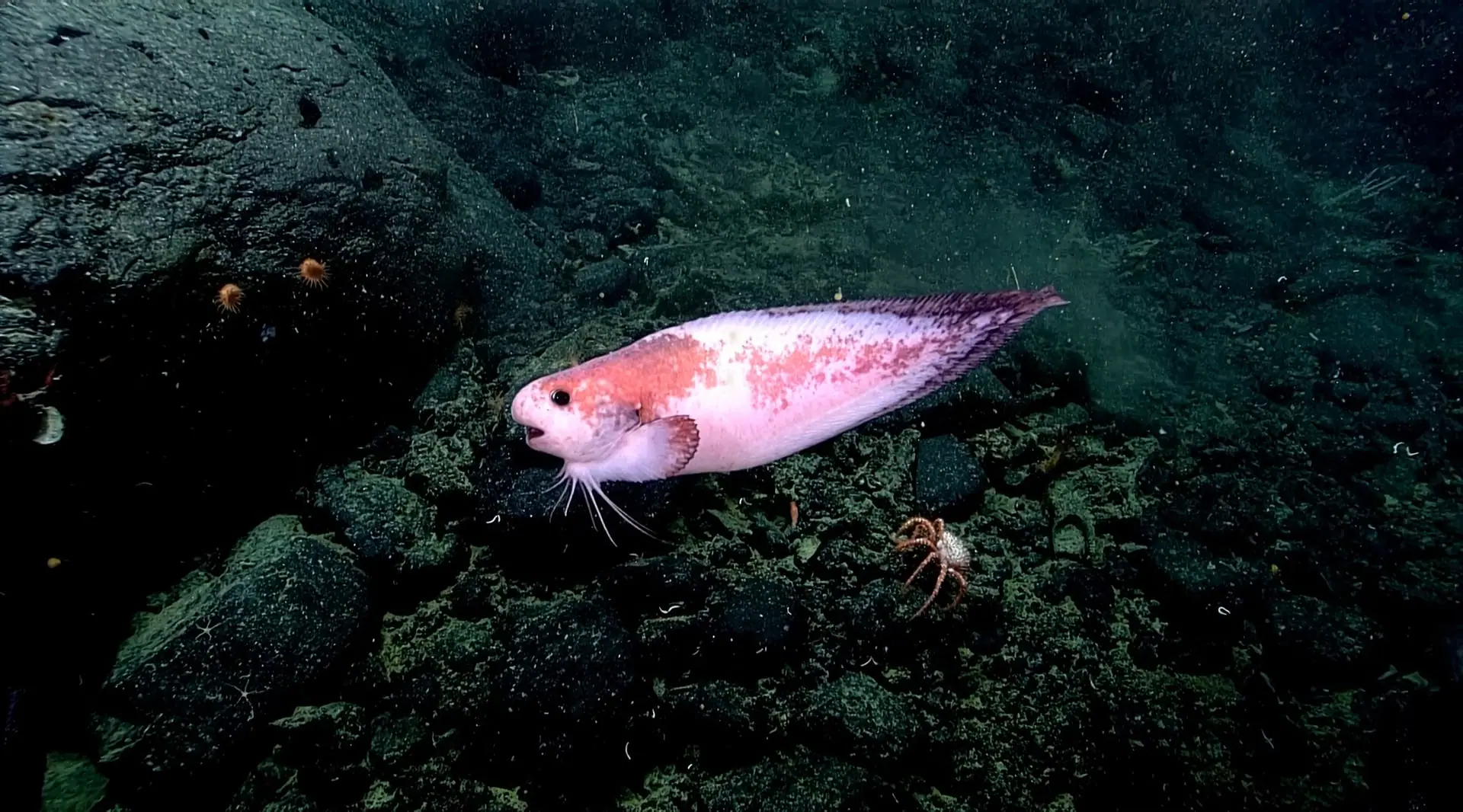
The snailfish in the photo above was filmed in 2023 at a depth of 1,365 m on Denson Seamount in the Gulf of Alaska. NOAA calls it a "smiling" snailfish. Perhaps it is the shape of its mouth. The record-holder was found more than six times deeper.
How deep is 8,336 m
NOAA offers a comparison: only the very highest mountains rise higher than 8,336 m goes down. Compared with live sightings of fish other than snailfish, it is roughly 1,000 m deeper.
Even so, it does not reach the deepest point of the ocean: the Challenger Deep in the Mariana Trench is about 11,000 m deep, still about 2,700 m further down.
The record was reported in a 2023 paper. In 2026, Alan Jamieson of the University of Western Australia and colleagues published a paper compiling about 460 hours of video filmed in the Japan, Ryukyu and Izu-Ogasawara trenches. Its authors include researchers from JAMSTEC (Japan Agency for Marine-Earth Science and Technology) and Tokyo University of Marine Science and Technology.
How has the record changed over time
Based on a 2017 press release from JAMSTEC and the 2023 paper, records of fish filmed alive have crept deeper step by step.
| When (filmed or announced) | Depth | Place | How it was confirmed |
|---|---|---|---|
| 2014 | 6,198–8,145 m | Mariana Trench | A British and American research group filmed two kinds of snailfish |
| April 2017 | 8,152 m | Mariana Trench | The Chinese Academy of Sciences announced it had filmed a fish |
| May 2017 | 8,178 m | Mariana Trench | JAMSTEC and NHK filmed it with a camera-equipped device |
| 2023 paper | 8,336 m | Izu-Ogasawara Trench | Filmed by a baited camera |
If you look only at the numbers, there is a deeper record. In 1970, a cusk eel, Abyssobrotula galatheae, was caught in a net that descended to 8,370 m in the Puerto Rico Trench in the Atlantic. But NOAA notes that it is hard to confirm whether the fish was caught at the deepest point of the net's descent.
In the 2017 survey, JAMSTEC and NHK placed a device baited with mackerel on the seafloor. At 7,498 m, snailfish appeared 3 hours and 37 minutes later, and soon several of them were swimming together. At 8,178 m, however, only a single fish appeared, after 17 hours and 37 minutes. JAMSTEC thinks far fewer snailfish live at 8,178 m than at 7,498 m.
In 1960, the crew of the submersible Trieste, which dived to the Challenger Deep, reported seeing a flat fish resembling a flatfish. But the very next year a paper suggested it was some other animal rather than a fish. As of JAMSTEC's 2017 press release, no fish had been confirmed at depths below 9,000 m.
Why are no fish found below about 8,400 m
NOAA points to research suggesting that a boundary for fish may lie somewhere between 8,200 and 8,400 m. All the animals discovered below it so far have been invertebrates without bony skeletons, such as sea cucumbers and isopods (relatives of pill bugs). For a different deep-sea sea cucumber, see our article on the bacteria living in the body wall of sea pigs.
The key seems to be the balance of water and salts inside the body. Marine bony fish keep the osmolality inside their bodies lower than that of seawater. Deep-living fish accumulate a substance called TMAO (trimethylamine N-oxide) that protects their proteins against pressure, but the more they accumulate, the higher their internal osmolality rises.
According to a 2014 paper in PNAS, TMAO in teleost fishes rose from 40 to 261 mmol/kg between depths of 0 m and 4,850 m. In the muscles of snailfish (Notoliparis kermadecensis) caught at 7,000 m in the Kermadec Trench, TMAO was 386 mmol/kg and osmolality 991 mOsmol/kg, close to seawater's 1,100 mOsmol/kg. Extending the rise of osmolality with depth, it would equal that of seawater at about 8,200 m. Deeper than that, fish would have to reverse the way they regulate their water balance, so the paper sees this depth as a possible limit for fish.
Snailfish seen in the trenches off Japan
The 2026 paper reports three kinds of snailfish of the genus Pseudoliparis (distinguished by their appearance) in the three trenches off Japan. Their depth ranges were 6,023–8,336 m, 6,579–7,621 m and 6,860–8,022 m. The 8,336 m record was set by the first of them, filmed in the Izu-Ogasawara Trench.
The snailfish approached the camera apparently not for the bait itself but to prey on the amphipods gathering around it. In the Japan Trench, snailfish that appeared to lack eyes were filmed at least twice. These fish usually have very prominent black eyes. The researchers write that they hope future studies will show whether this was an imaging artifact or the result of mutation or disease.
A fish with a big head swims at a depth that two Mount Fujis stacked on top of each other would still not reach. Isn't that amazing? We have also written about research measuring how the seafloor moves in the Japan Trench. The trench where this record was set lies just off Japan, too.