Think of a sponge and you might picture something small enough to hold in one hand. Yet in the deep sea off Hawaiʻi, a sponge as big as a car has been found. Here is the largest sponge known, through photos and explanations from NOAA Ocean Exploration, part of the U.S. National Oceanic and Atmospheric Administration (NOAA).
How big is the largest sponge
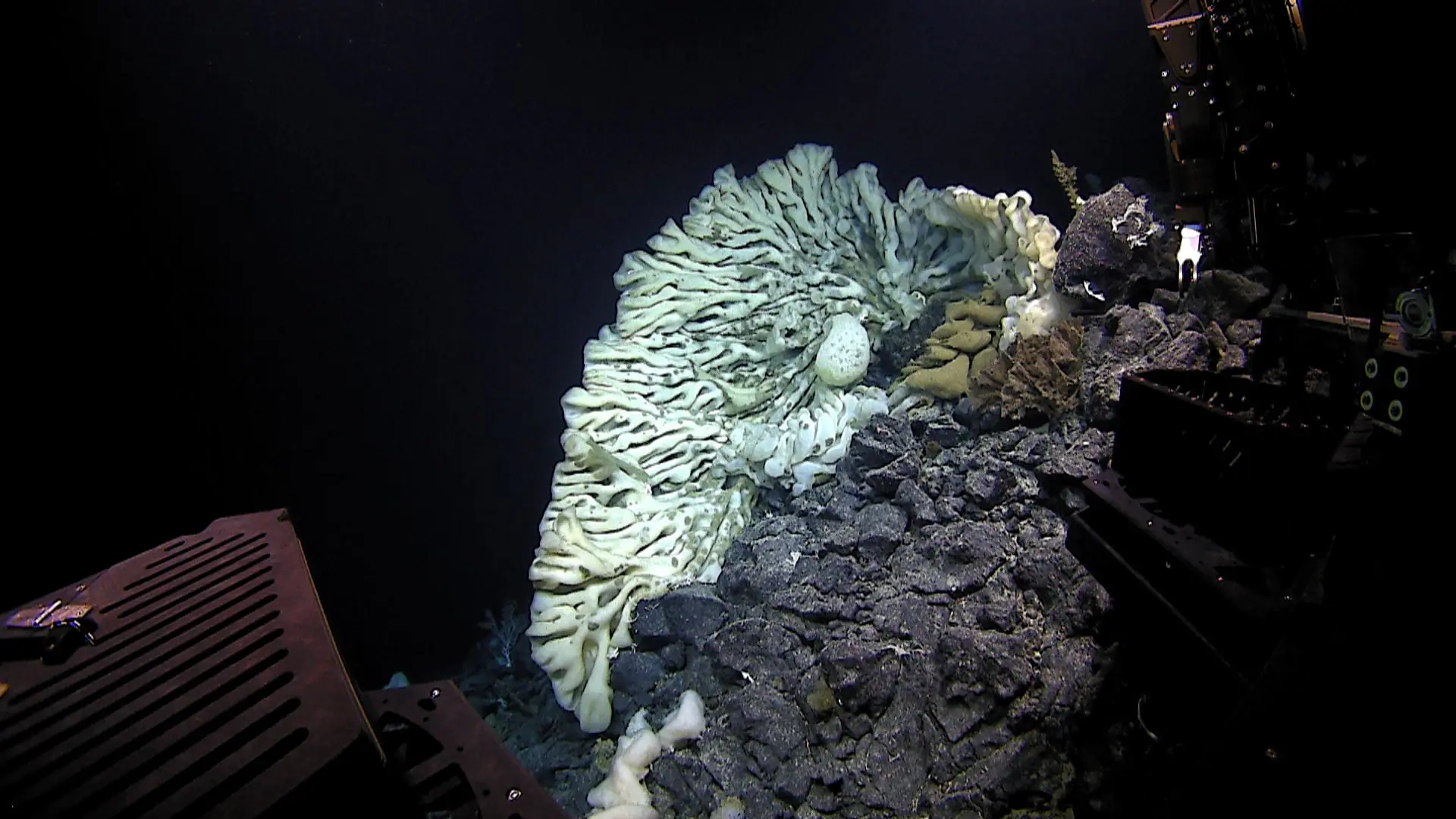
When it was found, it measured about 3.7 m long, 2.1 m wide and 1.5 m tall, and NOAA compares its size to a minivan. In the main image, the large white mass spreading over the rocks is that sponge.
NOAA writes that, by most measures, it is still the largest sponge ever found. Much of the ocean floor, however, has not yet been explored by cameras or remotely operated vehicles, so an even bigger sponge may be out there waiting to be discovered.
Where was it found
It was found in 2015 in Papahānaumokuākea Marine National Monument, which stretches northwest of the main Hawaiian Islands. NOAA's exploration ship Okeanos Explorer was carrying out an expedition called Hohonu Moana, using the remotely operated vehicles (ROVs) Deep Discoverer and Seirios to explore waters 700 to 4,875 m deep. The giant sponge appeared on camera during a dive on a ridge extending from a seamount south of Pearl and Hermes Atoll, at a depth of 2,130 m.
Daniel Wagner, the expedition's science lead, said in a 2016 NOAA announcement that the discovery of such a huge and probably very long-lived sponge shows how much there is to learn in remote, undisturbed deep waters.
What kind of sponge is it
Researchers Daniel Wagner and Christopher D. Kelley examined a sample of a similar, smaller sponge nearby and concluded that both belong to the family Rossellidae. This family is part of the glass sponges (class Hexactinellida). The team studied it for a year and reported it in May 2016 in the journal Marine Biodiversity.
A glass sponge's skeleton is made of elements called spicules, formed from silica, the same material used to make glass. Unlike most sponges, glass sponges make very large spicules that fuse into a "glass house" framework that often stays intact even after the sponge dies. Like most sponges, glass sponges live attached to hard surfaces such as rock and feed by filtering small organisms and particles from the passing water. Sponges have no nervous, digestive or circulatory systems, and they get food and oxygen from the water flowing through them.
How long does it live
The age of this giant sponge is unknown. NOAA explains, though, that some other large sponges have been found to be hundreds or thousands of years old. The 2016 announcement noted that some massive species living in waters shallower than about 30 m are estimated to live more than 2,300 years. Perhaps this giant, too, took a very long time to grow this big.
Sponges do not move, but many of them provide shelter and food for other living things. NOAA writes that a sponge this huge can play that role in a big way.
What other glass sponges are there
The deep sea of the northwestern Hawaiian Islands is home to other glass sponges with interesting shapes. The photo above, taken during a 2016 expedition, shows sponges of the genus Caulophacus, with white, ring-like bodies on top of thin stalks.
This one is the "gramophone" sponge, found during the 2015 expedition on a seamount north of French Frigate Shoals. Scientists determined that it is a glass sponge in the family Euretidae, and NOAA presented it as belonging to a new, not-yet-described genus and species.
The glass sponge NOAA calls the most famous is a species of Euplectella in the family Euplectellidae, known in English as the Venus flower basket. A shrimp that settles inside its skeleton becomes trapped once it outgrows the openings. Even so, the walls shield the shrimp from predators, and their tiny offspring can leave through the mesh.
The deep sea where a minivan-sized sponge was found may still hide other giants. Deep Sea Log has also covered long-lived deep-sea animals in an article on a deep-sea black coral dated to about 4,265 years. For more on deep-sea sponges, see our article on deep sponges and corals in Alaska.