In the lights of a vehicle diving into the deep sea, tiny white flecks drift slowly downward, like a snowy night. These flecks are called "marine snow," and they support life in the deep sea. Let's find out what they are through explanations and exploration photos from NOAA Ocean Exploration, part of the U.S. National Oceanic and Atmospheric Administration (NOAA).
What is marine snow made of
According to NOAA, marine snow is mostly debris from living things. It starts in the sunlit surface waters of the ocean, mainly as phytoplankton produced through photosynthesis and microbes. On the way down it gathers droppings, the bodies of animals that are breaking down, fine silt and even organic matter that may have washed into the sea from land. It got its name because it looks a bit like the white, fluffy snow that falls on land.
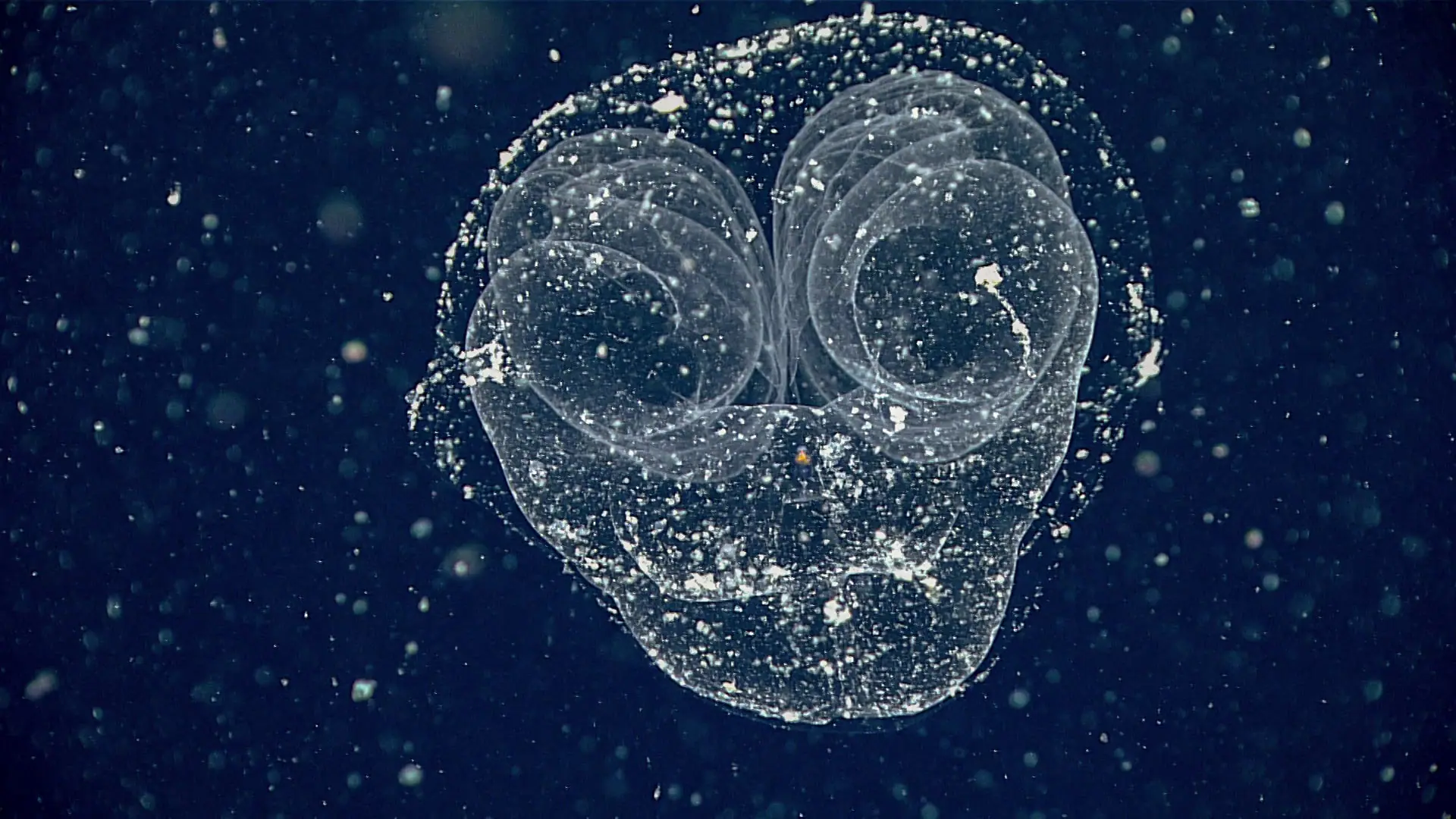
The main image shows the mucus "house" of a larvacean. Larvaceans use these houses as filters to strain small particles of food from the water. A larvacean leaves its house and builds a new one once the filter clogs. Judging by the many white flecks of marine snow, the house in the photo was quite full, and it was abandoned while the team was taking a closer look.
How do deep-sea animals eat it
For many animals in the dark ocean, marine snow falling from above is the main thing to eat. Some strain it out of the water, while others pick it up from the bottom. Measurements of the usable material in marine snow show that it carries enough carbon and nitrogen to sustain many deep-sea scavengers.
There are also animals in the seafloor mud that receive marine snow. NOAA explains that small animals such as worms living in deep-sea mud are among them. They play an important part in handing the energy in marine snow on to bigger animals that feed on the bottom.
Is the amount of snow always the same
On some dives there is a lot of marine snow, and on others there is very little. According to NOAA, the amount depends on many factors. Examples include how much phytoplankton grows at the surface, how much of the material is eaten or broken down on the way down, and how currents carry it sideways and up and down.
During a 2021 expedition off the southeastern United States, a lot of marine snow was drifting about 10 m above the seafloor at about 1,005 m. Lobate comb jellies like the one above were also common at that depth. During an expedition in the Aleutian Islands (Seascape Alaska 3), marine snow was plentiful for much of a dive in which a giant grenadier was seen swimming at 1,433 m.
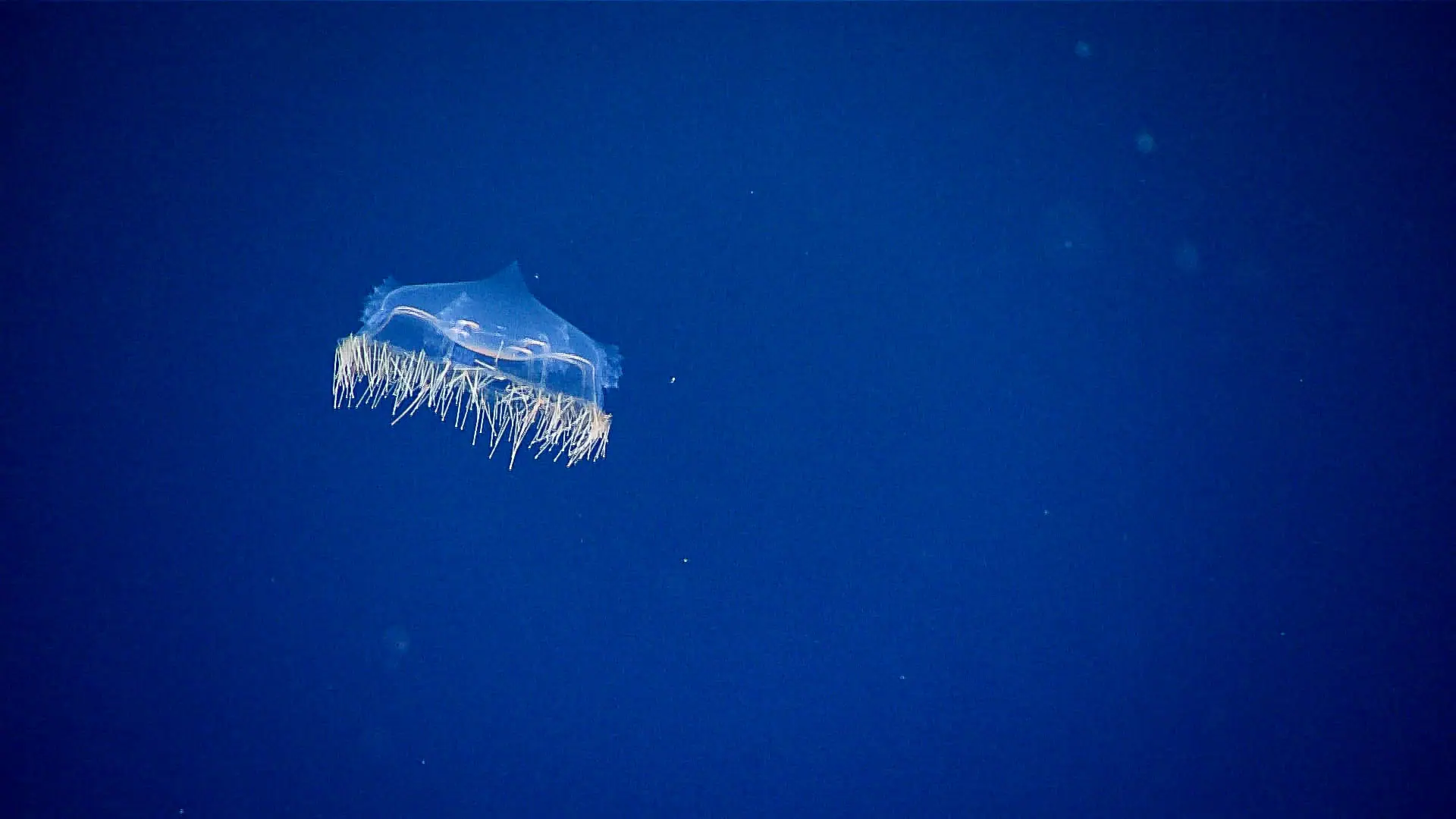
During a 2018 expedition in the same region, the team found a layer where the temperature fell sharply and oxygen rose. To compare conditions inside and outside it, they surveyed the water at 950 m and 880 m. NOAA writes that these depths came with a layer extremely dense with marine snow. The jellyfish above was photographed at 880 m.
How long does it take to reach the deep
Marine snow particles grow as they sink by collecting other debris, and they sink faster as they grow, but the journey to the deep can still take weeks.
This snow also slowly piles up on things that have sunk to the seafloor. Structures such as shipwrecks probably start to gather a coat of marine snow within a few years. NOAA says that, depending on the site, it may take hundreds of years or more for a structure to be completely hidden from view.
Material made at the ocean surface falls like snow and feeds life in the lightless deep. Deep Sea Log has also covered the animals that gather on whale carcasses on the deep seafloor in an article on a sperm whale fall in Sagami Bay. For more on colorful comb jellies, see our article on iridescent comb jellies.