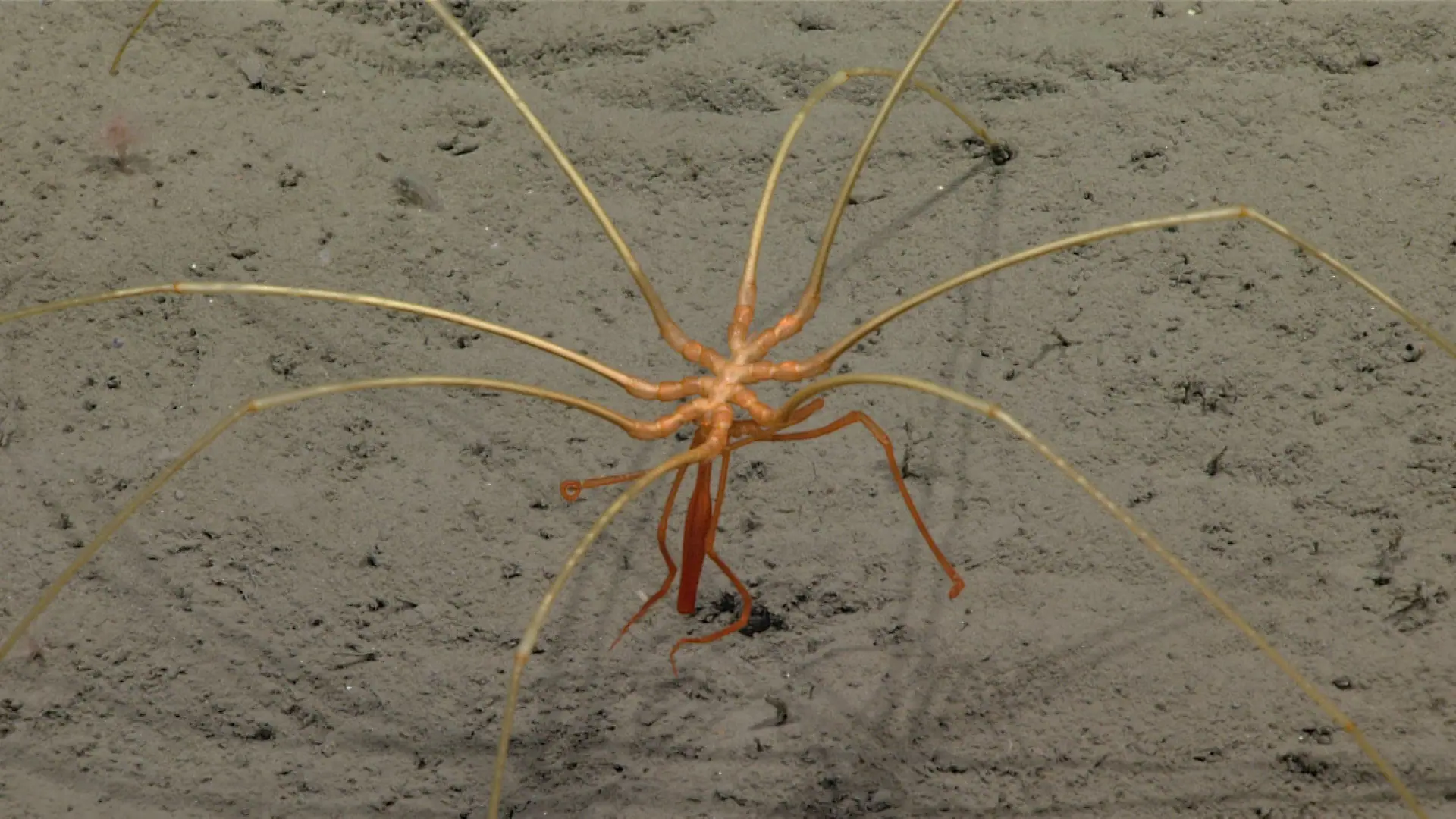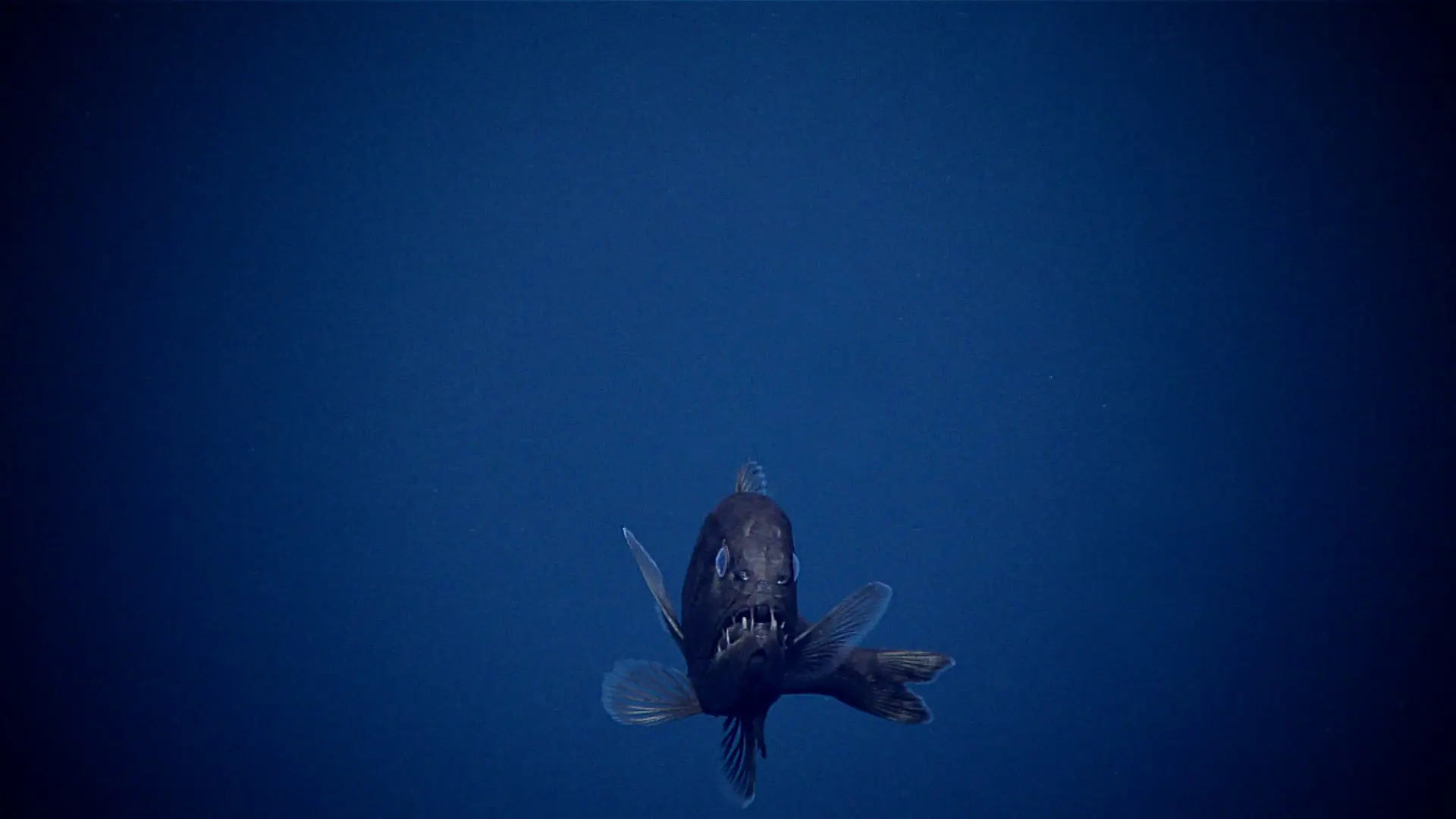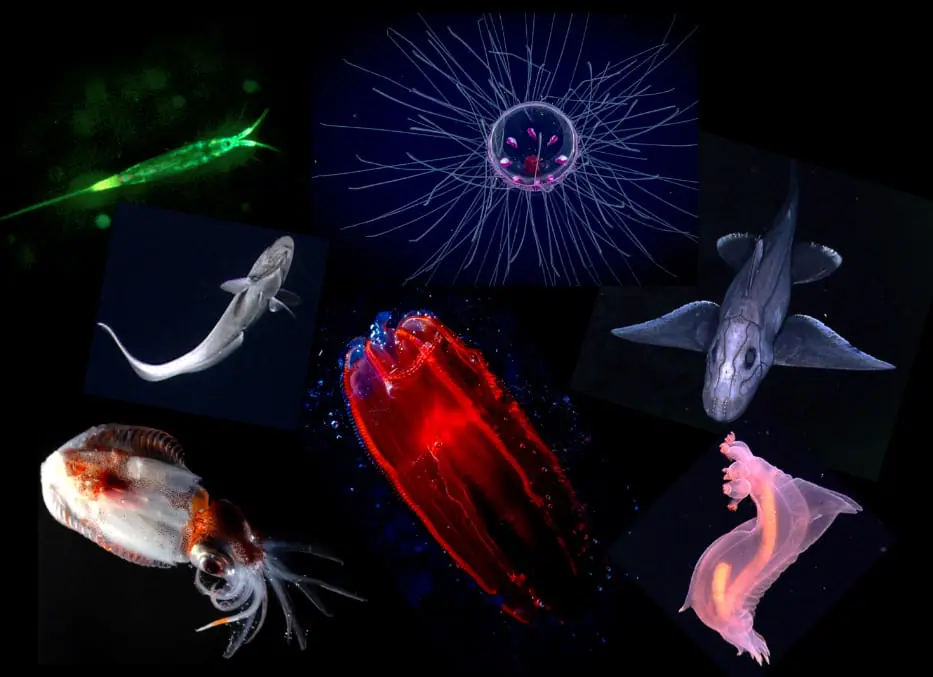
The results of a single survey that covered two uninhabited atolls at the northern tip of the Marshall Islands, Bikar and Bokak, from their land vegetation and seabirds down to the deep sea at 2,000 m, were published in Frontiers in Marine Science on 11 November 2026. Alan M. Friedlander of the University of Hawai'i and colleagues reported coral reefs rich in sharks and other large predators, as well as deep-water fish that appear not to have been recorded in the Marshall Islands before. The paper presents the two atolls as reference sites for "relatively intact" tropical ocean ecosystems.
What was surveyed at Bikar and Bokak atolls?
The 2023 survey was led by Pristine Seas, the National Geographic Society's ocean conservation project, and staff of the Marshall Islands Marine Resources Authority (MIMRA) are among the paper's co-authors. It covered land vegetation and seabirds, sea turtle nesting, the seabed and fish of shallow coral reefs, open-water fish, reefs at depths where light barely reaches, and the deeper sea.
The two atolls lie more than 850 km north of the capital, Majuro. From Utrik, the nearest inhabited atoll, Bikar is about 116 km away and Bokak about 385 km. Bokak was formerly also called Taongi Atoll. According to the news release, about 48,000 km² around the atolls became the country's first national marine sanctuary two years after the survey.
- Bikar Atoll
- Bokak Atoll
The team used different tools at different depths.
| Depth | Survey method | Main result |
|---|---|---|
| Shallow coral reefs (10 m, 20 m and others) | Visual surveys by scuba divers | 266 fish taxa |
| Open-water surface layer (10 m) | Baited floating cameras | 15 fish taxa (sharks, jacks, wahoo and others) |
| Down to about 275 m | DeepSee, a submersible that keeps one atmosphere inside (rated to 450 m) | 138 fish taxa, 14 apparently not recorded in the Marshall Islands |
| Mainly 500 m, 1,000 m and 2,000 m | Baited cameras lowered to the seafloor | 79 vertebrate taxa |
Cameras that attract fish with bait were also used on the shallow reefs. A depth of 2,000 m is more than three times the height of the Tokyo Skytree.
What state were the shallow reefs in?
On the reefs of both atolls, sharks, plant-eating fish and large predators made up a large part of fish biomass. When outer reef slope fish biomass was split by feeding group, sharks accounted for the largest share: 26.8% at Bikar and 33.9% at Bokak.
Large predators are thought to have declined sharply on many reefs near populated areas of the Indo-Pacific. The paper says the picture at both atolls matches features of remote reefs with little human influence. Grey reef sharks, whitetip reef sharks, Napoleon wrasse, bluefin trevally and others were common from shallow reefs down to deeper slopes.
On land, too, features being lost on tropical islands remained. Of the 17 seabird species seen on land, 15 were breeding or likely breeding. At Bikar, 71 turtle crawls and 132 nest pits were recorded, and the paper attributes the majority to green sea turtles (of the crawls identified to species, 20 were green turtles and 4 hawksbills). Polynesian rats were present on both atolls but were few and patchily distributed.
What lived at dimly lit depths and in the deep sea?
Below the shallow reefs, a diverse world continued. The submersible found widespread suspension feeders such as gorgonian fields, whip corals and sponges, and reef-building corals were seen down to about 100 to 120 m, particularly at Bokak.
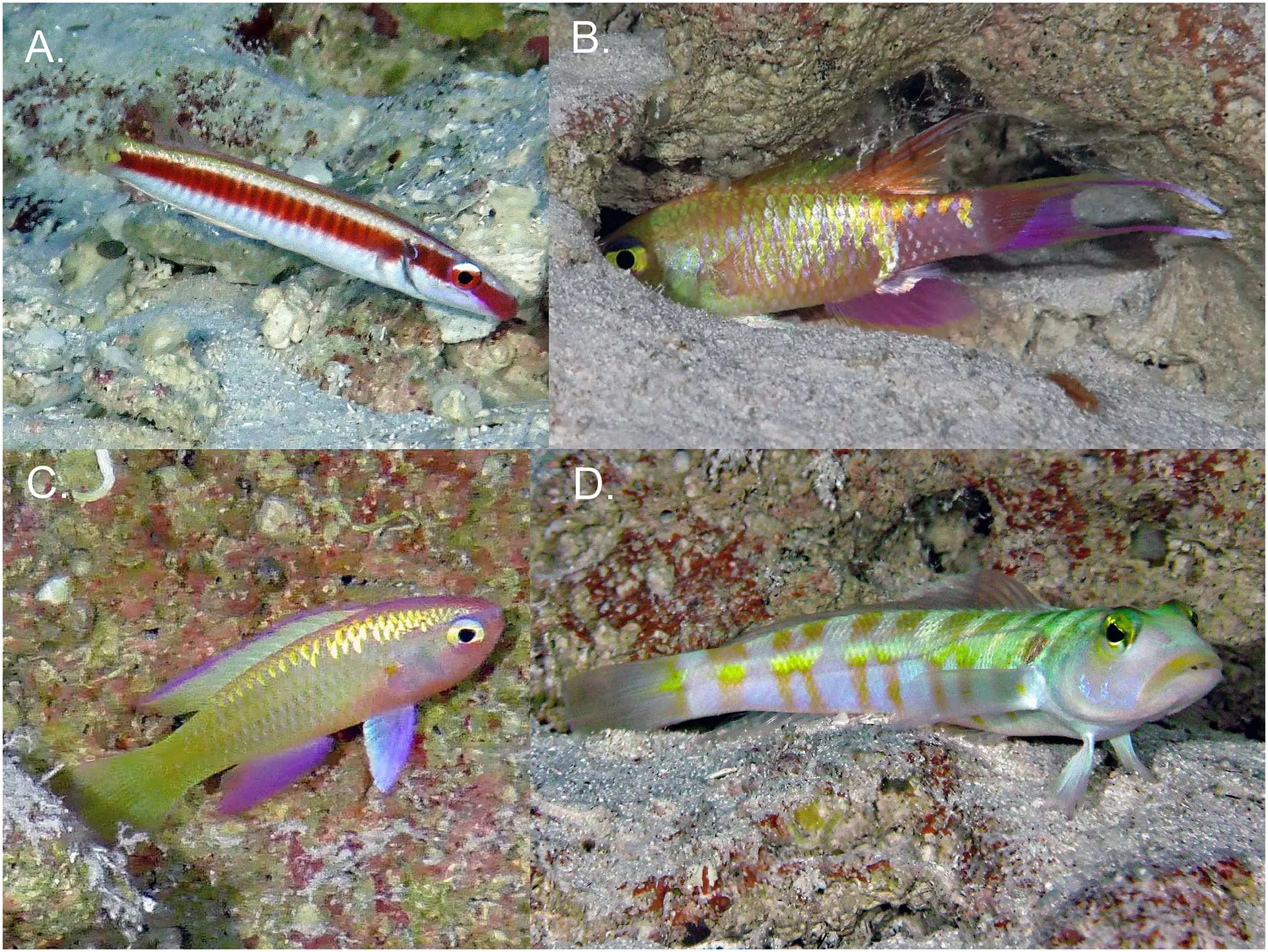
Of the 138 fish taxa recorded from the submersible, 14 appear not to have been recorded from the Marshall Islands, based on previous regional records. The main image shows such fish together with a provisionally identified one (a Parapercis species, bottom right). In addition, two fish could only be provisionally identified and one could not be assigned to a family, and the paper says all of them need to be confirmed by examining specimens and by genetic analysis.
Deeper still, the fish drawn to the bait changed markedly with depth. Snake eels and snake mackerels stood out at shallower and intermediate levels and grenadiers and hagfishes in the deeper layers, with sharks such as cow sharks (Hexanchidae) appearing at intermediate to deeper depths. Depth best explained the differences between deep-sea fish assemblages; once depth and atoll were accounted for, substrate type and relief added little and were not significant.
Why do two nearby atolls differ?
The two atolls share many features but differ considerably. Bokak is rich in coral, and fish biomass on its outer reef slopes was 445.0 g per m² in shallow water and 378.2 g in deeper water. At Bikar the figures were 210.0 g and 218.1 g, about 46% of Bokak in the model estimate. Shark biomass was also about 2.4 times higher at Bokak.
Bikar, on the other hand, had more seaweed and crustose coralline algae, and hard coral cover averaged about 20%. On land, mature forests of the tree Pisonia grandis covered Bikar, and sea turtle nesting was concentrated almost entirely there.
The paper did not test the reasons for the differences. Bokak is the larger, more elongated atoll, and its lagoon (about 78 km²) is roughly twice the size of Bikar's (about 37 km²). The paper mentions that such differences in shape could affect water exchange and wave exposure, but notes that water temperature, currents and similar factors were not measured. In the news release, Friedlander suggests that chance also plays a part.
There is also a bit of a lottery involved as to which species show up and persist at remote locations
— Alan Friedlander (University of Hawai'i, lead author of the paper)
Where do the news release and the paper differ?
The news release can be read as saying that 15 breeding seabird colonies were found, but the paper says: "Of the 17 seabird species observed during land surveys, 15 were confirmed or likely to be breeding". The 15 refers to species, not colonies.
The release also says that "two might be species new to science". What the paper shows is that two fish were provisionally identified to genus and one could not be assigned to a family, a stage at which specimens and genetic analysis are needed to check whether they are new species. The paper itself does use the phrase "undescribed taxa" in its summary of the deep surveys. The release also states flatly that 14 groups have not been recorded before and calls the 79 camera taxa deep-sea fishes, whereas the paper says the 14 appear to be new records and describes the 79 as vertebrate taxa.
The release headline speaks of ecosystems untouched by humans. The paper, by contrast, stresses that it does not use "relatively intact" to mean "pristine". Remoteness reduces direct human influence, but it cannot shield the atolls from introduced rats or from global pressures such as coral bleaching driven by climate change.
What remains unknown?
The paper describes the two atolls as seen in a single survey in 2023. Links between land and sea, and between shallow and deep water, such as nutrients from seabird droppings feeding reefs, are known from studies of other islands, but they were not measured here. Whether the differences between the atolls come from their shape, their history or chance is also unknown.
Submersible dives were not standardised in duration or route, so they were treated as records of occurrence rather than used to compare abundance. Coral bleaching history and resilience were not studied either, and the paper presents its work as a baseline for measuring future change.