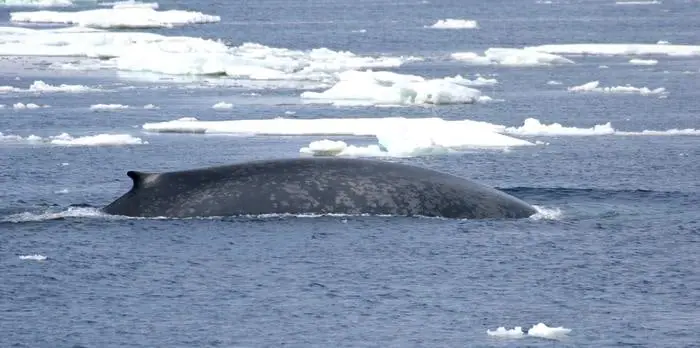
Antarctic blue whales (subspecies Balaenoptera musculus intermedia), whose numbers collapsed under 20th-century commercial whaling, grew from an estimated 418 animals in 1973, the year of the last reported catch, to an estimated 4,018 in 2024. A team led by the University of Washington published the study in Endangered Species Research on 5 November 2026. Their numbers are still only 1.9% of pre-whaling levels, however, and the paper's abstract expects a return to pre-whaling abundance to take more than a century.
How many Antarctic blue whales are there now, by the new estimate?
The team's model puts the 2024 population in the Southern Ocean at 4,018 blue whales. The news release describes the whales as seemingly on a slow way back from near extinction after five decades of protection. Every figure comes with a range, and the table below gathers the 95% credible intervals from the paper's abstract, which the release does not give.
| Item | Estimate | 95% credible interval (paper's abstract) |
|---|---|---|
| Carrying capacity (assumed pre-whaling number) | 205,905 | 168,473–276,342 |
| Number in 1973 (last reported catch) | 418 | 147–1,099 |
| 1973 number as share of pre-whaling | 0.20% | 0.08–0.42% |
| Number in 2024 | 4,018 | 1,874–8,395 |
| 2024 number as share of pre-whaling | 1.9% | 0.7–4.8% |
| Intrinsic rate of increase (per year) | 4.5% | 1.6–7.3% |
The 2024 figure of 4,018 ranges from 1,874 to 8,395, but even at the upper end of the 95% credible interval the population is only 4.8% of its pre-whaling size. Because pre-whaling numbers cannot be counted directly, this comparison treats the model's carrying capacity as the pre-whaling number, and the 4.5% annual increase is likewise the intrinsic rate of increase estimated by the model.
How severe was the decline to an estimated 418 in 1973?
The estimated 418 whales left in 1973 were 0.20% of the pre-whaling number. The news release puts the loss caused by whaling at 99.8%. The International Whaling Commission (IWC) banned their capture in 1964, yet Soviet fleets kept hunting them illegally for a further decade, and by the time that stopped the subspecies had very nearly been lost.
Antarctic blue whales are the largest animals known on Earth, and a single whale can exceed about 181 tonnes (400,000 pounds). Their oil made them highly lucrative, and they were the main target of 20th-century commercial whaling. Lead author Zoe Rand, a postdoctoral scholar in the University of Washington's School of Marine and Environmental Affairs, stresses how intense the hunting was.
No whale was hunted quite to the extent that Antarctic blue whales were hunted.
— Zoe Rand (University of Washington, lead author of the paper)
What data went into the estimate?
The team estimated how numbers changed from 1904 to 2024 in a single model, using three kinds of data. The paper's abstract describes the work as the first population assessment in more than 20 years.
- 20th-century catch records, including newly available information
- Estimates from line-transect surveys, in which a ship travels along a set line and records whales sighted and their distance (including data from three IWC surveys of the whole Southern Ocean in 1978–1984, 1985–1991 and 1991–2004)
- A capture-recapture estimate based on photo identification, which tells individuals apart from photographs
The most recent circumpolar abundance estimate is based on those three IWC surveys. Since then, few line-transect surveys have been carried out. The release notes that both photo identification and line-transect surveys have shortcomings and are costly. Although Antarctic blue whales are big enough to be seen from space, they surface only briefly, which makes accurate counts hard. According to the abstract, changing model assumptions and data sources barely altered the estimates.
How long will a return to pre-whaling numbers take?
The paper's abstract concludes that the population has kept growing since whaling ended, but that getting back to pre-whaling abundance will take more than a century. The release gives two reasons for the slow recovery: the collapse was so deep that only 1.9% of the original number remains, and the whales reproduce slowly, living long and having a single calf only once every two to three years.
I think it's probably an open question whether they will make it back to pre-whaling levels.
— Zoe Rand (University of Washington)
Rand also considers the current growth fairly realistic for this animal. Antarctic blue whales remain listed as Critically Endangered (CR) on the IUCN Red List, and how they will cope with environmental change is unknown. The release argues that only continued counting can show whether the whales are recovering or coming under new strain. Rand hopes passive acoustic monitoring, which estimates density from recordings of whale song, will help, but no one has yet worked out how to derive a total count from such recordings.
How are whale numbers linked to the deep sea?
Rand sees Antarctic blue whales as animals that shape their ecosystem. When one dies, its huge body sinks thousands of feet (even 2,000 feet is about 610 m) to the seafloor and feeds a whole community of animals there. This process, known as whale fall, recycles nutrients on a large scale and may help lock away carbon.
There is an argument that people bear some moral duty to undo the damage done by whaling, but the release says that is not the only reason to want the whales back. In our view, more whales at the surface also means more food reaching the deep seafloor.
The paper's eight authors are affiliated as follows, and the study was funded by the U.S. National Oceanic and Atmospheric Administration (NOAA).
- University of Washington: Zoe R. Rand, Professor Trevor A. Branch
- NOAA: Paula A. Olson, Douglas Kinzey
- Australian Marine Mammal Centre: Michael C. Double, Brian S. Miller
- Institute of Cetacean Research (Japan): Koji Matsuoka
- University of Pretoria, South Africa: Ken Findlay
We were able to read the University of Washington's news release and the paper's abstract. Because we could not read the full paper, this article cannot show details such as the breakdown of catch records used or the years covered by the photo-identification estimate.