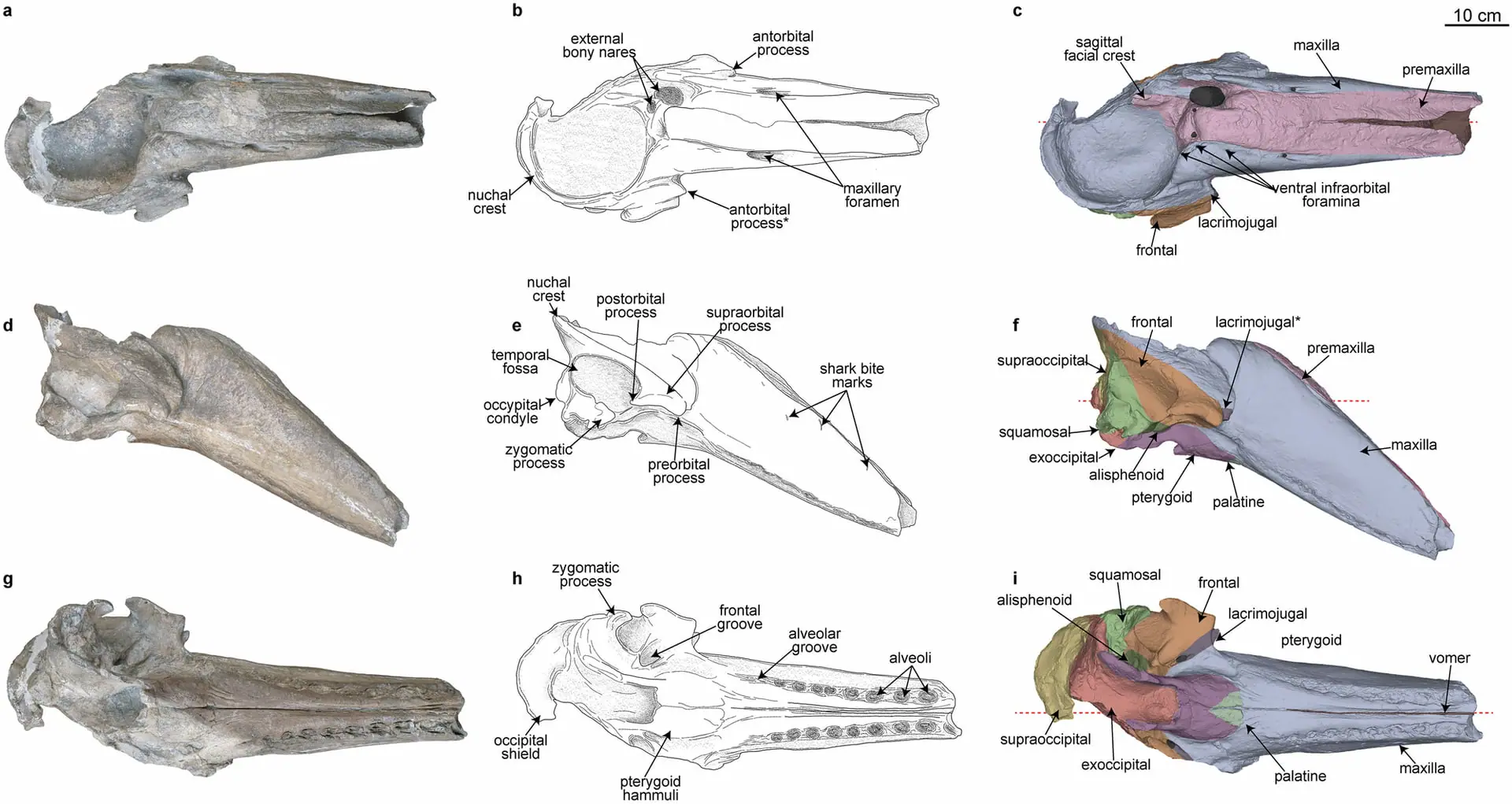
A whale skull found in 6.3 to 5.6 million-year-old rocks in southern Peru belongs to a new species of pygmy sperm whale (family Kogiidae), Scaphokogia huachafo. Both of its bony nostrils are shifted to the left of the skull's midline. An international team including researchers from the University of Zurich reported in Communications Biology on 9 November 2026 that the facial asymmetry of this genus is the greatest among the cetaceans compared, and possibly among all mammals.
What was found in Peru?
The specimen on which the new species is based (the holotype) is skull MUSM 972, held by the Museum of Natural History (National University of San Marcos) in Lima. The animal is estimated to have been about 2.7 m long. The skull is nearly complete apart from part of its left side, and its fully closed sutures show that it belonged to a mature adult.
Eight large tooth sockets (alveoli) are clearly visible on the underside of the upper jaw, but they are filled with spongy bone. The paper suggests the animal may have had teeth when young that were later lost or reabsorbed. In adults of the other species of the genus, most of the sockets are replaced by a continuous groove.
The skull comes from Aguada de Lomas in the Sacaco basin, Arequipa, southern Peru. The layers belong to the Pisco Formation and were laid down 6.3 to 5.6 million years ago, when a shallow sea spread over the land. According to the news release, the skull was dug up in the mid-1990s; lead author Aldo Benites-Palomino first saw it in 2015 and later studied it in detail for his doctorate at the University of Zurich.
The species name huachafo is a word used in Peru to mean "bizarre", "odd" or "extravagant", and the paper explains that it highlights the distinctive features of the skull.
How crooked is the face of Scaphokogia huachafo?
The skulls of most toothed whales are asymmetric. This asymmetry is linked to the development of fatty organs in the forehead used to produce sound, and it is especially large in sperm whales. In S. huachafo, the asymmetry extends beyond the area around the nostrils to the surrounding cranial structures.
The skull looks completely crooked
— Aldo Benites-Palomino (doctoral research at the University of Zurich, now at Friedrich-Alexander-Universität Erlangen-Nürnberg)
The left nostril is much larger than the right, and the notches and projections of bone in front of the eye sockets also differ in shape between the two sides. The team ruled out distortion by the weight of the sediment, because there is no deformation elsewhere on the skull.
The researchers placed 37 landmark points on the facial region of the skulls of 31 toothed-whale taxa (11 sperm whales, 4 early toothed whales and 16 other toothed whales) and compared how the bones are arranged. In this analysis, S. huachafo occupies the most extreme position within Kogiidae. It also stays at an extreme position in an analysis that takes evolutionary relationships into account, showing how novel its shape is.
In an analysis comparing only the left and right premaxillae (one of the upper-jaw bones), however, the most extreme taxon was the smallest species of the genus, S. totajpe. Even in this analysis, Scaphokogia stands out clearly as the most asymmetric genus among the cetaceans compared.
Why do researchers think it fed on the seafloor?
The clues are a heavy, downward-pointing snout (rostrum) and the range of motion of the neck joint. The paper sees these as consistent with searching for food on the seafloor.
In all species of Scaphokogia, the snout bends down from the skull axis, by an angle that differs between species.
| Species | Downward angle of the snout |
|---|---|
| S. cochlearis | About 16 to 21° |
| S. totajpe | 27° |
| S. huachafo (new species) | 31° |
The snout of S. huachafo is a thick tube made of dense, thickened bone and cartilage that had turned to bone. The heavy snout probably shifted the animal's centre of gravity forward. Increased bone mass is seen in marine mammals that actively feed on the seafloor, such as sea cows and walruses, and the paper explains that it gives better control of buoyancy in the water.
The movement of the neck was reconstructed from another specimen of the same genus, MUSM 171, which preserves the first neck vertebra (atlas). With the neck bent fully upward, the snout still pointed 22° below the body axis, and with it bent fully downward the angle reached 55°. The paper says this suggests that the snout always pointed downward.
The entire cranio-cervical complex is modified to point the snout directly toward the bottom
— Gabriel Aguirre-Fernández (University of Zurich, co-author of the study)
Most marine mammals that feed on the seafloor use their eyes or special structures around the mouth. Because Scaphokogia appears to lack special structures around the mouth, the team proposes that it evolved its own echolocation adaptations (sensing surroundings from the echoes of sounds) to find prey in soft sediment. The sound-producing organs are not preserved, so this is an inference from the bones.
How did it differ from today's deep-hunting sperm whales?
Living sperm whales are specialists that suck in cephalopods in the deep ocean. S. huachafo, a member of the same group, probably looked for food on the floor of a shallow coastal sea instead.
| Living sperm whales | S. huachafo (about 6.3 to 5.6 million years ago) | |
|---|---|---|
| Where they feed | Deep ocean | Floor of a shallow coastal sea (inferred) |
| How they feed | Suck in cephalopods at great depths | Probably searched for food on the seafloor |
| Living species | Sperm whale, genus Kogia | Extinct |
The Pisco Formation has also yielded other whales thought to have fed on the seafloor, such as Odobenocetops, a dolphin relative with a walrus-like face. In the paper's view, this area in the Late Miocene was rich in seafloor invertebrates and environmentally stable. That is thought to have allowed several kinds of seafloor-feeding specialists to live there. The paper says this stability lasted until the Pliocene, so S. huachafo lived shortly before the final turnover of marine life; the news release says this niche disappeared at the end of the Miocene.
The neck-joint analysis used data on the range of motion of the neck joint in cetaceans published in 2020 in the Journal of Anatomy by researchers at Nagoya University (Okamura and Fujiwara, affiliation according to Crossref). The team added Scaphokogia to this dataset and compared 31 species, including the living pygmy sperm whale (Kogia breviceps) and the sperm whale.
What remains unknown?
The new species is based on a single skull, and the neck movement was estimated from another specimen of the same genus. Soft tissues such as the sound-producing organs are not preserved, so the idea that the animal probed the seafloor with echolocation remains an inference.
Statistical support also varies. A MANOVA test strongly supported a clear phylogenetic signal in the arrangement of the facial bones (p = 0.001). A test of group differences in the comparison that takes evolutionary relationships into account gave p = 0.076. The paper calls this "marginal statistical significance" while noting that group membership explains a substantial share of shape variation (R² = 0.224). The paper itself also states the "among mammals" claim only as a possibility.