Mud taken from the seafloor 5,200 m deep in the Brazil Basin of the South Atlantic contains 323 to 629 µg of rare earths (rare earth elements and yttrium) per gram. A paper by Evgeniya D. Berezhnaya and six colleagues at the Shirshov Institute of Oceanology of the Russian Academy of Sciences was published in Frontiers in Marine Science on 9 November 2026. The paper attributes the lower rare earth content of Atlantic mud compared with western Pacific mud to differences in how fast mud builds up, arguing that the time fish bones and teeth spend taking up rare earths on the seafloor controls how rich the mud becomes.
What did the Brazil Basin mud reveal?
The team studied a 128 cm core taken during the 18th cruise of the research vessel Akademik Sergey Vavilov. The sampling site, station 1538 (15°52.9′ S, 24°04.6′ W), lies in the central part of a north–south line of eight stations within the Brazil Basin. A depth of 5,200 m is about 8.2 times the height of the Tokyo Skytree.
The mud is brown to dark brown pelagic clay, 91 to 97% clay minerals, with no microfossils. It contains 1 to 5% micronodules (small grains made of iron and manganese oxides), and a manganese nodule about 1.8 cm long also came up from a depth of 45 cm in the core.
Rare earth contents rise with depth, from 323 µg/g at the surface to 629 µg/g in the deeper layers. Because µg/g is the same unit as ppm, 629 µg/g works out to about 629 g of rare earths per tonne of mud.
Where in the mud are the rare earths?
The largest host of rare earths is the fraction that dissolves as phosphate when the mud is treated with chemicals. The team dissolved the mud step by step with four chemical treatments, separating phosphate, iron and manganese oxides, and a residue of clay and other minerals, and measured the rare earths in each.
| Fraction of the mud | Share of rare earths (average) |
|---|---|
| Fraction dissolving as phosphate (fish bones and teeth, plus adsorbed rare earths) | About 62% (54 to 72%) |
| Iron and manganese oxides | About 24% |
| Clay and other residue | About 14% |
The rise with depth comes from the phosphate fraction, whose rare earth content grows from 173 µg/g at the surface to 395 µg/g in the deeper layers. The rare earths held in the oxide fraction (79 to 100 µg/g) and the clay fraction (47 to 65 µg/g) barely change with depth.
What stands out is what the phosphate fraction contains. It released about an order of magnitude more rare earths than could be explained by dissolving fish teeth picked out of the same mud. The paper suggests that rare earths adsorbed on particle surfaces make up most of the difference. Earlier studies treated the adsorbed share as negligible, but the paper writes that in Atlantic mud it may be significant. There is not yet a method to measure the adsorbed share on its own, and the paper lists this as work still to be done.
Why is Atlantic mud poorer than western Pacific mud?
The paper attributes the lower values to mud building up faster than in the western Pacific. Rates measured earlier at two other sites in the Brazil Basin were no more than 4 mm and about 13 mm per 1,000 years (the latter for the Late Oligocene). The paper calls these extremely low, but they are still faster than the rate of less than 1 mm in the western Pacific. On a slowly accumulating seafloor, fish bones and teeth stay exposed for a long time to pore water rich in rare earths and take up a lot of them. In the Brazil Basin, where mud builds up faster than in the western Pacific, bones and teeth are diluted by material from land and have less time to take up rare earths, the paper explains.
Even at the same phosphorus content, Brazil Basin mud contained fewer rare earths than western Pacific mud. From this, the paper infers that the rate of sedimentation matters, not just the amount of phosphate. It also considers the higher values deeper in the core likely to reflect slower mud accumulation in the past. The values the paper cites for different regions are as follows.
| Region | Rare earth content (µg/g) |
|---|---|
| Western Pacific | Up to about 8,000 |
| Central and South-East Pacific | About 400 to 2,200 |
| Brazil Basin (this study) | 323 to 629 |
| Canary Basin (Atlantic) | Up to 513 |
| Angola Basin (Atlantic) | Up to 379 (average 115 or less) |
| Cape Basin (Atlantic) | Up to 170 |
The Brazil Basin is among the richest areas in the Atlantic, but it still falls far short of the richest Pacific mud. The paper notes that no rare-earth-rich sediments have formed in the Atlantic even in basins with slow sedimentation.
Where was the platinum?
Platinum was concentrated in the oxides. The mud itself held 8.5 to 11.3 ng of platinum per gram, but micronodules picked out of the mud reached 157 ng/g near the surface and 299 ng/g at 100 to 110 cm depth. That is higher than a manganese nodule from the same site (255 ng/g) and an iron–manganese crust from the same site measured in an earlier study (184 ng/g).
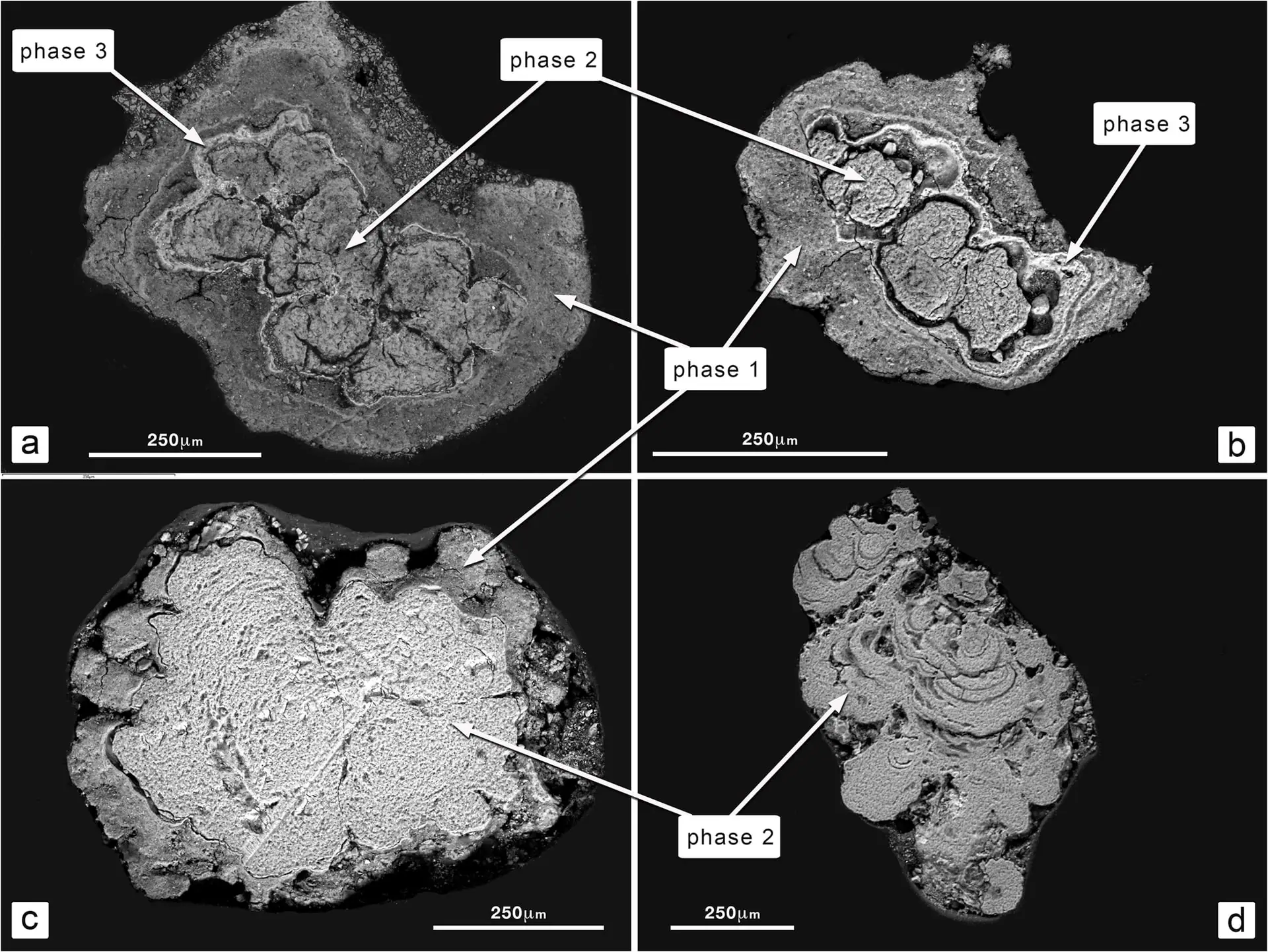
The paper suggests platinum builds up in the grains because, when the scattered iron and manganese oxides in the mud gather into grains, the platinum attached to them gathers too. Under the electron microscope, many of the grains show layers deposited directly from seawater alongside layers formed by chemical changes within the mud. The platinum-to-manganese ratio of the oxide fraction is almost the same as in an iron–manganese crust formed directly from seawater. Palladium, another platinum-group element, appears to stay in the clay residue and behaves differently from platinum.
Micronodules from the Clarion-Clipperton Zone (CCZ) in the Pacific average 60 ng/g of platinum, far less than in the Brazil Basin. The paper attributes this to differences in oxygen conditions in the mud when the grains formed.
How does it compare with the rare-earth mud near Minamitorishima?
The seafloor around Minamitorishima, in Japan's exclusive economic zone (EEZ), holds some of the richest rare-earth mud in the Pacific. In 2013, the Japan Agency for Marine-Earth Science and Technology (JAMSTEC) and the University of Tokyo reported mud with more than 6,500 ppm about 3 m below the seafloor at 5,600 to 5,800 m depth. That is more than ten times the highest value in the Brazil Basin core, 629 µg/g.
| Around Minamitorishima (JAMSTEC and University of Tokyo, 2013) | Brazil Basin (this study) | |
|---|---|---|
| Water depth | 5,600 to 5,800 m | 5,200 m |
| Highest content | Over 6,500 ppm | 629 µg/g (ppm) |
| Position of rich layers | About 3 m below the seafloor, among others | Deeper part of the 128 cm core |
In January and February 2026, as a test under Japan's Cross-ministerial Strategic Innovation Promotion Program (SIP), the deep-sea drilling vessel Chikyu lifted rare-earth mud continuously from below the seafloor at a pipe length of 5,569 m off Minamitorishima and recovered about 50 tonnes. A full-scale mining test in the same area is planned from February 2027.
The new paper compares Brazil Basin mud with western Pacific mud and does not discuss the Minamitorishima mud itself. JAMSTEC's 2013 announcement suggested, as one reason why the richest layers (over 5,000 ppm) appear in the top 1 to 2 m of the rare-earth mud, that minerals formed by chemical changes in the mud may have captured rare earths.
What remains unknown?
The paper analysed a single 128 cm core from one site in the Brazil Basin. It is therefore not known how far the range of contents and the platinum values apply to the basin as a whole. As noted above, the adsorbed share has not been measured directly. The sedimentation rates used were measured earlier at other sites in the same basin, not at station 1538 itself.