A dataset that gathers 368 records of polychaetes, the bristle worms, from deep-sea hydrothermal vents, cold seeps, whale carcasses and similar places into a single list has been published, drawn from 161 publications that appeared between 1957 and 2026. Three researchers from the Institute of Oceanology of the Chinese Academy of Sciences in Qingdao and partner institutions described it in Biodiversity Data Journal on 27 October 2026. Hydrothermal vents account for the most records, 189, with 69 from whale falls and even 7 from cow carcasses. According to the paper, no global dataset focused on polychaetes of these habitats, with each name and habitat checked line by line and linked to its source, had existed until now.
What are deep-sea chemosynthetic and reducing habitats?
Hydrothermal vents and cold seeps sustain chemosynthesis based on sulphide, methane, hydrogen and other compounds, while sunken whales and wood create reducing conditions as they decompose and can support chemosynthesis-associated communities at certain stages. The paper groups these places, which differ in origin and lifespan, as "deep-sea chemosynthetic and reducing habitats" and names polychaetes as one of the most important groups of seafloor animals there.
Yet the records of these worms were scattered across species descriptions, regional surveys, handbooks and reviews. The same species may appear under different genus names in different papers, or later turn out to be the same as another species, which made it hard to compare or reuse global records, the paper explains.
What does the polychaete checklist contain?
The 368 records span 6 orders, 29 families and 123 genera. Of these, 364 were confirmed as valid names in WoRMS (World Register of Marine Species), the global register of marine species names, and 363 are used in the core statistics. Counting all 368 records by habitat gives the table below.
| Habitat | Records |
|---|---|
| Hydrothermal vents | 189 |
| Cold seeps | 89 |
| Whale falls | 69 |
| Wood falls | 21 |
| Methane seeps | 15 |
| Cow falls | 7 |
| Other organic falls | 4 |
| Reducing sediments | 4 |
| Experimental substrates | 2 |
| Uncertain | 1 |
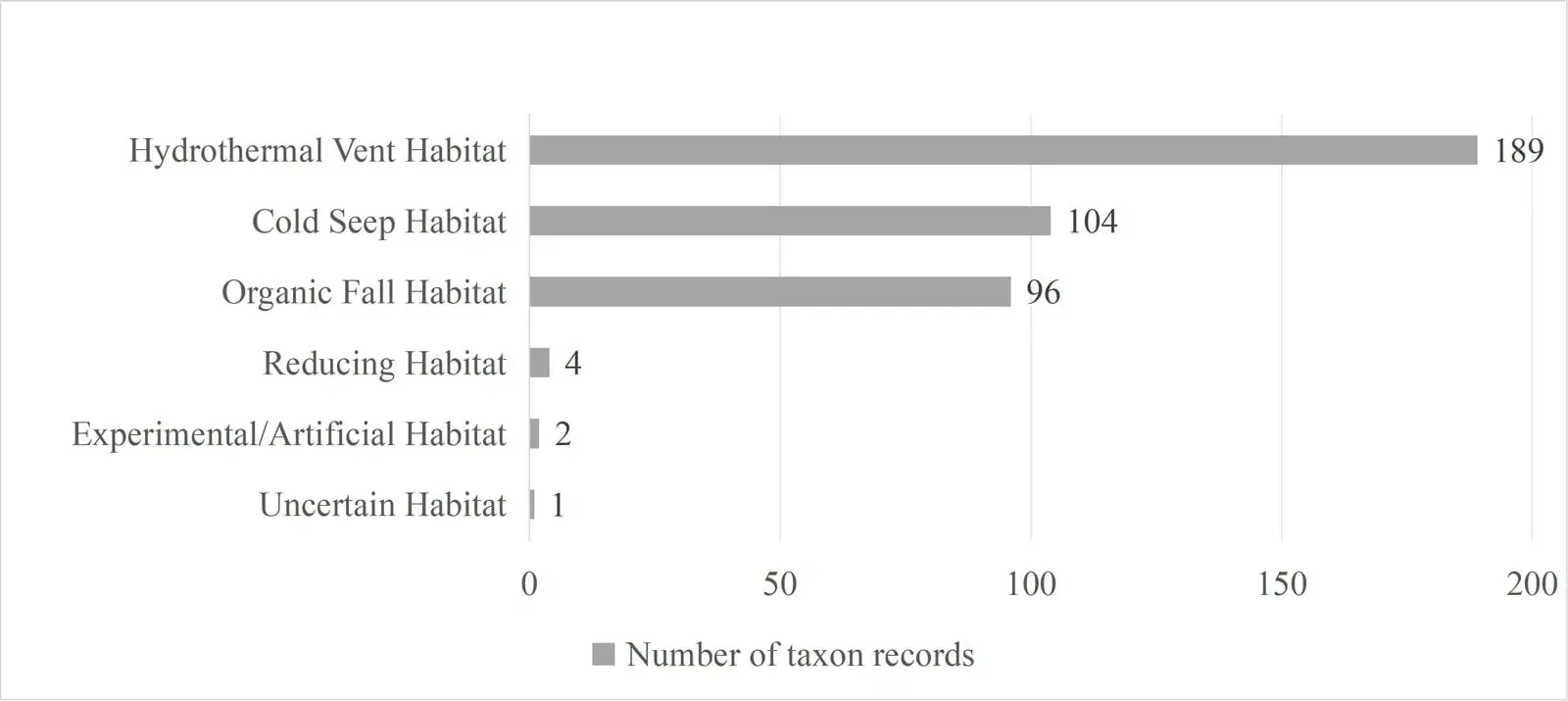
A taxon reported from both vents and seeps is counted in both, so the total exceeds 368. The numbers are taxa reported from each habitat, not a measure of how abundant they are there. Fig. 1, the main image, groups cold seeps and methane seeps into a category with 104 records and whale, wood, cow and other organic falls into one with 96 (within a category, each taxon is counted once).
By family, Polynoidae has the most records, 70, followed by Dorvilleidae with 54, Hesionidae with 42 and Siboglinidae with 38 (Fig. 2 of the paper). Alvinellidae has 13.
How were the 368 records gathered?
The team searched mainly in the Web of Science literature database. They also used Google Scholar, the Biodiversity Heritage Library and publishers' websites, and followed the reference lists of key papers. The final search was on 19 August 2026. Of the authors, Yu Li compiled the records and Xuwen Wu checked the taxonomy and habitat assignments. Disagreements were settled by returning to the original literature.
The checklist includes only polychaetes that literature shows were found in, or are stably associated with, vents, seeps, whale falls and similar habitats. Records known only from shallow water or ordinary deep seafloor, records whose sources cannot be traced and duplicates adding no new information were left out. 12 records carry a flag indicating that they may include undescribed or cryptic species, but these possible extra species are not added to the species count.
How does research in Japanese waters fit in?
By period, 8 of the 161 source publications appeared before 1980 and 28 between 1980 and 1999, with the rest from 2000 onwards. The paper explains that research expanded after hydrothermal vents were discovered in 1977.
Research in Japanese waters is part of this story. The sources include Miura and Hashimoto's 1991 paper describing a maldanid polychaete (Maldanidae) from cold seeps in Sagami Bay. In 1996 the same authors reported polychaetes of Nautiliniellidae (now treated under Chrysopetalidae) from cold seeps and hydrothermal vents in the Okinawa Trough and other sites around Japan. A 2026 paper describing Amphisamytha from the Okinawa Trough has also been added. Among the regions covered by literature from 1980 to 1999, the paper lists the western Pacific, including Japan and the Okinawa Trough, alongside the eastern Pacific and the Atlantic.
What can and cannot the checklist be used for?
Each row of the checklist is a taxon, not a station, sampling event or individual. It can therefore be used to summarise the polychaete fauna of the world or a region, or to compare taxonomic composition between habitats. Coordinates, depths, sampling dates and abundances, however, are not systematically included. The paper states plainly that it is not suited to fine-scale distribution modelling, station-level community analysis or species-richness estimates corrected for sampling effort.
The data are published on the Zenodo research data repository under CC BY 4.0 and are linked to WoRMS identifiers and source publications. Besides the main table of taxa, the package includes files with references, a habitat vocabulary, a field dictionary and taxonomic notes, plus a spreadsheet version. Habitat names are standardised to 10 controlled terms such as "hydrothermal vent", "cold seep" and "whale fall", and the original wording from the literature is kept in a separate field. The version now released is 1.0.1, and future versions may add new species and overlooked literature.
Because the checklist relies on published literature, the paper notes as a limitation that search coverage, the digitisation of older literature and language accessibility may have left records out. Whether the records from Japanese waters, which already include work from Sagami Bay and the Okinawa Trough, will grow as the checklist is updated remains to be seen.