The Clarion–Clipperton Zone (CCZ) in the central Pacific has 13 protected areas, known as APEIs, set aside to shield marine life from deep-sea mining. A team including researchers from Plymouth Marine Laboratory in the UK reported model results in Nature Ecology & Evolution on 23 October 2026 suggesting that these protected areas are barely connected by the larvae of seafloor animals. Assuming larvae that drift with near-bed currents, fewer than 0.02% of particles leaving one protected area reached another. Because their calculations show this exchange rising 406-fold, the team proposes adding "corridor" areas between the protected areas.
What kind of protected area is an APEI?
APEIs are protected areas set up in the CCZ by the International Seabed Authority (ISA); the name stands for Areas of Particular Environmental Interest. The CCZ is about 6 million km² of seabed with metal-rich rocks called polymetallic nodules, and more than 1.1 million km² of it is already under exploration licence. The APEIs were placed to represent diverse habitats and buffer the effects of mining. An expansion in 2021 brought their combined area to nearly 2 million km².
Most CCZ animals are attached to the seabed or move only slowly, so what links their scattered populations is, in many cases, larvae carried by currents. According to the paper, however, connectivity between the protected areas was not a formal design criterion. Whether the protected areas function as a connected network had also not been assessed at the scale of the whole CCZ.
How was larval exchange estimated?
The team did not observe real larvae; they ran particles through an ocean current model. On the CCZ seabed, 4,000–5,000 m deep, there are almost no measurements of where deep-sea larvae swim or how long they drift. The team therefore released particles from 18,679 sites spaced 25 km apart, let them ride the currents 10 m above the seafloor computed by the HYCOM ocean circulation model, and recorded their positions after 19, 35 and 69 days. These durations are the lower quartile, median and upper quartile of pooled drift times of deep-sea and wide-depth-range species. To include seasonal and year-to-year variation, the calculations used the currents of January and July 2019 and 2023.
Each simulation released more than 68 million particles. Because it is not known where animals are most abundant, the team made the simple assumption that larvae leave every part of the seabed at the same rate. This assumption reveals every pathway the currents allow, but it does not reflect differences in habitat quality.
How well connected were the protected areas?
In the model, the protected areas were barely connected.
| Item | Result |
|---|---|
| Particles reaching another APEI | 0.018% |
| Particles staying in their APEI of origin | 79% |
| Particles settling outside the network | 21% |
| Direct APEI-to-APEI connections (one-way) | flow in only 5 of 156 |
| Median travel distance after 69 days | under 100 km |
| Median distance from failed dispersers to the nearest other APEI | 389 km |
All five connections with any flow were one-way, and three routes, APEI 5 to 8, 8 to 9 and 13 to 9, accounted for more than 99% of transfers. With APEIs hundreds of kilometres apart, near-bed currents alone can hardly bridge the gaps. Retention is counted on 100 km grid cells and is only a guide for comparison. Even so, APEIs 3 and 6, for example, retained 88% and 86% of their particles. The least retentive, APEI 13, still kept 60%.
Where would larvae come from once mining starts?
Before mining, larvae settling in areas of mining interest (AMIs in the paper, combining exploration and reserved areas) came 76% from the AMIs themselves. Unprotected areas supplied 19% and protected areas just 5%. Also before mining, the share of AMI cells receiving at least 1,000 particles from APEIs in total across all simulations (a screening threshold, not a biological one) was 71% for a 69-day drift but fell to 55% at 35 days and 41% at 19 days.
If mining stops the AMIs from releasing larvae, the remaining supply comes 19% from protected areas and 81% from unprotected areas. Replenishment would then depend more on areas that are neither protected nor mined than on the APEIs.
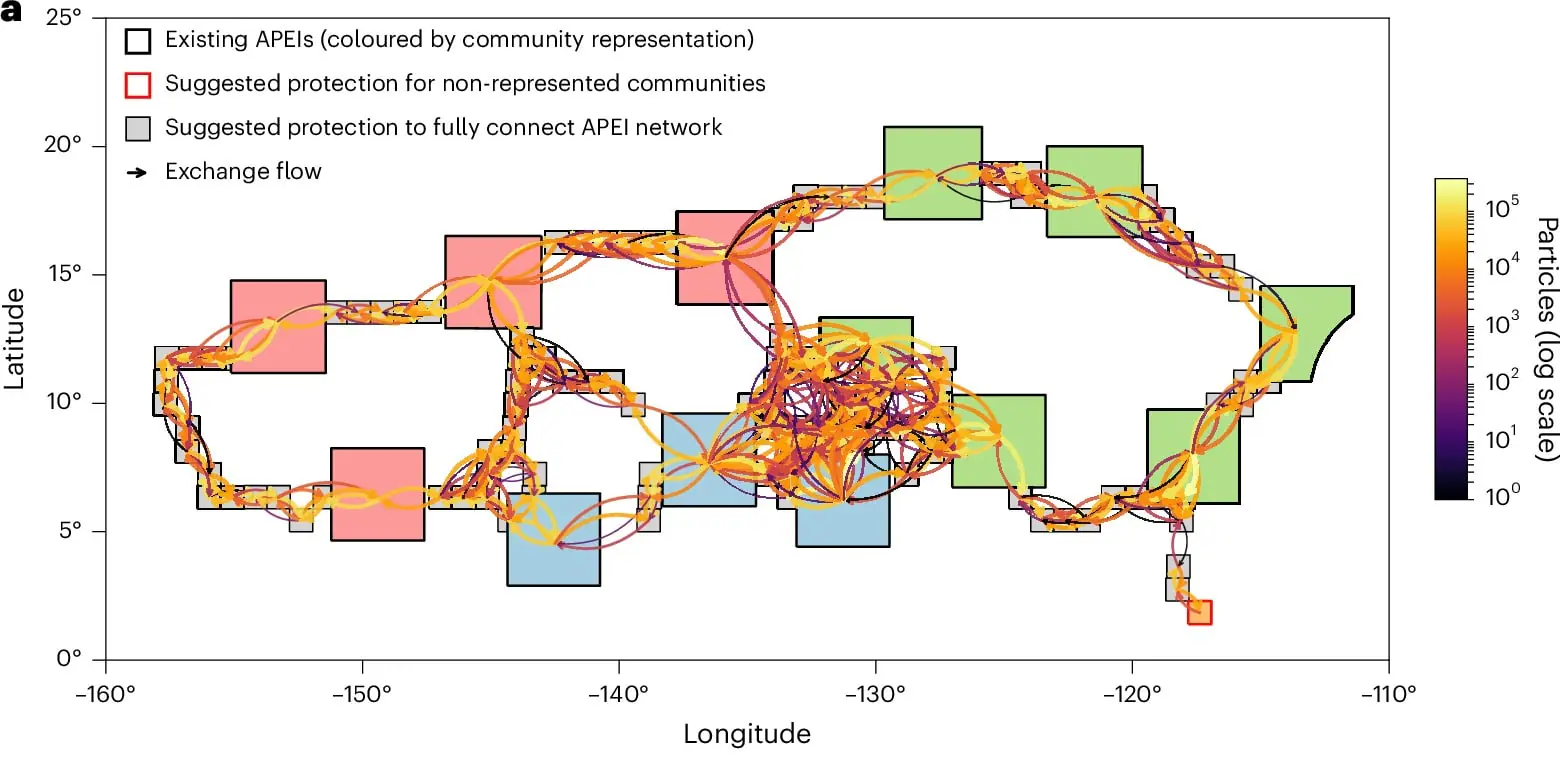
Network analysis of particle flows divided the CCZ into four semi-isolated communities, one of which contains no protected area at all. The largest, community 4, covers 36% of the analysed area, and if AMIs stop releasing larvae, its outward dispersal falls by 23% and its particle input by 24%. Of the top 10% of grid cells that act as hubs of exchange, 77% of the area lies outside existing APEIs.
What changes if corridors are added?
The team searched for a layout that connects the protected areas with as few additions as possible and identified 53 grid cells of 100 km by 100 km as candidate "corridors". They are the grey areas in the main image, linking existing APEIs like stepping stones.
Counting multi-step paths that use the corridors as stopovers, the share of particles reaching another protected area rose in the model from 1 in 5,556 to 1 in 14, a 406-fold increase. No new direct links appeared, but 151 indirect pathways via the corridors did. If AMIs stop releasing larvae, the protected network's share of the replenishment rises from 19% to 36%. All of these are figures from the model.
Of the 53 cells, 29 do not overlap AMIs. The other 24 partly do, and the overlap is 11% of the total corridor area. The paper presents the corridors as complements to, not substitutes for, large protected areas.
What can and cannot this model tell us?
The study shows whether the layout of the protected areas can be linked by currents, assuming larvae drift passively near the seabed. Whether exchange is enough to keep populations going cannot be answered with current data, the paper itself says. It also notes that the figures are relative values for comparison within the model, not to be judged against absolute demographic or genetic thresholds. The deep-sea currents come from the model, and there is not yet any check of them against observations on seabeds around 4,000 m deep. Because of the model's coarse resolution, connectivity between communities may be overestimated and local retention underestimated, the paper adds.
Upward swimming into faster currents is not in the model, so species that do this could travel by entirely different routes. The results apply most directly to species with drifting larvae; species with short or no larval drift cannot be evaluated, the paper says. Conversely, the risk that sediment plumes from mining could kill larvae is not included in the calculations, so the study calls its estimate of connectivity loss from mining conservative.
As next steps, the paper lists observations of near-bed currents in potential corridor zones, population genetic sampling across the boundaries of the four communities, and data on larval behaviour and drift times for CCZ animals. Knowing how far the larvae of animals with drifting larvae really travel would make it possible to draw the corridors with more confidence.