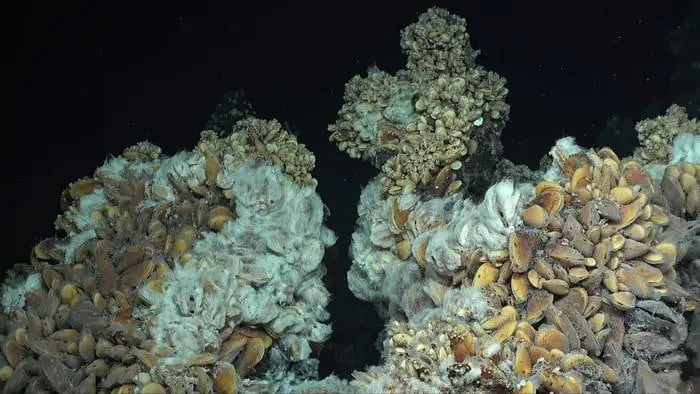
Cells taken from Bathymodiolus azoricus, a mussel that lives at hydrothermal vents on the Mid-Atlantic Ridge at depths such as 1,700 m, kept a roughly 24-hour rhythm of their own when grown in the lab, even though no sunlight or moonlight ever reaches the animal's home. A team from the University of Vienna, the French ocean research institute Ifremer and partner institutions reported the result in the journal EMBO Reports on 2 November 2026. Having kept the mussel cells alive for more than three years, the researchers can now study a deep-sea biological clock at the level of cells and genes.
Where does Bathymodiolus azoricus live?
Bathymodiolus azoricus is a mussel that crowds the seafloor around vent chimneys on the Mid-Atlantic Ridge. The University of Vienna release describes it as shaping the vent ecosystem; at 1,700 m the animals endure high pressure and are exposed to hot fluid rich in heavy metals.
That fluid is seawater that has seeped into the seafloor, passed through the rocks beneath and poured back out. Its direction of flow changes with the tides, which the release says is presumably why these mussels show tidal rhythms in both their behaviour and their molecular biology. How animals without a brain generate such rhythms had remained unclear.
Why study rhythms on a dark seafloor?
The deep sea, with no light, was long regarded as an exception where life has no rhythm. A 2020 paper in Nature Communications by Audrey Mat, first author of the new study, and colleagues gave the reason: below 1,000 m, sunlight is completely absent.
In that 2020 study, the mussels came from a structure called the Eiffel Tower in the Lucky Strike vent field, at 1,688 m depth. The remotely operated vehicle (ROV) Victor6000 collected them on 16 and 17 July 2017, with red filters on its lights to limit light contamination. When the team tracked gene activity through the day, rhythms close to the tidal period dominated, although a smaller set of transcripts also rose and fell on a near-daily cycle.
| 2020 study (mussels on site) | 2020 study (mussels in the lab) | 2026 study (cultured cells) | |
|---|---|---|---|
| Material | Mussels taken at 1,688 m in the Lucky Strike vent field | Mussels from the Menez Gwen vent field at 834 m | B. azoricus cells, cultured for more than three years |
| Conditions | Natural seafloor environment | Alternating 12 hours of light and 12 hours of dark | Constant conditions |
| Dominant rhythm | Tidal range (10.4–14.4 h): 7.4% of transcripts (2,502); daily range (20–24.8 h): 2.6% (869) | Daily range (20–24.8 h) at 7.5%, above 5.9% in the tidal range | A roughly 24-hour circadian rhythm |
Tidal rhythms on the seafloor and daily rhythms in the lab could not, on their own, tell the team whether the mussels were simply reacting to their surroundings or whether an internal clock was driving the cycles. The 2020 paper left both possibilities open.
What did cells grown in a fridge reveal?
The researchers established, for the first time, a way to culture cells from deep-sea mussels, then watched them under constant conditions with no external time cues. Although the cells came from an environment dominated by the tides, the isolated cells kept oscillating with a period of about 24 hours.
The cultures have now been running for more than three years. Lab cell cultures are usually kept at 25 to 37 °C, but these mussel cells grow in a fridge at deep-sea temperatures. Mat, who also started the experiments, put it this way:
While cells in the laboratory usually thrive at 25 to 37 °C, our mussel cells grow in the fridge, at deep-sea temperatures. This technical advance is unique in the world and allows novel insights into the biology of these animals.
— Audrey Mat (first author of the study)
A rhythm that persists in isolated cells shows that the cells have their own mechanism for a roughly 24-hour rhythm, even without external cues. Whether the tidal rhythm seen on the seafloor also arises inside the cells has not yet been tested. Because tidal rhythms dominate on the seafloor and daily rhythms in the lab, the release says this suggests considerable plasticity in the clock machinery.
Do the tidal clock and the daily clock work the same way?
The team suggests that a single internal clock may produce both the tidal and the daily rhythm, but this has not yet been confirmed. Deep-sea mussels carry the core circadian clock genes found in animals from flies to humans, but with modifications specific to the mussels.
The paper's abstract reports reporter assays using genomic regions upstream of the clock gene period that contain motifs known as E-boxes. The results suggest that a transcription–translation feedback loop (TTFL), in which gene transcription and translation repeatedly feed back on each other, contributes to circadian timing even in the deep sea.
On its own, the mussel's BazPeriod does not repress the transcription of clock genes, but it modulates BazCry2. Because BazPeriod itself rises and falls on a tidal cycle, the team thinks this may explain how one clock yields both tidal and daily rhythms. The release likewise says these mussel-specific modifications could let the clock switch between the 12.4-hour tidal cycle and the 24-hour circadian cycle, presumably through changes in the expression of the period gene.
What does this have to do with deep-sea mining?
The release notes that the deep sea is under considerable pressure from human exploitation, such as pending deep-sea mining. Kristin Tessmar-Raible and Marjolaine Matabos, who jointly coordinated the study, consider deep-sea clocks just as vulnerable as those on land:
The fact that these ecosystems are mechanistically highly complex and possess timing systems as sophisticated as those at the surface underlines how worthy of protection they are. On land, we know that human activities such as light or vibrations disrupt circadian clocks. Deep-sea clocks are very likely just as vulnerable, with significant consequences for organisms and ecosystems.
— Kristin Tessmar-Raible and Marjolaine Matabos (joint coordinators of the study)
The release's summary adds that mining could affect the timing of organisms and their ecosystem even from a great distance. What lives on the seafloor targeted by mining is the subject of our article on the tiny animals counted in the crevices of polymetallic nodules.
From the editors
The publisher's site blocked us with a verification page, so we could read only the abstract and the release. We were therefore unable to check where the mussels used for the cultures were collected, which tissue the cells came from, the culture temperature, or how many days the rhythms were recorded.
It also matters that the 24-hour rhythm was found in lab cells kept under constant conditions. As the 2020 study showed, the rhythm that dominates in mussels on the seafloor is tidal. Near-daily transcripts were found in mussels on the seafloor too, but these results alone do not tell us how far the cellular clock governs the animals' behaviour down there. For more on which animals live at vents, see our article on the Grimsey vent field north of Iceland.