Two small gobies collected at 30 m off Walih Island, Saudi Arabia, in the northern Red Sea have been described as a new species, Trimma charon. Viktor Nunes Peinemann of King Abdullah University of Science and Technology (KAUST) and colleagues published the description in the journal ZooKeys in September 2026. The name likens the golden spots scattered across its tail fin to the coins paid to Charon, the ferryman who carries the dead to the underworld in Greek mythology.
What kind of fish is Trimma charon?
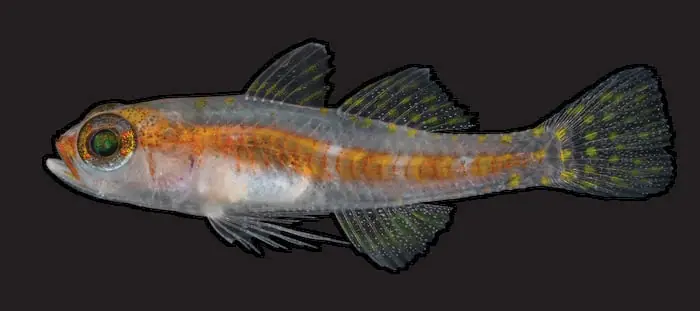
It is a member of the goby genus Trimma with a standard length (from snout tip to the base of the tail fin) of just 16.8 mm and 12.1 mm, a translucent body with a broad orange-red stripe along its side, and golden spots running from the tail fin onto the caudal peduncle (the narrow part just in front of it).
Trimma are small gobies that live close to the seabed; according to the paper, 117 species have been described, many with narrow habitat preferences, and new lineages confined to small areas as well as new species keep turning up as surveys continue.
| Feature | Trimma charon |
|---|---|
| Specimens | Two (holotype 16.8 mm, paratype 12.1 mm, both standard length) |
| Collection | 15 May 2023, Walih Island, northern Red Sea, 30 m |
| Habitat | Bottom of a cave entrance on a steep reef slope that drops below 100 m |
| Color | Translucent, with a broad orange-red stripe from the eye to the tail-fin base, interrupted by three narrow pale bars |
| Tail fin | Numerous golden spots, continuing onto the caudal peduncle |
| Eye | Iris divided into four unequal sectors: white above and below, orange in front and behind |
The news release describes this as "an unusual four-part eye", but reading the paper's description, it is not the eye itself that is divided; the iris is colored in four sectors of white and orange.
Peinemann and colleagues collected both fish on the same day at the same spot while scuba diving, using clove oil and hand nets, and the specimens are held at the Royal Ontario Museum (ROM).
Why was it named after Charon?
The paper explains the name by the golden spots on the tail fin, which look like the coins paid to Charon, and the news release adds a second idea: the fish may actually live mainly on dark, deep reefs.
Charon is the ferryman who carries the souls of the dead across the river to the underworld, and by tradition the dead were given a coin for the fare. Peinemann described the spots this way.
One of the most striking features of the new species is the golden spots scattered across its tail fin. They cover most of the fin and resemble small gold coins.
— Viktor Nunes Peinemann (King Abdullah University of Science and Technology)
According to the news release, the team suspects the species is more common on dimly lit reefs below 30 m, and Peinemann likens those little-studied, darker depths to an underworld lying below the bright, shallow reefs that people know far better. The paper suggests "Charon’s pygmygoby" as the English common name.
Why are only two fish known?
Thirty meters was the deepest the team could survey by diving, and the new species was found just once at that limit; searches of similar habitats since then have not turned up any more. Thirty meters is not the deep sea; it lies just above the reefs deeper than 30 m that the news release calls "mesophotic".
The paper suggests the species may be either genuinely rare, or 30 m marks the shallow edge of its range and it lives in greater numbers on deeper reefs. Large-scale fish collections using chemicals and DNA surveys of fish larvae have been carried out in the Red Sea, but the species did not appear in any of them, which the paper takes as further support for its rarity or its restriction to deeper, northern habitats. The paper also points out that most collections in the region have been limited to depths shallower than 30 m.
So far, the entire species is known from only a single encounter and two specimens.
— Viktor Nunes Peinemann (King Abdullah University of Science and Technology)
According to the paper, this is the second new Trimma found at 30 m in the Red Sea in the past five years; the first was Trimma berumeni, which the paper's field notes describe as living inside large caves. The team considers it likely that more species remain to be discovered at this depth and on deeper reefs.
How does it differ from the most similar species?
The most similar species is Trimma anaima, which ranges widely from East Africa to the Pacific; the two share features such as an orange-to-red stripe and unbranched pectoral-fin rays, but they can be told apart by the number of pectoral-fin rays, the color of the iris and the shape of the stripe. In life, their colors separate them at a glance.
| Feature | Trimma charon | Trimma anaima |
|---|---|---|
| Distribution | Northern Red Sea (two specimens only) | Comoros to Fiji; not recorded from the Red Sea |
| Pectoral-fin rays | 14 | 15–17 (usually 16) |
| Body stripe | About one-third of body depth wide, interrupted by three pale bars | Continuous, extending onto the lower part of the caudal peduncle |
| Tail fin | Distinct golden spots | None (sometimes on the upper and lower edges of the caudal peduncle) |
| Iris | Four sectors, white above and below, orange in front and behind | Uniformly bright red with a blue stripe on top |
Genetically, a 2025 study comparing COI (a mitochondrial gene) sequences from 93 described species found Trimma anaima to be the closest to the new species, with 85–86% identity. Modern coral reefs have existed in the Red Sea for only about 5.5 million years, and the paper calculates that if the new species is endemic to the Red Sea and the sister species of Trimma anaima, differences would have accumulated at a rate of at least about 3% per million years. However, the paper also raises the possibility that the new species is more widespread or is sister to an unsampled or now-extinct lineage, and says broader phylogenetic analyses are needed to determine which lineage is truly its sister.
Why does the Red Sea have so many endemic Trimma?
With this species, the Red Sea now has 11 Trimma species. The paper considers at least nine of them to be found only in the region, an endemism rate of more than 80%, far above the 19.3% for reef fishes in the Red Sea and Gulf of Aden as a whole and about 27% for Red Sea gobies.
The reason the paper gives is a lack of similar habitat outside the Red Sea: along most of the coasts of southern Oman and eastern Somalia, upwelling (deep water rising to the surface) limits coral reef development, and only two Trimma species are recorded from Oman and four from Socotra. For small, short-lived gobies that stay in one place, this barrier has probably helped cut Red Sea reefs off from the nearest comparable habitats in the western Indian Ocean. The paper also includes an identification key with photographs for all 11 species, along with notes on where and at what depths each lives.
The link with Japanese research, and what remains unknown
Following the identification key for the whole genus Trimma (Winterbottom, 2019), the new species ends up at the same branch as two species described in papers reporting new species from Japan and Palau, Trimma imaii and Trimma matsunoi. It is separated from them by the width of the bone between the eyes, 55–62% of the pupil diameter, between T. imaii (about 40%) and T. matsunoi (about 75%), and by the presence of the body stripe, which shows that species from those papers on Japan and Palau are among those it had to be compared with. For the blue staining used to examine the sensory organs on the head, the paper also cites a chapter in an identification guide to the fishes of Japan (1993, Tokai University Press).
On the other hand, with only two individuals known, how deep and how abundant the species is remains unknown, and its relationship with Trimma anaima awaits broader phylogenetic analyses. The key lies in surveys of reefs below 30 m, beyond the team's diving limit, and the news release quotes the team as saying that Red Sea reefs below that depth almost certainly hold more undiscovered gobies.