In the body wall of sea pigs (genus Scotoplanes) collected from the deep Northwest Pacific, a single bacterium made up 76.4–98.9% of the bacterial community. In a paper published on 11 November 2026 in the journal ISME Host Microbe, a multi-institutional Japanese team including the University of Tokyo proposed this bacterium as a new genus and species, "Candidatus Abyssoplasma scotoplanesicola". Its complete genome is only 649,000 bases long, and genes for proteins displayed on the cell surface take up 27.6% of it.
What was found in the body wall of sea pigs?
The team found a bacterium that lives in clusters on the epidermal side of the body wall, the layer that encases the sea cucumber's body. Like sea stars and other echinoderms, sea pigs host bacteria within the layers of their body wall, known as subcuticular bacteria. The paper's abstract notes that these bacteria are widespread among echinoderms, but that their diversity, metabolic properties and host associations remain poorly characterized.
| Item | What the study found |
|---|---|
| Host | 8 sea pigs (genus Scotoplanes) of 3 species from the deep Northwest Pacific |
| Name of the bacterium | "Candidatus Abyssoplasma scotoplanesicola" (proposed new genus and species) |
| Classification | Phylum Mycoplasmatota (which includes the mycoplasmas) |
| Share in the body wall | Over 70% of bacterial 16S rRNA gene sequences; 76.4–98.9% of the microbiome, depending on the specimen |
| Where it lives | Forms aggregates on the epidermal side of the body wall |
| Genome | Two high-quality genomes, one of them a complete circular genome of 649,000 bases |
Yu Yoshida, a Ph.D. student at the University of Tokyo's Graduate School of Frontier Sciences and a lead author, described the starting point of the research:
Taxonomic and genomic information about these body-wall inhabiting bacteria is scarce, and very few studies of deep-sea species have linked this information to the bacteria's location within host tissues.
— Yu Yoshida (Graduate School of Frontier Sciences, University of Tokyo)
What kind of bacterium is Abyssoplasma scotoplanesicola?
In short, it has given up many of the tools it would need to live on its own, and instead carries a large set of genes for decorating its cell surface. Its genome is 649,000 bases long; according to Yoshida, the genome of E. coli is about seven times larger.
The genome is not only small but also lopsided. Both genomes lacked some of the central metabolic pathways common in bacteria, including glycolysis, which breaks down sugar to release energy. The press release says the bacterium is thought to obtain much of what it needs from its host's tissues: amino acids, nucleic acid precursors, lipids and mineral nutrients.
The phylum it belongs to, Mycoplasmatota, includes the mycoplasmas, small bacteria without a cell wall, some of which cause disease in humans. Whether the new bacterium has a cell wall is not stated in the press release or the abstract. The new bacterium belongs to a lineage of symbionts associated with marine invertebrates, but it differs substantially from known types, which is why it was proposed as a new genus.
Why do the giant proteins stand out?
They stand out because, in a bacterium with such a trimmed-down genome, genes for cell-surface proteins still took up more than a quarter of the genome, which surprised the team. The share is 27.6% of the complete genome, and some of the proteins exceed 5,000 amino acids. Since bacterial proteins average about 300 amino acids, that is more than 15 times the average length.
| Feature | The new bacterium | For comparison |
|---|---|---|
| Genome size | 649,000 bases | E. coli's genome is about 7 times larger |
| Protein length | Some exceed 5,000 amino acids | Bacterial proteins average about 300 amino acids |
| Surface-protein genes | 27.6% of the genome | – |
The press release says these surface proteins, including the giant ones, may be used to interact with host tissues or to help the bacteria cluster together.
According to the paper's abstract, these surface proteins are acidic, and their genes lie clustered in the genome near defense islands, regions where defense-related genes are concentrated. When the team compared the two closely related genomes, they found localized genome plasticity in these regions. The researchers see this as a possible mechanism by which surface proteins diversify at the interface between host and symbiont.
How did the team look beneath the sea pig's skin?
Gene sequences alone cannot tell where in the animal a bacterium lives. The team therefore combined two kinds of work: using DNA to find out which bacteria were present and in what amounts, and using fluorescence in situ hybridization (FISH), a method that makes bacteria glow, to see where they sit. The material was DNA from various tissues of eight sea pigs collected during deep-sea expeditions. For the dominant bacteria, the team reconstructed the genomes from that DNA.
In body-wall samples from the three species, one bacterium accounted for more than 70% of bacterial 16S rRNA gene sequences. Yoshida said it "truly dominated the body wall". The paper's abstract gives the sampling area only as the Northwest Pacific, and neither the abstract nor the press release gives depths or sites.
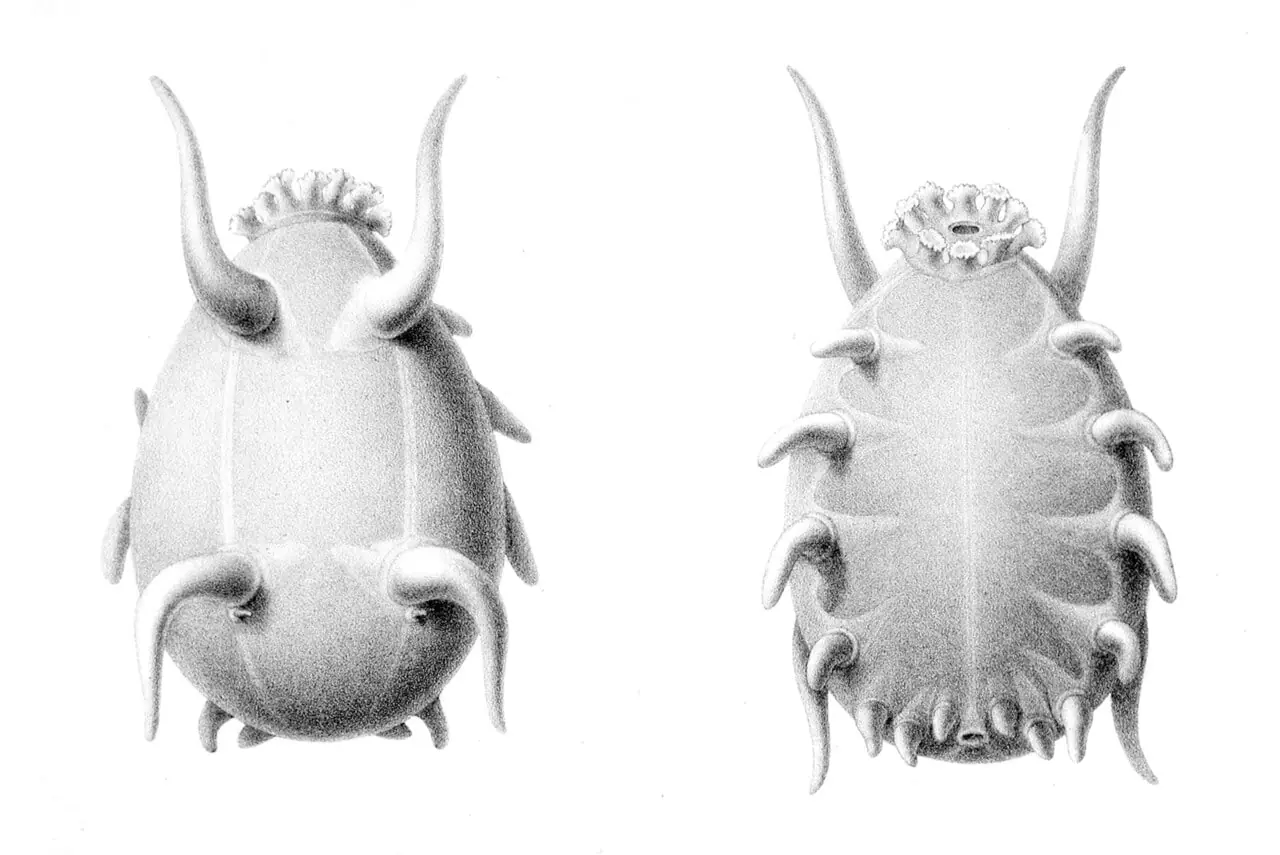
The host sea pigs are translucent, soft-bodied sea cucumbers that walk across the deep seafloor on enlarged, leg-like tube feet. According to the press release's photo caption, they can grow to around 15 centimeters long and sometimes gather in large groups to feed on organic-rich sediments, including those around whale falls. In some areas of the deep sea, sea cucumbers account for more than 90% of the biomass of large bottom-dwelling animals, so the bacteria living in their bodies matter for understanding deep-sea ecosystems.
What do the sea pigs get from the bacterium?
What the sea pigs gain from this bacterium is not yet known. Neither the paper's abstract nor the press release presents data showing whether the bacterium helps, harms or has no effect on its host. The press release mentions that it may protect the host from pathogens, but notes that this is still to be confirmed. On the next questions, Yoshida said:
We would really like to understand how this bacterium could become so dominant in the body wall, the functions of the giant surface proteins, what competition it faces from other bacteria, and of course the effects on the host.
— Yu Yoshida (Graduate School of Frontier Sciences, University of Tokyo)
From the bacterium's side, it offers clues to which functions remain when a microbe shifts to a life that relies heavily on its host. What was missing were some of the pathways for extracting energy; what remained in abundance were the genes for building the cell surface that touches the host.
Editor's note: "sea pig" covers more than one species
The English press release calls the specimens "sea pigs" as a group, but as its own text notes there were three species: the paper studied several species of the genus Scotoplanes. In Japanese, the common name "senju-namako" refers to just one species of the genus, Scotoplanes globosa, so the Japanese version of this article calls the specimens "relatives of senju-namako". Neither the abstract nor the press release says which species the specimens belonged to.
We were able to read the University of Tokyo press release and the paper's abstract, but not the full paper: the publisher's site stops automated access with a verification page, so we could not check its figures, tables or sampling sites. With only eight specimens, it is too early to judge the relationship between the bacterium and the sea pigs. We have also covered a study that counted the animals living in the cracks of polymetallic nodules, another look at small life on the deep seafloor.