KM3NeT/ORCA, a neutrino telescope under construction on the Mediterranean seabed about 40 km off Toulon in southern France and roughly 2,450 m down, has searched for a breakdown of "Lorentz invariance", a principle at the foundation of relativity. The international KM3NeT collaboration analysed 5,828 atmospheric neutrino candidates from 1.4 years of data but found no evidence of a violation. The work appeared in the Journal of Cosmology and Astroparticle Physics (JCAP) on 4 November 2026.
Why count neutrinos at the bottom of the sea
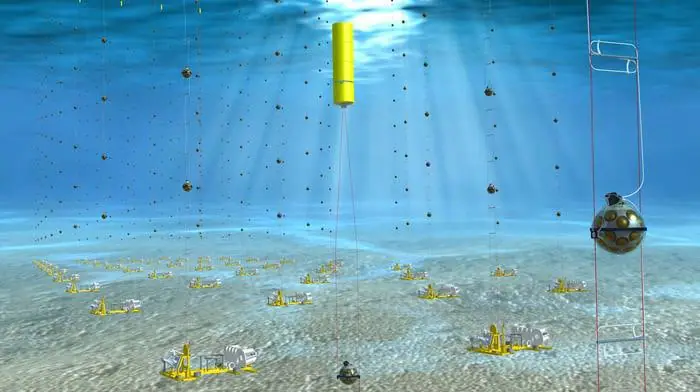
KM3NeT is a research facility, still being built as a whole, that threads networks of highly sensitive light sensors through the deep Mediterranean to pick up the faint glow given off when a neutrino hits matter. It has two telescopes with different jobs.
| Telescope | Location | Depth | Main target |
|---|---|---|---|
| ORCA | About 40 km off Toulon, France | About 2,450 m | Neutrinos made in Earth's atmosphere and how they change type (oscillate) |
| ARCA | Off Sicily, Italy, near Portopalo di Capo Passero | About 3,500 m | Much higher-energy neutrinos from distant astrophysical sources |
ORCA's depth of about 2,450 m equals roughly 3.9 Tokyo Skytrees (634 m) stacked end to end. The light sensors sit inside spherical modules fixed to the ropes of "detection units" that rise from the seafloor.
What was searched for, and what was found
The team looked for an isotropic kind of violation, one that does not depend on direction. Their tool was neutrino oscillation, in which a neutrino switches between types, or "flavours", in flight in a way that can be predicted very precisely. By setting the measured energies and arrival directions of the neutrinos against those predictions, any discrepancy could signal new physics, potentially including a violation.
No evidence of a violation emerged. The detector used was only part of what is planned, yet the release calls the results competitive with long-running experiments such as IceCube and Japan's Super-Kamiokande. The release stresses that this does not rule a violation out. According to the abstract, new limits now apply to some of the coefficients.
| What was constrained (per the abstract) | Meaning |
|---|---|
| Off-diagonal (flavour-mixing) coefficients, mass dimension 3 | Limits competitive with other experiments |
| Differences in diagonal coefficients between the muon and tau sectors, mass dimensions 3 to 8 | The first direct limits |
The second row directly narrows how much the size of a violation could differ between muon neutrinos and tau neutrinos.
What could six strings of KM3NeT/ORCA tell us
When the data were taken, ORCA was still at an early stage of construction. A 2024 paper says only six of 115 planned detection units were working. That is about one-twentieth of the plan. The 2024 paper also used the six-unit set-up and the same number of neutrino candidates (5,828) to measure oscillation properties. The abstract does not say the sample is identical, but the new study appears to reanalyse the same data with a different question. Lukas Hennig, a PhD student and the study's other corresponding author, said:
These results show the potential of KM3NeT/ORCA to test fundamental principles of physics, even with a relatively small detector.
— Lukas Hennig (ECAP, PhD student)
Why doubt Lorentz invariance
The paper's abstract describes Lorentz invariance as a fundamental symmetry that underpins both the Standard Model of particle physics and General Relativity.
The doubt comes from attempts to build a theory of quantum gravity that would merge gravity with quantum physics, some of which hint that the principle may not hold in every case. In some of those proposals spacetime becomes grainy at the very smallest scales, and a grainy spacetime could let Lorentz invariance fail. Alba Domi of the Erlangen Centre for Astroparticle Physics (ECAP), one of the study's two corresponding authors, said:
We still don't know whether our spacetime is continuous or might be discrete.
— Alba Domi (Friedrich-Alexander-Universität Erlangen-Nürnberg, ECAP)
The researchers next want to take the search to ARCA, which catches high-energy neutrinos from far-off sources, since effects that grow with distance and energy would be easier to spot in its data, if they exist. Domi adds that ARCA has not yet gathered enough astrophysical neutrinos for that analysis. The analysis was part of her EU-funded Marie Skłodowska-Curie postdoctoral fellowship (QGRANT).
How does it compare with Super-Kamiokande
One of the long-running experiments the release names for comparison is Japan's Super-Kamiokande, 1,000 m underground in Kamioka, Hida City, Gifu Prefecture. The University of Tokyo describes it as an observatory made of a 50,000-tonne water tank and light sensors that has been taking data since April 1996.
| Point of comparison | KM3NeT/ORCA | Super-Kamiokande |
|---|---|---|
| Location | Mediterranean seafloor (about 40 km off Toulon) | Underground in Kamioka, Hida City, Gifu |
| Depth | About 2,450 m below the sea surface | 1,000 m underground |
| Water | The surrounding seawater itself | A 50,000-tonne water tank |
| Status | Under construction (6 of 115 planned units used here) | Observing since April 1996 |
Seawater overhead and rock overhead are different conditions, so the two depth figures cannot simply be compared. Kamioka keeps its water in a tank under rock, while ORCA uses the sea itself as the detector's water and lowers its sensors into it.
For the other comparison, the IceCube Neutrino Observatory, the release notes that the 2026 Nobel Prize in Physics went to Francis Halzen. The release links the prize to his role in building IceCube and to its detection of cosmic high-energy neutrinos, and treats it as proof that this field now carries real weight.
From the editors
Deep-sea instruments usually bring to mind vehicles that survey animals or landforms, but KM3NeT turns the deep sea's water itself into the place where measurements happen. For other ways of measuring in the ocean, see the article on a fibre-optic towed array that senses its own bending and the article on NOAA testing three AUVs off Hawaii.
We were able to read the news release and the paper's abstract, but not the full paper, so the numerical values of the limits remain unchecked. In the abstract, the limits described as competitive are those on mass-dimension-3 off-diagonal coefficients, and the release's comparison with other experiments most likely refers to these. The next question is how small a violation the same analysis could reveal once all 115 units are in place.