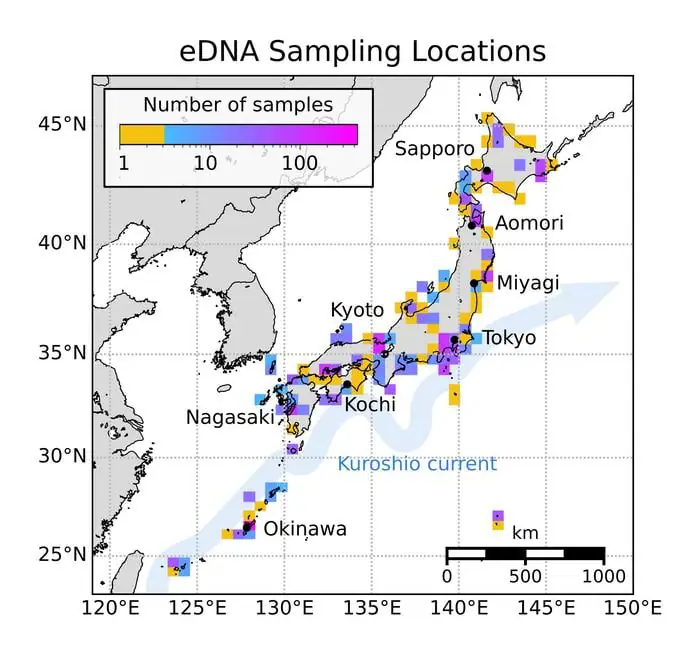
Environmental DNA in seawater collected along Japan's coasts has turned up 126 fish species north of the northern limits shown in existing databases. A team at the Okinawa Institute of Science and Technology (OIST) analysed samples gathered from 2017 to 2024 and reported the results in Diversity and Distributions on 26 October 2026. The species found farther north include commercially important fish such as Japanese scad and blacktip grouper, as well as black rabbitfish, a fish blamed for helping strip seaweed beds bare.
What is environmental DNA, and why could this be done in Japan
Environmental DNA, or eDNA, is the DNA that fish and other creatures shed into the water, so a single bucket of seawater can hint at which species were around. Older ways of tracking fish ranges, from citizen sightings and fieldwork to museum specimens and habitat models, each carry drawbacks such as unchecked data, cost or uncertain predictions. The release calls this the first nationwide use of eDNA for the job and highlights how much less effort it takes than typical surveys.
First author Ayşe Haruka Oshima Açıkbaş, who has since completed her PhD at OIST, explains why the study could be done in Japan:
One advantage of applying this method in Japan was the fact that the reference DNA sequences needed for eDNA analysis, known as the MiFish primers, were developed in Japan.
— Ayşe Haruka Oshima Açıkbaş (OIST, first author)
According to her, sustained work in Japan to sequence local marine life has improved the coverage and accuracy of species detection within the country. Cooperation with marine stations, fishers and government agencies across Japan was also essential to cover so much coastline.
How was "farther north than recorded" decided
The team compared the northernmost point at which each species turned up in eDNA with three existing sets of range data, and checked whether it lay well beyond them.
| Yardstick (per the abstract) | What it is |
|---|---|
| GBIF/OBIS | Databases that pool occurrence records of species worldwide |
| Aquamaps | Ranges predicted by modelling suitable habitat |
| IUCN range maps | Ranges compiled by experts |
The abstract puts at 126 the number of species whose eDNA northern limits lay well beyond the ranges shown by the three reference datasets. In the heavily sampled years of 2020 to 2022, out-of-range detections reached up to 511 a year against the IUCN maps and 1,069 against Aquamaps, more than the out-of-range records available on GBIF/OBIS.
The abstract also points out that the reference datasets disagree with one another, and concludes that they should be cross-checked with each other and with the literature before being used as baselines.
Which fish turned up farther north
According to the abstract, the 126 include subtropical vagrants that may be overwintering, commercially important species and small, hard-to-spot species. The release singles out three:
- Japanese scad (Decapterus maruadsi): a commercially important jack
- Blacktip grouper (Epinephelus fasciatus): a commercially important grouper
- Black rabbitfish (Siganus fuscescens): a seaweed grazer blamed for "isoyake", the loss of seaweed beds
Grazing damage by rabbitfish has been studied by fisheries research institutes in prefectures such as Kanagawa and Hiroshima, so a northward spread of such fish would matter for managing seaweed beds too.
How do the numbers in the release and the paper differ
The figures describing the study's scale do not match between the news release and the paper's abstract. We set them side by side so readers comparing other reports are not confused.
| Item | News release | Paper's abstract |
|---|---|---|
| Number of samples | 2,672 (about 1,000 newly collected) | 2,904 |
| Period | 2017–2024 (described as 7 years) | 2017–2024 |
| Sampling locations | 316 | Not stated |
| Fish species detected | "Thousands" | 1,290 (36,247 occurrence records) |
| Species farther north than recorded | 126 | 126 |
The sample counts may differ because of how samples were counted for the analysis, but we could not read the full paper to check. The species counts do not match either: the release's "thousands" is far more than the abstract's 1,290.
Why does this matter for fishing
Timothy Ravasi, who heads OIST's Marine Climate Change Unit and is the paper's senior author, says the change is already felt on the water:
Fishermen across Japan are already finding differences in the types of fish they reel in compared to a few decades ago.
— Timothy Ravasi (OIST, senior author)
Ravasi also pointed to unfamiliar fish in local kitchens and the loss of species that traditional dishes depend on. New catches demand new gear and know-how, which weighs most on small family-run boats.
From the editors
What the study shows is that a fish's DNA was present in seawater north of its known range; it does not show whether the fish has settled and is breeding there. DNA can also drift on currents or contaminate samples, and the release itself stresses that care must be taken to avoid contamination. The abstract notes that the detections include vagrants that may be overwintering. As the body of the release puts it, fish "may be living further north", which remains a possibility. Sampling was concentrated in 2017–2024, so the study does not directly measure a northward shift compared with the past. On the link between climate and the sea, see also the study of signs that marine cold spells briefly strengthen after major eruptions.
Even so, building up records is worthwhile. As eDNA samples taken the same way across the country accumulate, it will become possible to follow how northern limits move every few years. The list of 126 species is a starting point for watching how far north each fish is turning up along Japan's coasts.