The seafloor around Minamitorishima, Japan's easternmost island, holds "rare-earth mud" rich in rare earths, but no date has been announced for when it might actually be used. The Cross-ministerial Strategic Innovation Promotion Program (SIP) of Japan's Cabinet Office and the Japan Agency for Marine-Earth Science and Technology (JAMSTEC) have announced a full-scale mining test from February 2027 and an overall evaluation, including economics, by March 2028.
What is rare-earth mud
Rare-earth mud is sediment below the seafloor that holds high concentrations of rare earths, the elements that high-tech products depend on. In Japan's exclusive economic zone (EEZ) around Minamitorishima, a 2013 cruise of JAMSTEC's deep-sea research vessel Kairei found especially rich mud containing from 2,000 to more than 5,000 micrograms of rare earths per gram.
According to a 2018 paper in Scientific Reports by a team including the University of Tokyo, this mud is rich in the heavier group of rare-earth elements and relatively low in radioactive uranium and thorium. The rare earths are concentrated in grains of biogenic calcium phosphate, such as fish teeth. Because these grains make up the coarser part of the mud, the paper also showed that sorting by grain size can concentrate the rare earths.
How much is down there
The same paper estimated more than 16 million tonnes of rare earths, as oxides, in an area of about 2,500 km² south of Minamitorishima. In the most promising zone of 105 km², the mud from the seafloor down to 10 m was calculated to hold 1.2 million tonnes. That equals 62 years of annual world demand for yttrium and 56 years for dysprosium. This figure, however, is based on demand at the time of the 2018 paper, and it is not the amount that could actually be mined.
How do you lift mud from about 6,000 m
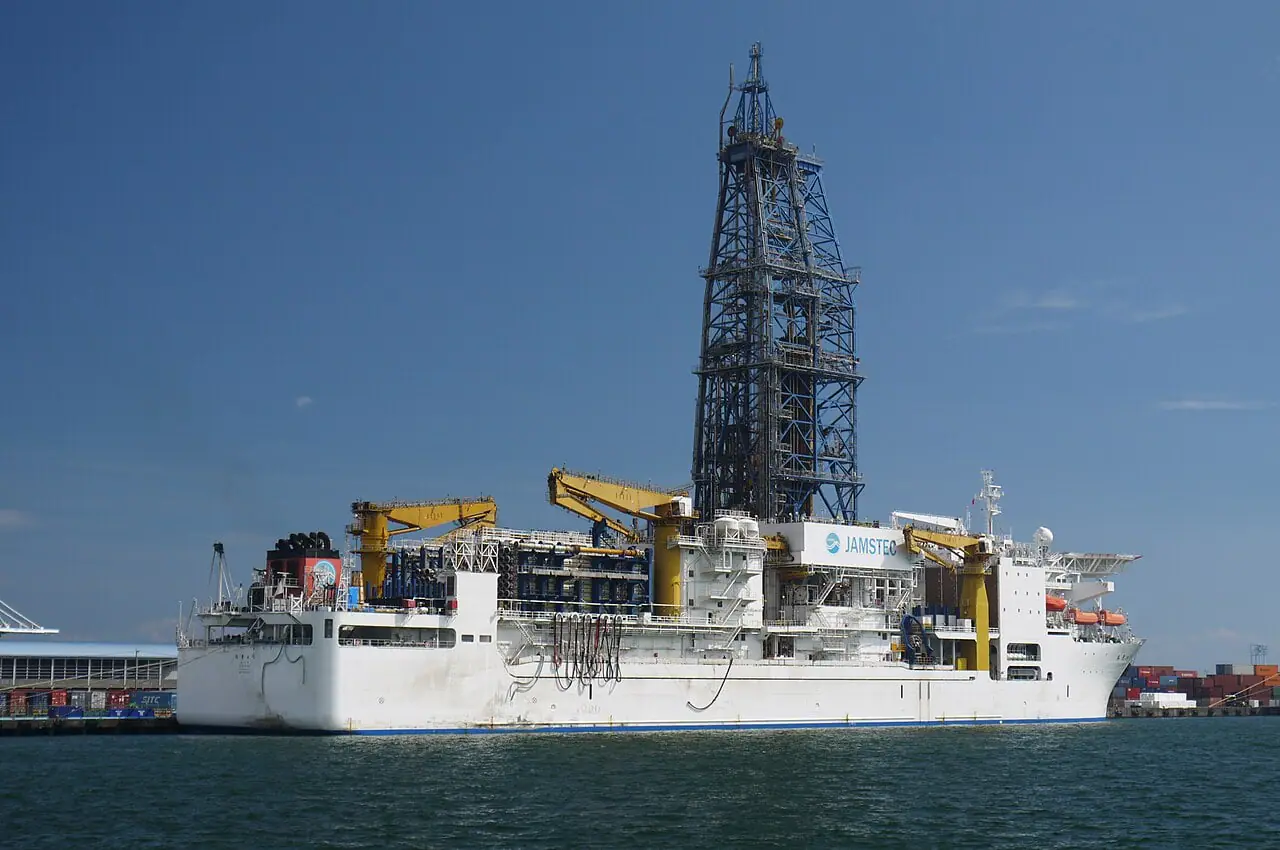
Unlike oil or natural gas, rare-earth mud is a firmly packed solid just below the seafloor, so it does not flow up by itself under underground pressure. JAMSTEC says that no technology had existed to lift large amounts of sediment from such a deep seafloor. The answer was a "closed circulation system": inside a unit pushed into the seafloor, which JAMSTEC calls a kaideiki (here, "mud-loosening unit"),, the mud is mixed with seawater into a slurry, and a flow of water created inside the pipe connected to the ship carries it up to the deck. Moving the mud inside a closed pipe is meant to keep the cloudy water from spreading into the surrounding sea. In 2022, a lifting test using the deep-sea drilling vessel Chikyu was carried out at a depth of 2,470 m off Ibaraki Prefecture.
What did the 2026 test show
After leaving the port of Shimizu in Shizuoka Prefecture on 12 January 2026, Chikyu reportedly ran into rough weather with waves close to 7 m high a few times in the test area off Minamitorishima. Lowering the mining unit and pipe to the seafloor took 12 days instead of the planned 7, but on 30 January the mud-loosening unit landed on the seafloor at a pipe length of 5,569 m, a depth measured from the length of the pipe, and shortly after 00:30 on 1 February mud began arriving on deck continuously.
Over three days of testing, mud was recovered from three layers, about 50 tonnes by weight after removing the seawater added. About 54% of the total rare earths were "medium and heavy rare earths" such as yttrium and dysprosium, which are essential for things like magnets in electric-vehicle motors, and no significant levels of harmful or radioactive substances were detected, according to the announcement. JAMSTEC describes this as the world's first continuous lifting of mud from below the seafloor at a pipe length of 5,569 m.
To study the effects of mining on marine life, instruments such as the seafloor observation unit Edokko-1 COEDO and hydrophones were placed on the seafloor, and on the ship, biological communities in surface seawater and in the lifted mud were monitored with methods set out in International Organization for Standardization (ISO) standards. Data analysis is still under way, but the results of a shipboard bioassay reportedly led to the judgement that the risk of mineral-derived pollution from the mining in this test is low.
What remains before it can be used
In the full-scale mining test planned for about one month from February 2027, the plan is to ship the lifted mud to Minamitorishima, dewater it into "mud cake" and send it to the Japanese main islands. The aim is to test the steps through to extracting and refining the rare earths and to check a production flow at a scale that could work as an industry. After that, by March 2028, an overall evaluation, including economics, is planned of whether domestic rare earths can become an industry.
Deep Sea Log has covered a study of why deep-sea mud in the Atlantic is poor in rare earths in an analysis of mud from the Brazil Basin. For what happens to the seafloor after deep-sea mining, a study of the track left by a 1979 mining test offers clues. When and how the mud of Minamitorishima will be used should become clearer after the 2028 evaluation.