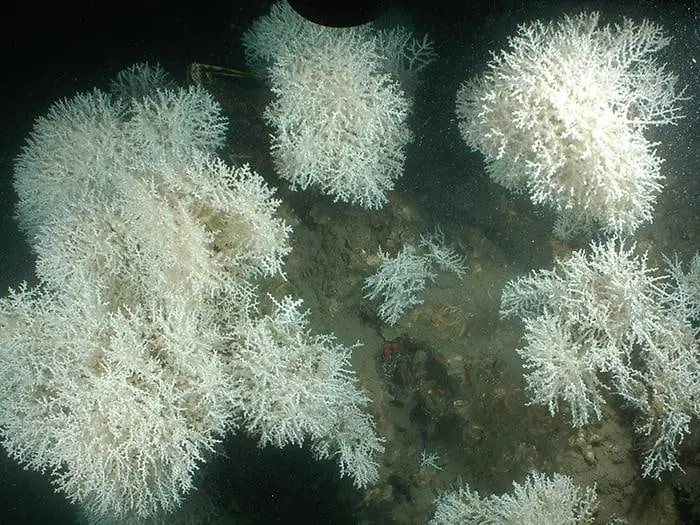
Only a few years ago, Mediterranean deep-sea corals were pictured as isolated clusters, but they now appear to be almost everywhere, according to an organiser of an international symposium. The University of Barcelona made the point in a feature published on 28 October, ahead of the 9th International Symposium on Deep-Sea Corals (9ISDSC), scheduled for 2–5 November 2026 in Barcelona.
Where do Mediterranean deep-sea corals live
Professor Andrea Gori of the University of Barcelona, one of the organisers, says the view of Mediterranean deep-sea corals has changed sharply in recent years:
In just a few years, we have gone from thinking that deep-sea corals were isolated pockets in the Mediterranean to discovering that they are almost ubiquitous.
— Andrea Gori (University of Barcelona)
The table lists places that Gori and the other organiser, Covadonga Orejas of the Spanish Institute of Oceanography (IEO-CSIC), gave as examples.
| Site | What the organisers said |
|---|---|
| Catalan continental shelf; Blanes, La Fonera and Cap de Creus canyons (Spain) | Places where Gori said deep-sea corals are found, as examples of them being almost everywhere |
| Cabliers Bank, Alboran Sea | As far as is known, the only Mediterranean deep-sea coral ecosystem to have built a true reef of the Atlantic kind; in good condition |
| Santa Maria di Leuca (Italy) | One of the sites with deep-sea coral communities |
| Gulf of Lion canyons | As above |
The feature notes that deep-sea corals occur worldwide on shelves, in canyons, on seamounts and along ridges, reaching beyond 3,000 m. Their three-dimensional structures house and feed many other animals, the feature says, and Gori calls deep-sea corals biodiversity hotspots of the deep.
What threatens deep-sea corals
| Threat | What the feature says |
|---|---|
| Fishing, above all deep-sea bottom trawling | In the Mediterranean it is destroying "forests" of the bamboo coral Isidella elongata |
| Oil and gas extraction | Listed as an activity to which these communities are exposed |
| Pollution and climate change | Endanger organisms that grow extremely slowly |
Deep-sea coral communities are classed as vulnerable marine ecosystems (VMEs). Once wrecked, they may need decades or even centuries to come back, the feature says.
The Isidella elongata forests also give cover to Aristeus antennatus, a red prawn that fishers in the Mediterranean value highly. Orejas points out that the coral is listed as Endangered (EN) in the Mediterranean on the IUCN Red List and falls under the Barcelona Convention, which commits signatories to protect it. Protecting such ecosystems, she says, calls for a medium- and long-term view.
Destroying the natural habitat means destroying the associated marine resources and failing to ensure the sustainability of their exploitation.
— Covadonga Orejas (Spanish Institute of Oceanography)
Why compare corals to forests
Gori likens deep-sea corals to trees on land, comparing the loss of a deep-sea coral ecosystem to losing a forest along with everything living in it. The loss, he adds, reaches beyond biodiversity to the services these ecosystems give people.
Orejas says decades of research have sharpened knowledge of where these communities live, how varied they are and what state they are in. She nonetheless warns that the Mediterranean is among the regions where they have suffered most.
What 9ISDSC had planned
The venue was a hall in the University of Barcelona's historic building. The announcement expected more than 250 participants from many scientific fields, the arts and the public, and the meeting was to be the first of the series held in a Mediterranean city. The feature opens with four questions, which we paraphrase here:
- What is global change doing to deep-sea corals?
- Can colonies damaged by people be brought back?
- How exposed are they to invasive species?
- What future technologies could reach corals in the remotest waters?
The opening lecture was to be given by Asako K. Matsumoto of the Chiba Institute of Technology in Japan, on new deep-sea coral species from the Indian Ocean and the Timor Passage. An art exhibition, "BINOMIOS", built on exchanges between artists and marine ecologists, was also planned as part of 9ISDSC.
From the editors
The source is an announcement of a scientific meeting. The claims that Cabliers Bank is, as far as is known, the Mediterranean's only true deep-sea coral reef and that deep-sea corals are almost everywhere are both the organisers' views. The feature does not cite the individual studies behind them. Once the work due to be presented at the symposium is published, it should be possible to check with real numbers where the Mediterranean's deep-sea corals are, how many there are and how many trawling has destroyed.
If recovery can take decades to centuries, then, in our view, decisions on where to fish and where to protect need to weigh resources generations ahead rather than just the next catch. For an example of disturbed deep seafloor staying altered for decades, see the study finding that organic matter in the mud of a mining test track had still not recovered 44 years later. With an opening lecture planned from a researcher based in Japan, deep-sea coral science is clearly not only a Mediterranean story.