Between about 53 and 49 million years ago, during the Early Eocene Climatic Optimum (EECO), one of the warmest stretches of the roughly 66 million years since the dinosaurs died out, phytoplankton in the Southern Ocean around Antarctica appear to have begun leaving nutrients unused in the surface water. On 6 November 2026 an international team led by the Max Planck Institute for Chemistry in Germany reported in Nature Geoscience that the ocean's "biological pump", which moves carbon into the deep sea, weakened during this period. In the team's estimate with a simple model, once temperature and other feedbacks are included, that weakening may explain at least half of the rise in atmospheric carbon dioxide (CO2) at the time. The clue came from tiny foraminifera shells buried in seafloor sediment.
What was the Early Eocene Climatic Optimum (EECO)?
The Early Eocene Climatic Optimum lasted about 4 million years, between about 53 and 49 million years ago, and was one of the intervals with the highest temperatures and atmospheric CO2 of the Cenozoic Era, the last 66 million years. The news release puts global temperatures at more than 10°C above today's, and CO2 reached about 1,600 ppm.
Why CO2 stayed so high for millions of years is still not well understood. Suggested causes include less burial of organic carbon, continental rifting and volcanism. Citing, among other things, the time lag between volcanic activity and warming, the paper argues that these alone cannot explain the highest CO2 levels of the EECO. The team therefore turned to the Southern Ocean, which appears to have driven much of the CO2 change across the recent (Pleistocene) cycles of ice ages and interglacials.
How does the Southern Ocean's biological pump lower CO2?
In the biological pump, phytoplankton take up CO2 near the surface and part of their biomass sinks, storing carbon in the deep ocean. Carbon that reaches the deep can stay out of the atmosphere for hundreds to thousands of years. How much can be stored depends on how completely phytoplankton use up the nutrients in the surface waters of the high-latitude ocean.
As the paper explains, today's biological pump runs below its full potential. In the Southern Ocean, deep water wells up and brings nutrients and excess CO2 to the surface, but that water sinks back into the deep before phytoplankton have used them all.
During the ice ages of the Pleistocene, nitrogen isotopes in fossils show that nutrients in the Southern Ocean were used more completely. This has long been considered one of the main reasons CO2 was low in glacial times, and the new study set out to test whether the same mechanism worked in reverse in a hot world.
How did the team measure nutrient use 50 million years ago?
From sediment cores drilled by the Ocean Drilling Program (ODP) at four sites, the team picked about 1,000–1,500 shells (5–10 mg) of the planktic foraminifera genus Subbotina per sample and measured the nitrogen isotope ratio of the organic matter locked inside. Subbotina was chosen because it was the only genus present in measurable quantities at all four sites.
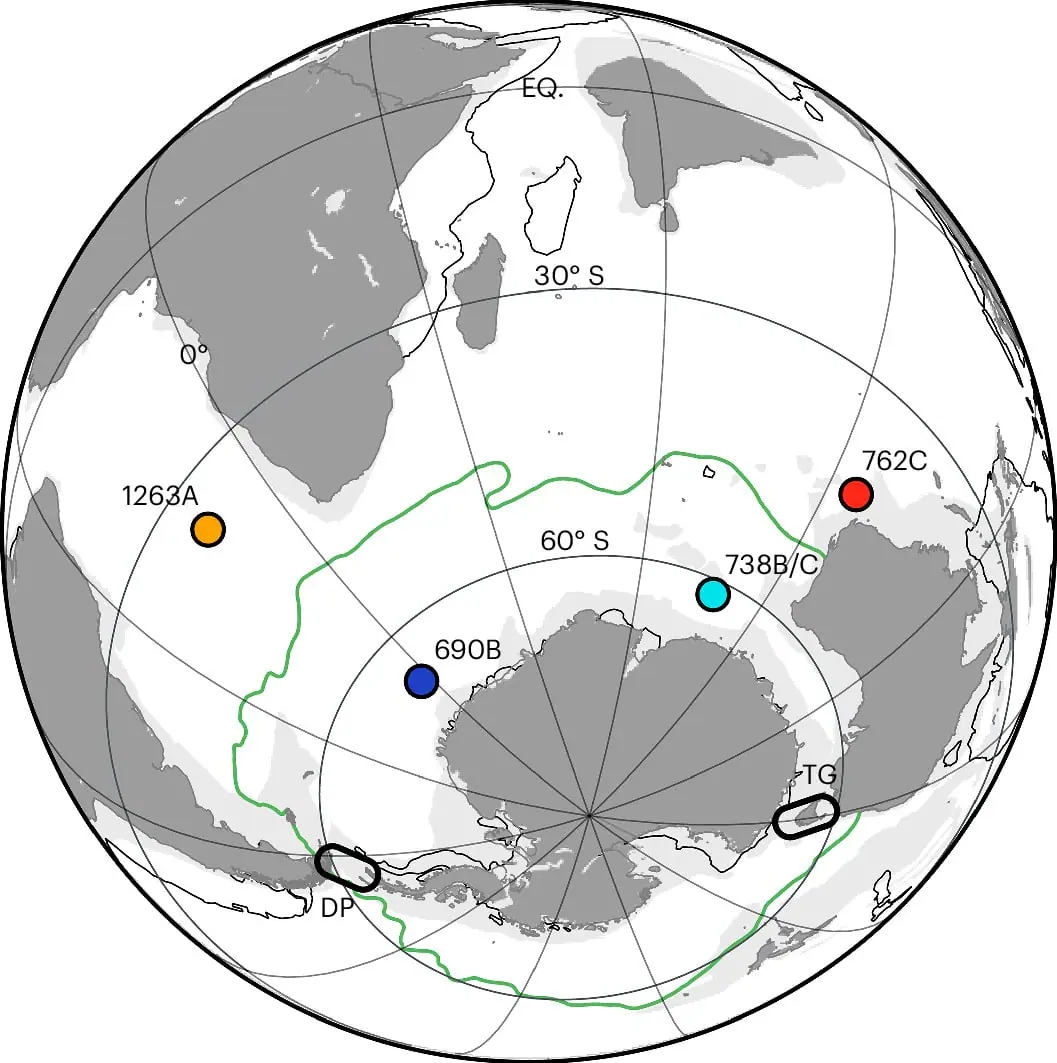
Phytoplankton take up light nitrogen (14N) first, so the more surface nitrate is consumed, the heavier (richer in 15N) the remaining nitrate and the plankton growing on it become. The team used two mid-latitude sites (1263 and 762; Site 762 now lies at about 20° S but was at about 43° S at the time), where nutrients are almost fully consumed, as a baseline and estimated how much nutrient was left unused in the Southern Ocean surface from how much lighter the two Southern Ocean sites (690 and 738) were.
- ODP Site 1263 (South Atlantic)
- ODP Site 762 (South Indian Ocean)
- ODP Site 690 (Southern Ocean)
- ODP Site 738 (Southern Ocean)
Because denitrification across the ocean declined, the nitrogen isotope ratio fell over the long term at all sites, from about 12‰ to 5‰, but the two Southern Ocean sites were consistently lower than mid-latitude sites of the same age. The gap was largest at the hottest part of the EECO and shrank or disappeared before and after it.
How much did the Southern Ocean change raise CO2?
The isotope gap suggests that at the peak of the EECO the degree of nutrient consumption in the Southern Ocean was about 40% lower than before and after. The team fed Eocene seawater conditions into a simple ocean–atmosphere model known as the box model of Sarmiento and Toggweiler to estimate how much this would shift atmospheric CO2.
| Model scenario (Eocene ocean) | Atmospheric CO2 |
|---|---|
| Starting point (set to correspond to about 7°C of warming relative to pre-industrial) | 700 ppm |
| Fraction of nutrients used down by about 0.4 (40 percentage points; no feedbacks) | about 900 ppm |
| Including temperature and carbonate compensation feedbacks | about 1,100 ppm |
| CO2 rise reconstructed for the EECO | about 800 ppm |
A rise to about 1,100 ppm amounts to about 400 ppm, at least half of the reconstructed rise of about 800 ppm. The same change in nutrient use produced a much smaller absolute CO2 increase (in ppm) under Pleistocene ocean conditions. The proportional change is similar in both cases, but the higher starting level in the Eocene makes the rise in ppm larger. On top of that, the main reason is the weak buffering of Eocene seawater: with more calcium ions and a lower pH, it contained less carbonate ion and was less able to damp CO2 changes, the paper explains.
Co-author François Fripiat of the Université libre de Bruxelles described the difference in buffering in the news release.
Because Eocene seawater had a much lower capacity to buffer changes in CO2 than today's ocean, a weakening of the biological carbon pump could have had a far greater impact on atmospheric CO2 than under present-day conditions.
— François Fripiat (Université libre de Bruxelles, co-author of the paper)
Why did high CO2 last for millions of years?
In the conventional view, CO2 released from the ocean warms the climate, speeds up rock weathering on land and is drawn back down in less than a million years. The paper instead adopts the view of earlier studies that before the uplift of the Alps and the Himalayas, the flat, deeply weathered continents of the Eocene weakened this weathering "thermostat". If so, CO2 released from the Southern Ocean could have stayed in the atmosphere for the roughly 4 million years of the EECO.
The Drake Passage and the Tasmanian Gateway were probably closed at the time, and there was likely no Antarctic Circumpolar Current like today's. Geochemical data indicate that the Southern Ocean was then the main source of the world's deep water, and numerical simulations show that closed gateways favour deep-water formation near Antarctica. The paper sees a positive feedback, in which warming leaves more unused nutrients in the Southern Ocean surface, releasing CO2 and driving further warming, operating both in Pleistocene interglacials and in the EECO.
Lead author Simone Moretti of the Max Planck Institute for Chemistry stressed that a mechanism known from the glacial Southern Ocean was also at work in a far warmer world.
Our study shows that the Southern Ocean played a major role in regulating atmospheric CO2 during the early Eocene, millions of years before the onset of the recent ice ages.
— Simone Moretti (Max Planck Institute for Chemistry, lead author of the paper)
What does the study leave open?
The paper does not settle why nutrients were left over in the Southern Ocean surface. It offers two explanations: stronger mixing or circulation of deep water increased the nutrient supply, or phytoplankton growth itself declined. Existing palaeoceanographic data suggest that iron, which limits growth in today's Southern Ocean, changes much only during the coldest parts of the Pleistocene ice ages, so the paper considers the second effect small. Either way, its conclusion stands that the biological pump became less efficient and the ocean released CO2.
The data rely on a single foraminifera genus, Subbotina, and four drilling sites. Samples without enough Subbotina could not be measured, so the time resolution is uneven. The "about 40%" means the fraction of nutrients used up fell by about 0.4 (40 percentage points). The CO2 estimate also comes from a simple model that divides the ocean into a few boxes and assumes the ocean's total nutrient inventory stayed constant, and the "at least half" result rests on the assumption that weathering was a weak thermostat at the time.
The paper ends with a look at the future. In the short term, freshwater input could weaken Antarctic deep-water formation, but simulations run for centuries to thousands of years suggest it strengthens, and the paper sees it as likely that the Southern Ocean will behave in a similar way over the longer-term future.