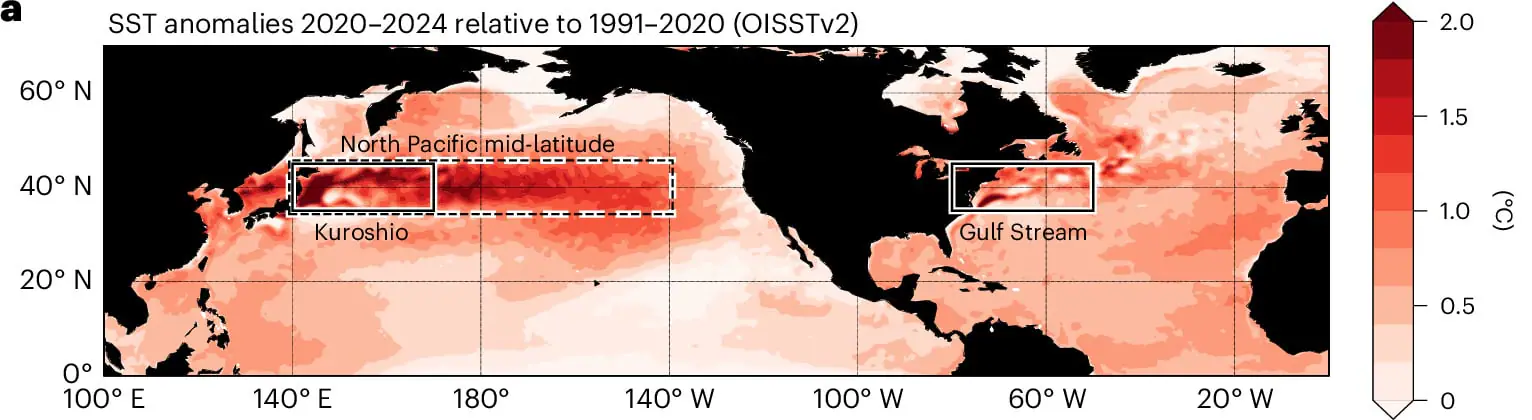
About 13% of the natural rise and fall of sea surface temperature around the Kuroshio Extension, off the east coast of Japan, can be explained by temperature changes in the Atlantic's Gulf Stream region, according to climate model calculations. A team led by Yoko Yamagami of the Japan Agency for Marine-Earth Science and Technology (JAMSTEC) published the findings in Nature Geoscience on 17 November 2026. In this view, warmth in the Atlantic, far from the Pacific, reaches the waters near Japan over several years by way of the atmosphere above the Arctic and the North Pacific Ocean.
What was found about Kuroshio Extension temperatures
The Kuroshio Extension is the current formed where the Kuroshio, after flowing along the Japanese coast, leaves the shore off the Boso Peninsula and heads east. Using a high-resolution version of the Japanese climate model MIROC6 (MIROC6subhires) that resolves the ocean finely, the team ran a 100-year simulation under pre-industrial conditions, without the effects of global warming. They then ran experiments, ten each, in which sea surface temperatures only in the Gulf Stream region, only in the Kuroshio region or only in the tropical Pacific were held to the values of that original run.
Calculated from the average of the ten runs, Gulf Stream variability explained about 13% of the variability lasting several years or more, longer than year-to-year changes, in the Kuroshio region (140° E to 170° E, 35° N to 45° N). For the Kuroshio region, that is larger than the share from the tropical Pacific, home of El Niño (about 4%). JAMSTEC highlights this point. Across the whole mid-latitude North Pacific, however, the tropical Pacific's 17% exceeded the North Atlantic's 10%. In the other direction, no evidence was found that Kuroshio temperatures drive those of the Gulf Stream, so the influence ran mainly from the Atlantic to the Pacific. The 13% figure is a share of natural variability within the model, and the remaining roughly 90% comes from things such as other ocean regions and chance fluctuations in the air and sea. The paper notes that the share is smaller still when calculated from each of the ten runs separately. The Atlantic is just one factor.
What happens in the winter atmosphere
It starts in winter: when the sea surface in the Gulf Stream region is warm, a north-south pressure pattern forms over the North Atlantic in early winter, and the stratospheric polar vortex, the ring of strong winds circling the Arctic, strengthened in the simulations. Towards late winter, a high-pressure anomaly builds over the North Pacific and the Aleutian Low weakens. The paper sees this change, resembling the Northern Annular Mode (Arctic Oscillation) from the stratosphere down through the lower atmosphere, as the route by which the Atlantic's influence reaches the Pacific.
How is it carried through the ocean
When winds change over the central North Pacific, anomalies in sea surface height form and travel west over several years. Their behaviour matches theory and observations of wind-driven oceanic Rossby waves. When they reach the area east of Japan, the Kuroshio Extension shifts north and warm water carried by the Kuroshio reaches farther north, so the sea east of Japan warms. In the simulations, Gulf Stream temperatures were positively correlated with Kuroshio temperatures when leading them by up to 4 years. A look at heat gains and losses near the sea surface showed that ocean currents strengthened the warmth, while heat escaping from the sea surface to the air weakened it.
This influence was hardly reproduced by the standard-resolution MIROC6, which cannot represent ocean eddies or sharp temperature boundaries (ocean fronts). Because a high-resolution model computing the ocean on a grid of about 0.25 degrees was needed, the paper concludes that strong currents and the fronts around them are key to linking the Atlantic and the Pacific.
How does this relate to the warm 2020s
The paper writes that global mean temperature reached record levels in 2023 and 2024, with marine heatwaves across the world's oceans. JAMSTEC describes a marine heatwave as a period of several days or more when water temperatures are markedly higher than the baseline of past decades. The team compared global-warming scenario runs for 2015 to 2024 with runs in which observed sea surface temperatures were imposed only in the Gulf Stream region, only in the tropical Pacific, or in both. Imposing observed Gulf Stream temperatures strengthened the warmth mainly around the Kuroshio Extension, while the tropical Pacific mainly affected the central and eastern North Pacific. With both included, the runs came closest to the observed pattern of warmth across the mid-latitude North Pacific. The paper concludes that the results suggest Gulf Stream temperatures contributed particularly to the recent extreme warming in the western mid-latitude North Pacific (off eastern Japan).
What comes next
The paper says the mechanism may offer a source of predictability for Northern Hemisphere climate on roughly decadal timescales. JAMSTEC named as a next step how changes in the Atlantic ocean circulation, which there are concerns could weaken in the future, may affect the climate around Japan through this mechanism. Deep Sea Log has also covered a model study of the Atlantic cold blob on North Atlantic currents and climate.
The paper writes that such extreme warming poses substantial risks to marine ecosystems and fisheries. On coastal fish around Japan, Deep Sea Log has also covered an environmental DNA survey in which 126 species were found farther north than previously recorded.