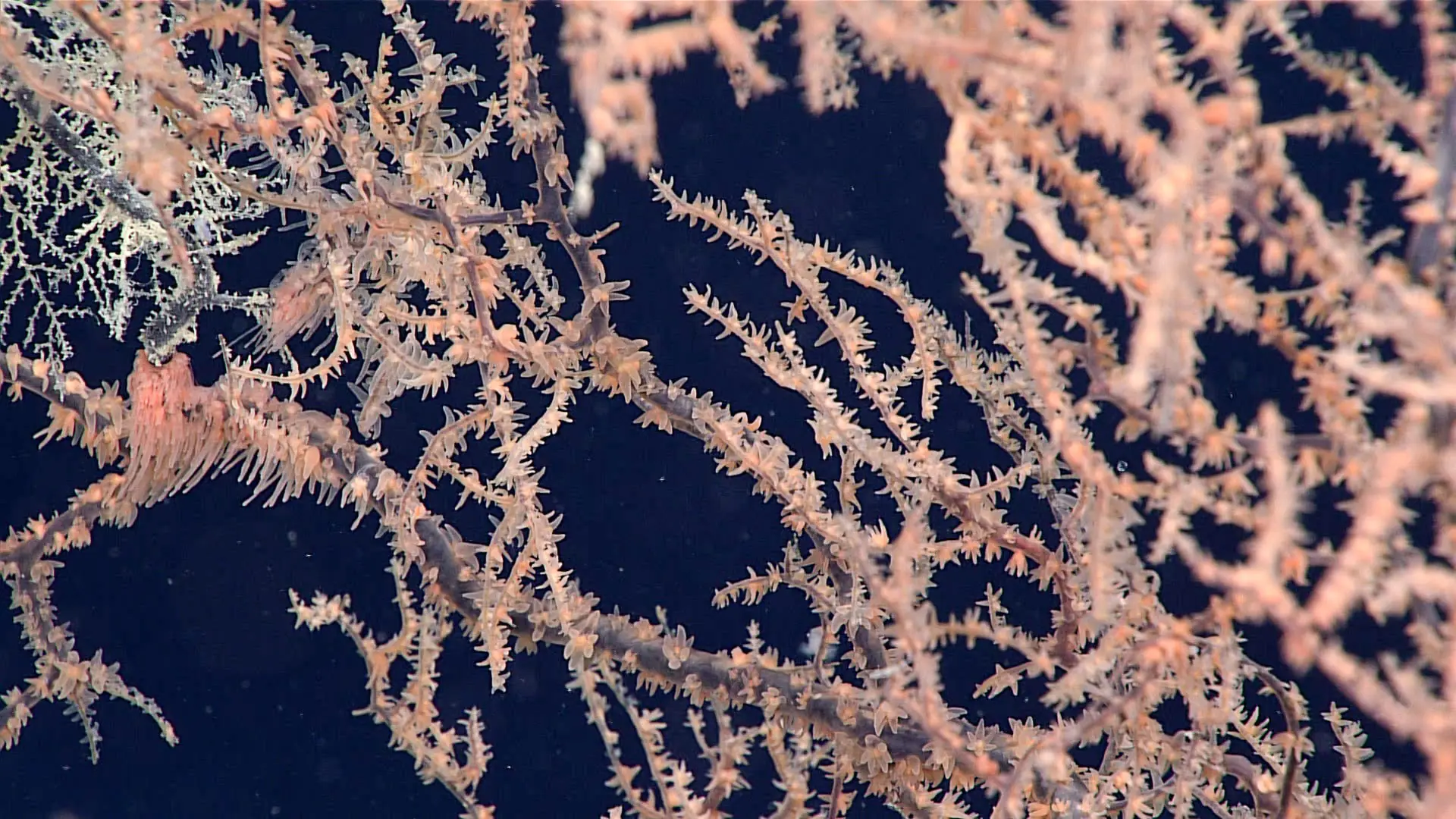
The oldest known coral colony is a black coral of the genus Leiopathes found in the deep sea near Hawaii, and carbon dating of its skeleton put its age at about 4,265 years. That is how NOAA Ocean Exploration, part of the U.S. National Oceanic and Atmospheric Administration (NOAA), describes it. The deep sea also has sharks whose lifespans are estimated in centuries.
How do you count a coral's age
Working out a coral's age is surprisingly tricky. A coral larva drifts in the sea, settles on the seafloor and grows into a small polyp like a tiny sea anemone, and as it clones itself, the copies stay linked through a shared skeleton and tissue, forming a colony. What we usually call "a coral" is this colony.
NOAA explains that a single polyp may live only a few years, while the colony and its genes can last far longer. In shallow water, a group of elkhorn corals found in 2016 appeared to have grown from pieces of what was once a single coral. NOAA writes that their shared DNA was more than 5,000 years old.
What is a black coral over 4,000 years old
Black corals are named not for the colour of the polyps covering them but for their black skeleton, made of protein and chitin.
Tina N. Molodtsova of the Shirshov Institute of Oceanology wrote an entry for a NOAA expedition log in 2019. The entry describes a colony of Leiopathes annosa from Hawaii whose age was found to exceed 4,000 years, and notes that the samples dated were neither the biggest nor the oldest in the area. According to the same entry, every Leiopathes species is fragile, and a damaged colony can scarcely be brought back. A form that took thousands of years to grow cannot easily be regained once broken.
Long-lived corals also offer clues to the ocean's past. Some black corals and deep-sea bamboo corals build growth rings in their skeletons, much like the rings of a tree. NOAA explains that the chemistry and thickness of these rings record ocean temperature and acidity from hundreds to thousands of years ago. Deep Sea Log has also covered the state of deep-sea corals in the Mediterranean, as described by a researcher.
Are deep-sea sharks long-lived too
NOAA Fisheries describes the Greenland shark, which is sometimes photographed in the deep sea, as a species estimated to live for several centuries.
Close enough to the Greenland shark to interbreed with it, the Pacific sleeper shark is Alaska's biggest shark, and may even be the biggest predatory fish anywhere in the sea. An April 2024 NOAA Fisheries article reported that a clearly immature female was at least 35 years old. A July 2024 article said the species may take 50 years or more to mature. New genetic evidence suggests it may form one big population across the whole Pacific, from Alaska to the southern end of the Southern Hemisphere. As of 2024, the team hoped to estimate age by radiocarbon dating the eye lenses of a dead female about 4.3 m (14 feet) long, caught in the Aleutian Islands the previous summer, whose eyes were the size of cantaloupes.
Why long lives call for care
Like many other sharks, the Pacific sleeper shark is thought to grow slowly, mature late and live long, and NOAA Fisheries writes that these traits make it highly susceptible to overfishing. Cindy Tribuzio of NOAA Fisheries notes that even the spiny dogfish, a relative with a lifespan of 100 years, can sustain a harvest rate of only about 3 percent. Long-lived deep-sea animals may be best watched over quietly. For how deep-sea populations can decline, see also our story on the genes of deep-sea fish and shrimp in the Gulf of Mexico.