Even after the concentration of carbon dioxide in the atmosphere starts to fall, anthropogenic carbon that entered the ocean through human activity keeps increasing below 1,000 m until the year 2500, according to projections by a group including the University of Toyama and the Japan Agency for Marine-Earth Science and Technology (JAMSTEC). The results come from running MIROC-ES2L, an Earth system model developed in Japan, out to 2500; they were published in the journal Biogeosciences on 11 November 2026 and selected as a Highlight Paper. Anthropogenic carbon is the extra carbon stored in the ocean because burning fossil fuels and other human activities raised atmospheric carbon dioxide.
How do you study the ocean of the year 2500?
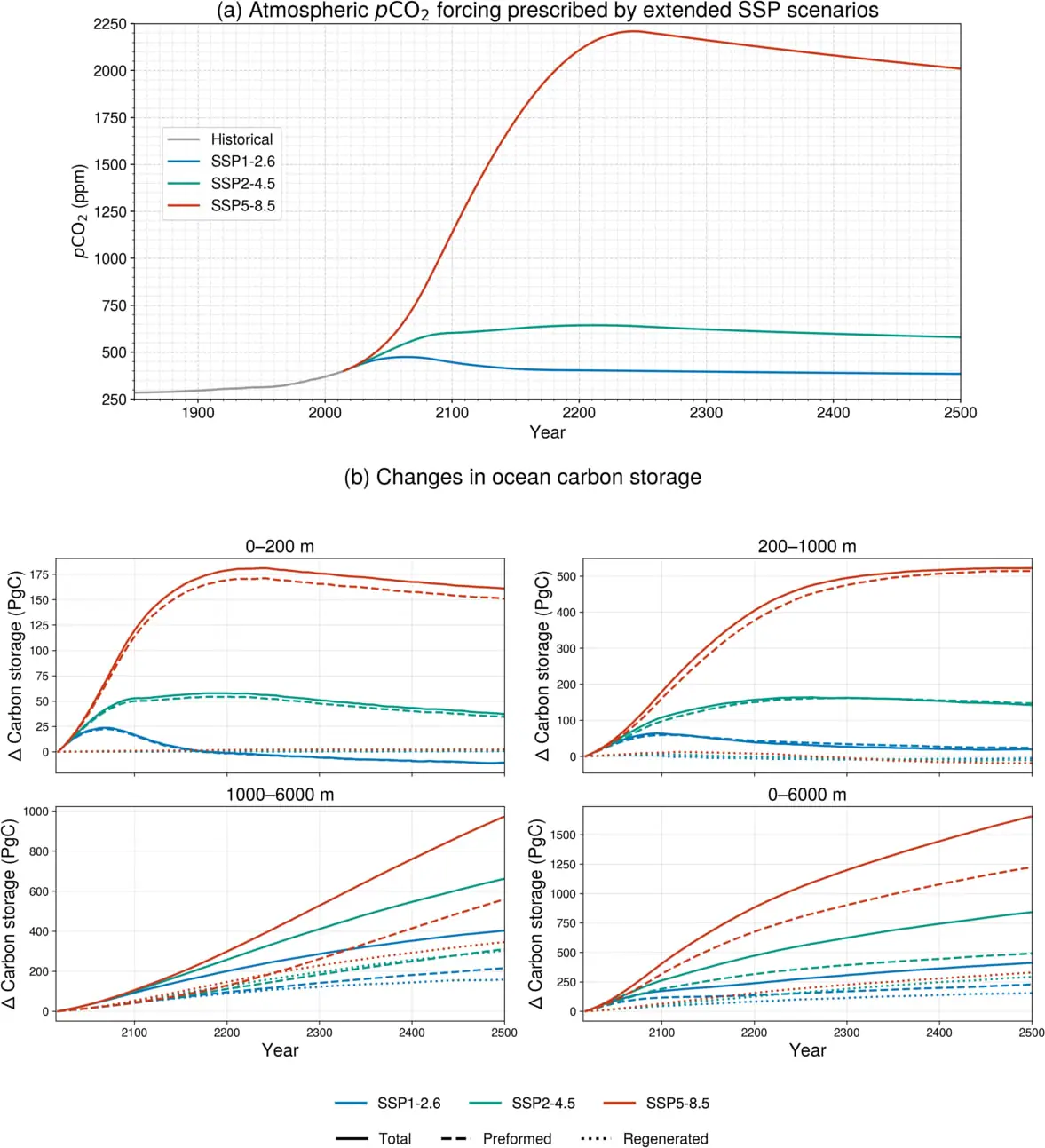
The group ran an Earth system model, which calculates the atmosphere, ocean, land, ecosystems and carbon cycle together, on JAMSTEC's Earth Simulator. The ocean currently absorbs about 25% of annual global carbon dioxide emissions, the paper notes, but climate projections have so far mostly stopped at the end of the 21st century. How the ocean carbon cycle changes afterwards remains unclear. The team used eight Shared Socioeconomic Pathway (SSP) scenarios of greenhouse gas concentrations that had been extended to 2500, focusing on three of them: low (SSP1–2.6), intermediate (SSP2–4.5) and high (SSP5–8.5) emissions.
In the paper's set-up, every scenario reaches net-zero emissions by 2500, and even in the high-emission scenario the atmospheric concentration of carbon dioxide falls after 2250. The concentration paths differ widely between scenarios, from about 393 ppm in 2015 up to more than 2,000 ppm by 2250 in the highest, high-emission scenario.
What happens to anthropogenic carbon in the deep ocean?
In the calculation, the ocean responded at very different speeds depending on depth.
| Depth | Change in anthropogenic carbon (paper) |
|---|---|
| Surface (0–200 m) | Rises and falls quickly with the atmospheric concentration |
| Intermediate (200–1,000 m) | Levels off or declines under low emissions; keeps rising or stays high under high emissions |
| Deep (1,000–6,000 m) | Keeps increasing until 2500 in every scenario, with no sign of reversal |
Carbon keeps building up in the deep layer because carbon taken up at the sea surface is carried, slowly, into the deep ocean by the circulation. Deep water takes a long time to be renewed, so carbon keeps accumulating there even after the atmospheric concentration stabilizes or falls.
Heat reaches the deep ocean with a similar delay. Even under low emissions, warming in the upper 200 m peaks at about 0.8 °C in the second half of this century, while the layer below 1,000 m slowly warms by a similar amount, about 0.8 °C, by 2500. In the layer at roughly 500–1,000 m, warming continues until 2500 even under low emissions. Under high emissions, deep warming is especially strong in the Arctic Ocean, where the water below 1,000 m warms by more than 7 °C by 2500. The global mean at the same depth is about 2 °C.
How long will the ocean keep absorbing carbon dioxide?
Under high emissions, the amount of carbon dioxide the ocean absorbs grows until the late 21st century and then declines as the carbon dioxide partial pressure of surface seawater approaches that of the atmosphere. Between the mid-23rd and late 25th centuries, areas where the surface partial pressure exceeds the atmosphere's spread across the equatorial and subtropical oceans.
One reason absorption becomes harder is that seawater's ability to convert carbon dioxide into other forms and store it, its buffering capacity, falls as carbon accumulates. Under high emissions it keeps declining throughout the simulation and reaches its effective minimum across almost the entire surface ocean around 2200. The deep ocean, by contrast, remains far from chemical equilibrium with the atmosphere and keeps a large capacity to take up more carbon dioxide. Under low emissions it partly recovers from around 2200 onwards. Under high emissions, warming of the surface makes upper and lower waters mix less and the deep circulation weakens, so deep water rich in alkalinity reaches the surface less easily and the ocean's uptake slows further.
Under high emissions, the flow of deep water formed by sinking in the North Atlantic weakens from about 30 Sv in the preindustrial era (1 Sv is 1,000,000 cubic metres per second) to about 5 Sv by 2100. The Southern Ocean around Antarctica stayed ready to absorb carbon dioxide throughout the simulation. The paper links this to the continuing influence of deep water little affected by human activity, and possibly to strong westerly winds that enhance gas exchange between sea and air.
What does it mean for marine life?
Marine biological production increased under low emissions and decreased under high emissions. The dividing line lies near the point where atmospheric carbon dioxide reaches about three times the preindustrial level, and it was closely tied to a weakening of the Atlantic Meridional Overturning Circulation (AMOC) and the resulting change in how nutrients reach the surface. For what a weakening AMOC can bring, see also our article on a modelling study of the North Atlantic cold blob.
The group assessed the following five stressors on marine ecosystems:
- Rising sea temperatures
- Acidification
- Deoxygenation
- Falling calcium carbonate saturation
- Nutrient decline
Under high emissions, stress on surface ecosystems keeps intensifying until the late 22nd century. Under low emissions the changes settle sooner than under high emissions, yet surface temperature, acidification and deoxygenation only return to near present-day levels around 2200. Surface temperature stays about 0.5 °C above today's after the 21st century, and in regions such as the Arctic Ocean the effects of high temperatures and nutrient decline lasted until the late 25th century.
What difference does cutting emissions make?
The study concludes that cutting emissions changes not only how large the ocean's changes are but also how long they last. The announcement by the University of Toyama and partners says that the path emissions take from now on affects not only 21st-century climate but also the timescales of change and recovery in the ocean for the following centuries.
Editor's note: why look beyond 2100
Climate projections are often summed up as "so many degrees by 2100", yet the deep ocean takes centuries to finish taking up carbon and heat. This calculation shows, layer by layer, that change continues in the deep ocean even after the atmospheric concentration levels off or falls. For what the water sinking into the deep ocean around Antarctica carries, see also our article on dissolved organic matter in the Weddell Sea.
At the same time, this is a calculation with a single model. The announcement says the model does not fully represent freshwater from melting ice sheets or the exchanges with seafloor sediments and coral reefs that change the ocean's carbon and alkalinity. Adding these processes, which matter over hundreds of years, could change estimates of how long the deep ocean stays affected.