The deep seafloor, where almost no light reaches, is a place with very little food. When a large whale sinks there, the area quickly turns into a busy dining hall, and in time a distinctive community of animals, a "whale-fall community", forms around the carcass. A study that photographed a sperm whale on the deep floor of Sagami Bay, Japan, for more than two months gives a view of that feast.
How big a meal is one whale
A 2018 paper in Scientific Reports cites earlier work showing that a 40-tonne adult whale can deliver as much organic matter as more than 200 years of marine snow and other material raining down on that patch of seafloor. The fisheries service of the U.S. National Oceanic and Atmospheric Administration (NOAA Fisheries) also explains that many deep-sea animals have evolved to rely on nutrients from sinking carcasses. Whales that sink to the seafloor can lock away the carbon stored in their bodies for hundreds to thousands of years, it says.
In what order does a whale-fall community change
Earlier research suggests that the animals around a whale carcass change in four broad stages. First comes a stage in which animals that swim or walk in, such as fish and crabs, eat the flesh; it lasts from a few months to about a year and a half. The next stage, called the enrichment-opportunistic stage, lasts from a few months to about four and a half years. After that, as bacteria break down the fat inside the bones and release sulphide, animals that host sulphide-using bacteria in their bodies live there for decades, and finally the remaining bones serve as a home. It is a very long feast.
Who came to the sperm whale in Sagami Bay
The study used a young male sperm whale, 464 cm long and weighing about 1.2 tonnes, that had stranded on the coast at Mihama, Aichi Prefecture, in April 2008. The frozen whale was sunk on 8 June 2012 to the seafloor at 492 m in Sagami Bay, about halfway between Hatsushima Island and the tip of the Manazuru Peninsula. A camera placed nearby took a photo every two hours for 72 days, from 14 June to 24 August.
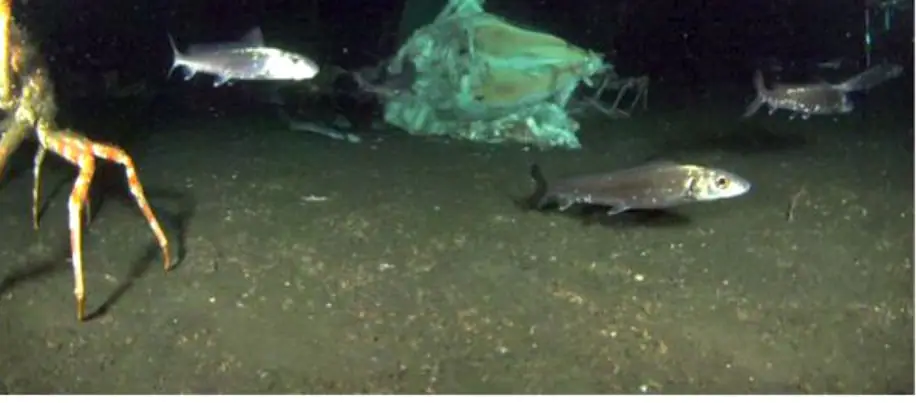
The animal seen most often was an eel, the snubnosed eel (Simenchelys parasitica), with 4,052 sightings in total, more than half of all. Second came the Japanese spider crab (Macrocheira kaempferi), with 1,002. A fish called Pterothrissus gissu and a giant isopod, Bathynomus doederleini, followed, and at the start of the series a large bluntnose sixgill shark was even caught tearing off flesh. The feast had truly begun.
Is there a night shift and a day shift
Counting the 72 days of photos by time of day showed that the snubnosed eel, the Japanese spider crab and P. gissu followed a clear 24-hour day-night rhythm rather than the rhythm of tidal currents near the seafloor. The carcass-eating snubnosed eels and spider crabs gathered more at night, while P. gissu, a predator, was more common by day. The paper sees this as a result suggesting that the two groups share out the hours and avoid being at the carcass at the same time. It is a bit like a feast with a night shift and a day shift.
From week 4 to week 5 of the observations (around day 34), P. gissu began to replace the spider crabs. Even then the snubnosed eel was the animal seen most often, and it remained abundant until the end of the observations. About 50 days after the whale was sunk, almost all the flesh was gone. The paper sees this time, when brittle stars began to gather in the sediment around the bones, as the move from the first stage to the next. Based on gray whales of 5 and 35 tonnes, the first stage is said to range from 4 to 5 months up to 1.5 to 2 years, depending primarily on carcass mass. The paper says it may not be surprising that this 1.2-tonne whale moved on so early. It also points to the shallower depth, where scavengers are more abundant, as a reason for the fast pace.
Is the feast over once only bones remain
The feast goes on even when only bones are left. In a survey announced in 2006 by the Japan Agency for Marine-Earth Science and Technology (JAMSTEC), another sperm whale, sunk off Atami at 900 m in April 2005, became almost bare bone in just nine months. Many Paralomis multispina crabs gathered on the soft tissue left in the head and fed on it.
Its ribs were thickly covered with Osedax, a group of polychaete worms also known in English as zombie worms. JAMSTEC explains that these worms are thought to rely on bacteria inside their bodies to break down the fat in the bones and to get their nutrition from those bacteria. In 2006, JAMSTEC announced that the Sagami Bay worms were very likely a new species. Deep Sea Log has not been able to confirm what became of the planned paper. It is remarkable that the fat in a whale's bones supports the lives of small animals by way of bacteria.
Other new animals have also been found on whale bones near Japan, and Deep Sea Log has covered new species of peanut worms described from vents, seeps and whale bones. On deep-sea life and daily rhythms, there is also research on the 24-hour rhythm kept by the cells of a deep-sea mussel. A single whale can link many lives over decades, in a feast found only in the deep sea.