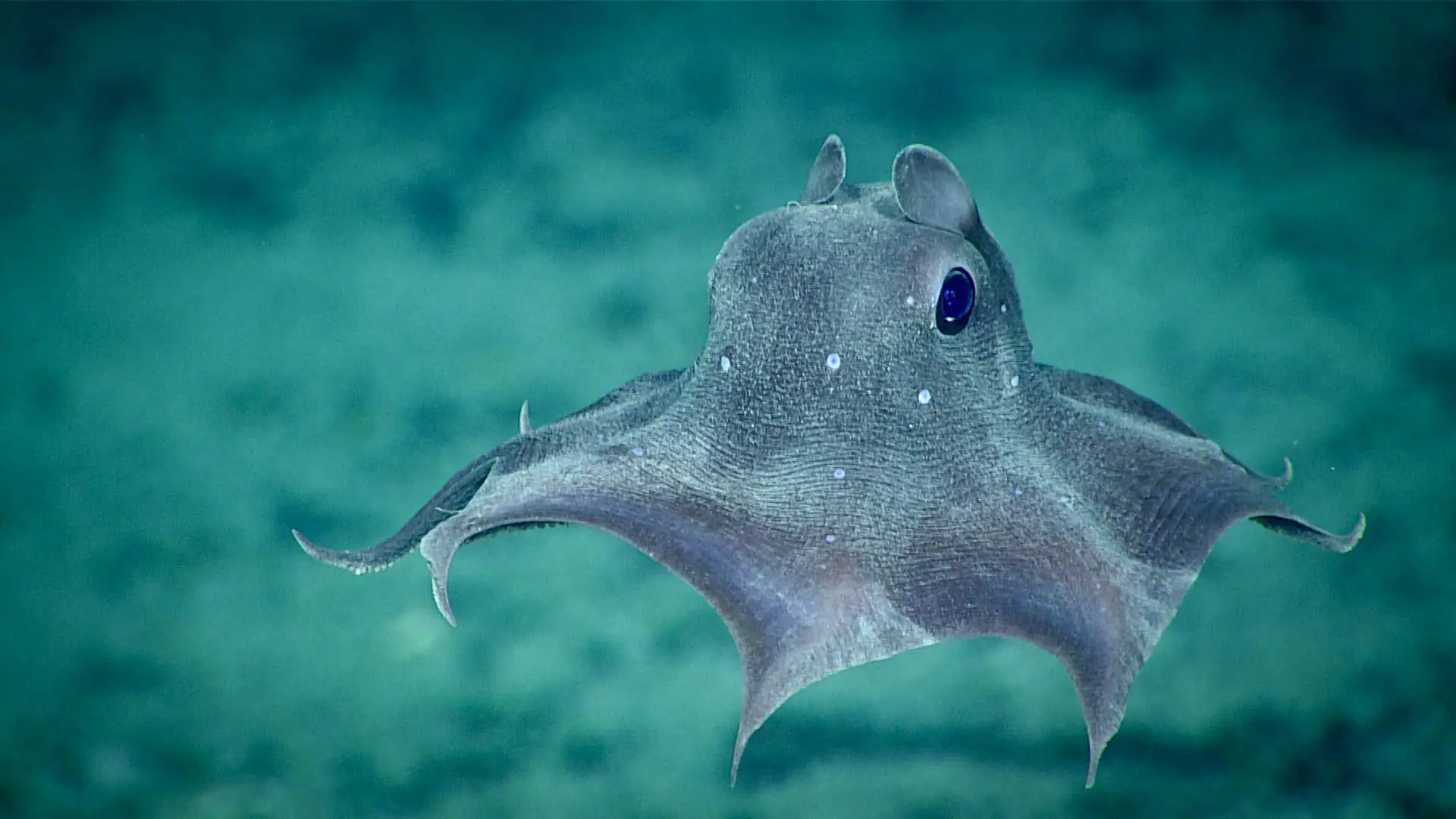
Big eyes, and two little "ears" sticking out of what looks like a head. The relaxed look of the deep-sea dumbo octopus may come down to these ear-like fins. NOAA Ocean Exploration says that the finned deep-sea octopuses (Cirrata) hardly ever swim by squirting water any more, and these "ears" are how they mostly get around.
Why is the dumbo octopus called "dumbo"
The name comes from Dumbo, the elephant in the Disney film. Because the big fins look like the elephant's ears, finned deep-sea octopuses as a group are called dumbo octopuses in English.
Octopuses are famous for shooting out water to dart away. This group has almost given that up and is pushed along mainly by its ear-like fins. Dumbo octopuses of the genus Grimpoteuthis also lack an ink sac. A U.S. university researcher writing for NOAA's website explains that this is reasonable, given that they spend their whole lives in darkness. According to that 2012 article, Grimpoteuthis has been found at 4,000 m, far deeper than the 1,000 m below which light hardly reaches.
What are the white dots on its body
The Opisthoteuthis agassizii in the opening photo is also a finned deep-sea octopus. It was filmed on the 12th dive of a 2019 deep-sea survey off the southeastern United States. The white dots on its body are transparent "windows" in its skin. NOAA says it is uncertain what they are for, but thinks they might help the animal catch a little more light.
Arms rolled up like never before
On a 2014 expedition in the Gulf of Mexico, a dumbo octopus was filmed with each of its arms rolled up tightly from the tip. These octopuses had been seen holding their arms in many different ways before, but never curled up like this.
This dumbo octopus became a favourite among the scientists on the expedition and the people watching the live feed. The photo was chosen in NOAA's photo contest in the Unexpected Finds and Changing Perspectives category. Why the octopus rolled up its arms is not explained.
Is there a dumbo that cannot see
Among the finned deep-sea octopuses is a rare species whose eyes cannot form images. Cirrothauma murrayi has no lens in its eyes and a degenerate retina, so it can sense light but cannot see shapes. That is why it is also called the "blind octopod" in English. In 2015, NOAA filmed this octopus at a depth of nearly 4,000 m on the west wall of Mona Canyon off Puerto Rico. An octopus thought to be Cirrothauma magna, another rare species of the same genus, was also filmed at 2,484 m in the North Atlantic in 2021 (its eyes are not described).
What is a "sea pig"
The animals called sea pigs are not pigs at all but sea cucumbers. Sea cucumbers of the genus Scotoplanes, which Deep Sea Log covered in a study of the bacteria living in their body wall, are also called sea pigs. Sea cucumbers are echinoderms, like sea stars and urchins, and are especially common in the deep sea.
According to NOAA, sea cucumbers have neither lungs nor gas-filled spaces, so their bodies are less affected by the crushing pressure of the deep. Where food is scarce, sea cucumbers "eat" seafloor mud with their tube feet, take out the little nourishment it contains and pass the rest out again. This way of feeding has earned them the nickname "vacuum cleaners of the sea".
In the photos, the leg-like bumps under their plump bodies add to the relaxed look. A pure white sea pig was also filmed at about 4,200 m off Alaska, and its photo shows many spike-like projections. On a 2023 dive off the U.S. West Coast, sea pigs (family Elpidiidae) were usually seen resting on the muddy bottom, but at 2,410 m one was recorded rising off the seafloor and swimming up.
What lies behind the relaxed faces
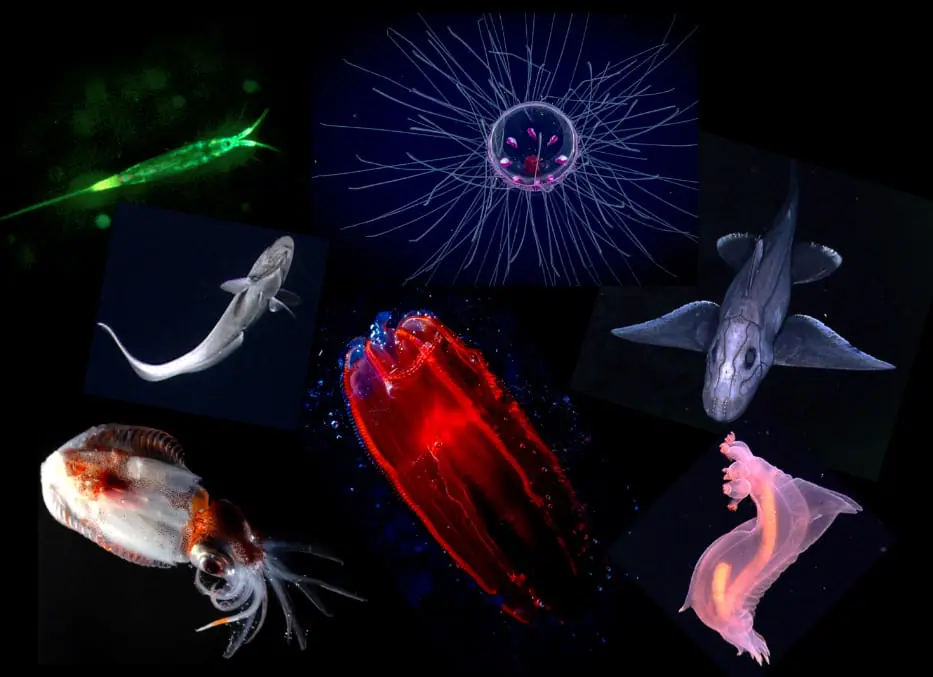
Swimming with fins comes from NOAA's descriptions, the missing ink sac from a researcher's article on NOAA's website, and the body without gas-filled spaces from NOAA's explainer. Linking these features to the relaxed look is our own reading, but if you read the descriptions alongside the photos, bodies built to cope with darkness and pressure emerge behind the easy-going faces. Some deep-sea animals, such as the vampire squid, a relative of octopuses and squid, match the density of their bodies to seawater and drift with little swimming. Next time you see a photo of a deep-sea creature, try looking for the reasons behind its relaxed face.