Around deep-sea hydrothermal vents and seeps, where no sunlight reaches, live crustaceans whose hair is thickly coated with bacteria. In 2014, the Japan Agency for Marine-Earth Science and Technology (JAMSTEC) announced direct evidence that Shinkaia crosnieri from the Okinawa Trough eats these bacteria and lives on them. Across the ocean off Costa Rica, a hairy animal from the group nicknamed yeti crabs has also been found waving its claws.
What kind of animal is Shinkaia crosnieri
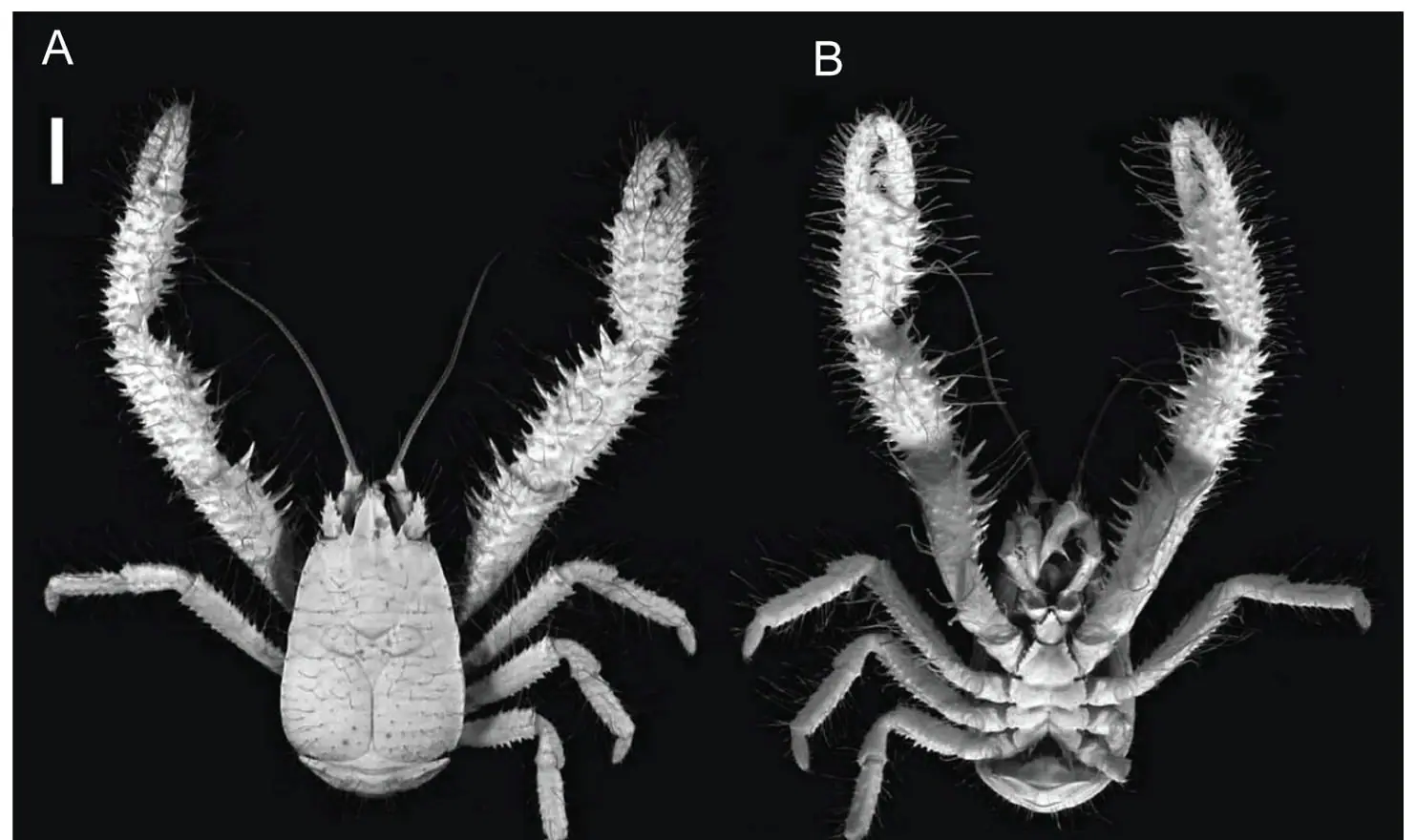
Shinkaia crosnieri is a crustacean that carpets the area around deep-sea hydrothermal vents in the Okinawa Trough. A relative of hermit crabs, it is about 5 cm long. Its body is covered in hairs that carry chemosynthetic bacteria, which grow by drawing energy from substances in the vent fluid.
Does it really eat the bacteria on its hair
A 2014 study made it clear that Shinkaia crosnieri really does eat the bacteria on its hair. A JAMSTEC group led by researcher Watsuji had earlier reported that the animal scrapes its hair with its maxillipeds, appendages next to the mouth, as if carrying food to its mouth, and had developed a way to catch it alive by stopping gases in its body fluids from forming bubbles on the way up. In the 2014 study, most of the dissected animals had hairs in their guts. When the bacteria on the hairs were stained with dye, the dye had reached the gut 24 hours later.
Extracts of ground-up gut were able to break down the bacteria, which suggests the bacteria are digested in the gut. The study also found it highly unlikely that other bacteria living in the gut are a food source. The bacteria on the hairs, meanwhile, took up more than 40 times as much carbon as Shinkaia crosnieri received, and the group concluded that only they could be its food source. JAMSTEC describes this as the first result to clearly show that a deep-sea animal gets its nutrition from bacteria living on the outside of its body. Whereas the 2011 yeti crab paper introduced below inferred the diet from chemical traces in the body, this study directly followed the bacteria being eaten and digested.
What is the hairy "yeti crab"
In 2005, an animal with claws densely covered in hair, collected at a hydrothermal vent on the Pacific-Antarctic Ridge, was described as a new species, and a new family, Kiwaidae, was created for it. It is called the yeti crab in English. Despite the word crab in its name, it is, like Shinkaia crosnieri, a squat lobster related to hermit crabs. As of the 2011 paper, this species, Kiwa hirsuta, was known from only one individual, collected at more than 2,200 m.
In 2006, a second species, Kiwa puravida, was found at a methane seep at a depth of about 1,000 m off Costa Rica. Researchers diving in the crewed submersible Alvin came across it rhythmically swinging its bacteria-covered claws. The two species were collected 6,500 km apart. The species name puravida comes from the Spanish phrase "pura vida" (pure life), commonly used in Costa Rica.
Does it wave its claws to grow bacteria
The paper's authors think the claw waving may help the bacteria on the hair grow. The paper published in PLOS ONE in 2011 reported that analyses of lipids and isotopes in Kiwa puravida supported the idea that the bacteria on its hair are its main food. The appendages near its mouth carry special comb-like bristles, which it uses to scrape off the bacteria and bring them to its mouth.
The team's hypothesis is that waving the claws in water containing methane and other substances strips away the layer of water that builds up around the bacteria, helping them grow. If so, the yeti crab could be said to be farming its own food. However, the link between the waving and how well the bacteria grow was not measured directly.
Connections to Japanese waters
Many animals also live around vents and seeps near Japan, and Deep Sea Log has covered new species of peanut worms found at vents, seeps and whale bones in waters near Japan. Among vent animals, we have also covered the 24-hour rhythm kept by the cells of a deep-sea mussel in the Atlantic. In its 2014 release, JAMSTEC also mentioned the waving behaviour of Kiwa puravida. It wrote that, as of 2014, it was not known whether host animals actively grow their external bacteria, and that it planned to test this by experiment using Shinkaia crosnieri. We have not traced the later results, but living by keeping bacteria on one's hair and eating them has been found both on the seafloor off Okinawa and off Costa Rica.