The deep sea, which sunlight never reaches, is a pitch-dark world, yet when exploration vehicles shine their lights, unexpectedly colourful animals appear. Here are some of the deep sea's snappy dressers, from a comb jelly that shimmers like a rainbow under the lights and a purple nudibranch to a tiny squat lobster perched on coral branches, as photographed by NOAA Ocean Exploration, part of the U.S. National Oceanic and Atmospheric Administration (NOAA).
Why are so many deep-sea animals red
Sunlight is a mix of many colours. NOAA explains that in water they reach farthest in this order: blue, green, yellow, orange and red. Red light is absorbed quickly with depth and barely reaches the deep sea; at 100 m it no longer gets through, so a red fish is hard or even impossible to see.
The colour of an object is the light it reflects, so where there is no red light a red animal has nothing to reflect and looks blackish. That makes a red body a hiding colour in the deep sea. NOAA notes that black and red animals are common in the twilight zone, while blue animals, which would reflect the blue light and stand out, are scarce.
Is the rainbow comb jelly glowing on its own
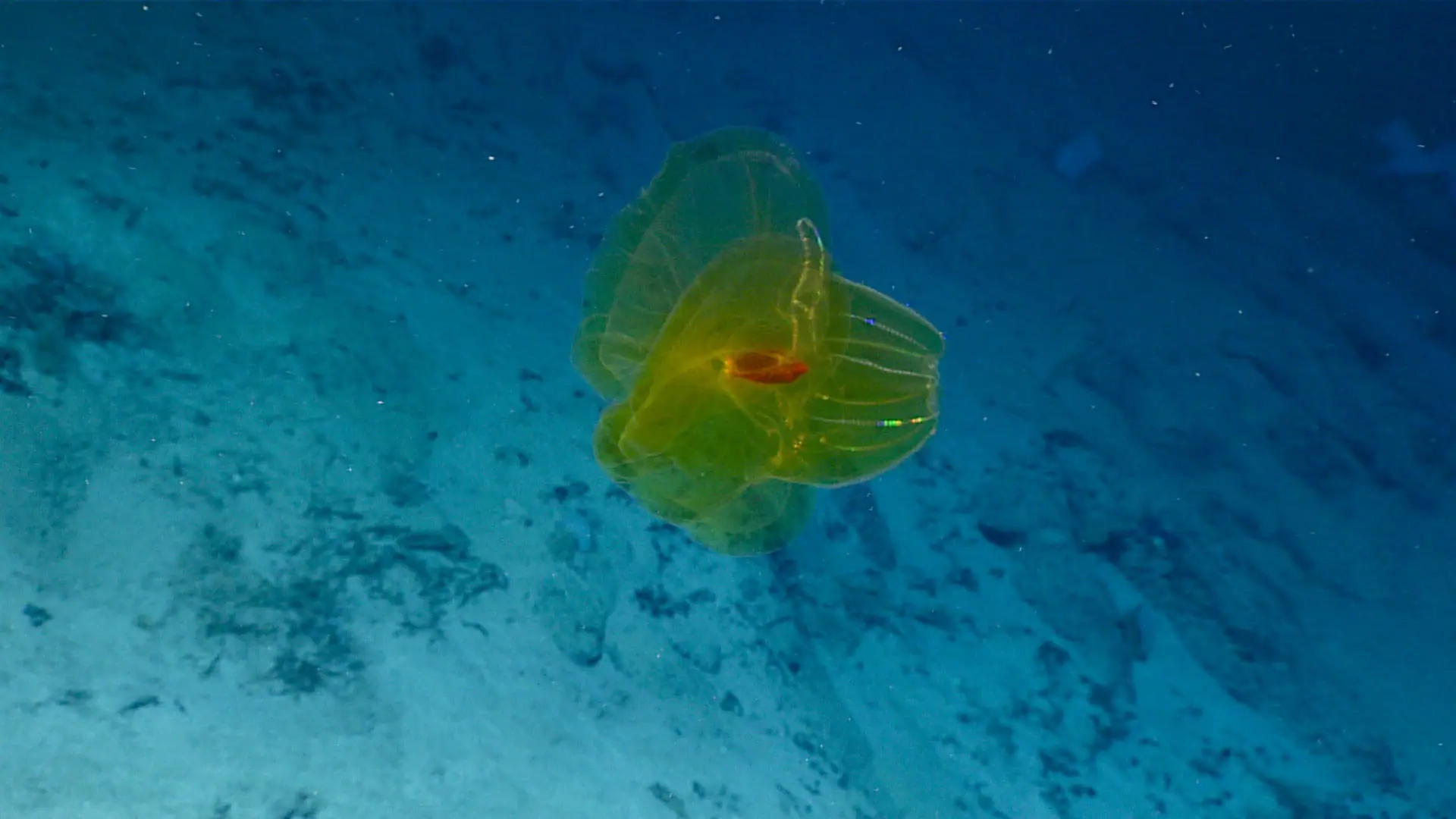
On the fourth dive of a 2021 expedition in the North Atlantic, a yellow comb jelly was swimming in open water above the seafloor. It was first thought to be the species known in English as the bloody belly comb jelly, but NOAA's 2021 feature said emerging research suggested it might be a different, new red-bellied species. In the deep sea, even naming an animal can be hard work.
First, the rainbow: this shimmer is not light the comb jelly makes itself but reflected light from the exploration vehicle. A comb jelly has eight rows of ctenes, plates made of fused cilia, and these ctenes catch the bright lights of the remotely operated vehicle (ROV) Deep Discoverer and appear rainbow-coloured. The ctenes also work as oars for swimming.
Next, the red belly: in this genus of comb jellies, body colour varies, but the red belly stays the same. As we saw above, red is almost invisible in the deep sea, so even if prey glows by bioluminescence after being eaten, it does not show from inside the red belly, and NOAA explains that this makes the comb jelly less likely to be targeted by other predators. It is not just stylish but practical.
Are there nudibranchs in the deep sea too
Nudibranchs live in the deep sea too. During an expedition in the Gulf of Alaska, a small purple nudibranch, Tochuina nigritigris, was photographed at about 3,000 m. With its frilly, white-edged body, it looks as if it is wearing a dress.
"Nudibranch" means "naked gill", after the secondary gills on these animals' backs. On an expedition in the Aleutian Islands, a small nudibranch was also found at 2,285 m. NOAA wrote that because nudibranchs are not commonly seen in the deep ocean, it was a fun find.
Who is hiding in the coral forest
On a 2025 expedition in Papahānaumokuākea, a small red squat lobster was perched on the fine branches of a coral at 2,278 m. See if you can find it on the left side of the photo. NOAA explains that such symbiosis shows the value of deep-sea corals as engineers of habitat for other animals. Deep Sea Log has also covered a deep-sea black coral dated at about 4,265 years.
On the 2022 Voyage to the Ridge expedition, a rainbow of colourful life appeared throughout much of the ninth dive. This single frame alone shows crinoids, gastropods, stony corals, octocorals, brittle stars and more. In a video from a different expedition, NOAA also asks why deep-sea corals are so colourful in a completely dark environment. For more on the curious looks of deep-sea animals, see our story on the "relaxed faces" of the dumbo octopus and the "sea pig".